


Interaction between low tidal volume ventilation strategy and severity of acute respiratory distress syndrome: a retrospective cohort study
- PMID: 31300012
- PMCID: PMC6626332
- DOI: 10.1186/s13054-019-2530-6
Interaction between low tidal volume ventilation strategy and severity of acute respiratory distress syndrome: a retrospective cohort study
Abstract
Background: Although low tidal volume is strongly recommended for acute respiratory distress syndrome (ARDS), whether or not the benefit varies according to the severity of ARDS remains unclear. This study aimed to investigate whether or not there is an interaction between low tidal volume and severity of ARDS.
Methods: This was a secondary analysis from a randomized controlled trial. The patients were subgrouped according to whether the PaO2/FiO2 (P/F) was > 150 or ≤ 150 mmHg on day 0. The interaction between a tidal volume of 6 mL/kg and the P/F was investigated in hierarchical chi-square analysis and logistic regression models.
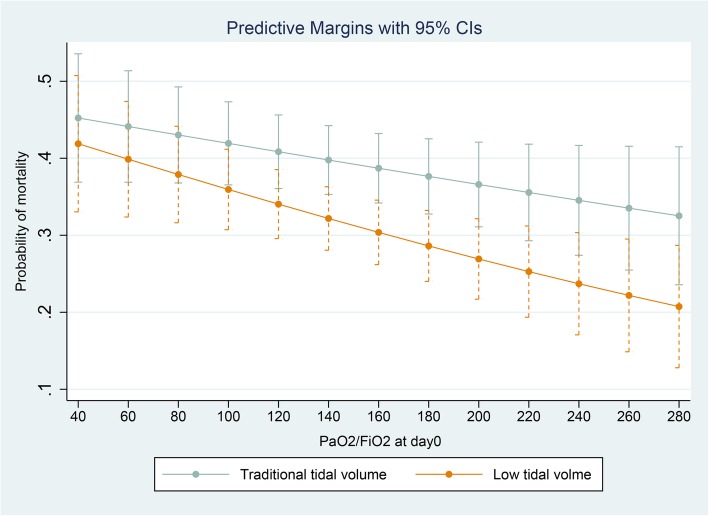
Results: Eight hundred and thirty-six patients with ARDS were enrolled (345 in the high P/F subgroup [> 150 mmHg] and 491 in the low P/F subgroup [≤ 150 mmHg]). Compared to the traditional tidal volume group, the mortality of patients with low tidal volume was significantly lower in the high P/F subgroup (41/183 (22.4%) vs. 64/162 (39.5%), p = 0.001) but not in the low P/F subgroup (95/256 (37.1%) vs. 96/235 (40.8%), p = 0.414). In the hierarchical chi-square analysis, the test of homogeneity was significant (risk ratio of mortality 0.56 [0.40-0.79] vs. 0.91 [0.73-1.13], p = 0.018). In the multivariable logistic model, the odds ratio of mortality for the interacted item was significant (2.02, 95% confidence interval [CI] 1.06-3.86, p = 0.033). The odds ratio of mortality for low tidal volume was significant in the high P/F subgroup (0.42, 95% CI 0.24-0.72, p = 0.002) but not in the low P/F subgroup (0.89, 95% CI 0.60-1.31, p = 0.554).
Conclusions: The benefits of low tidal volume ventilation remain uncertain in patients with severe ARDS. Further studies are needed to validate this significant interaction.
Keywords: Acute respiratory distress syndrome; Low tidal volume; Mortality; PaO2/FiO2.
Conflict of interest statement
The authors declare that they have no competing interests.
Figures
References
-
- Phua J, Badia JR, Adhikari NK, Friedrich JO, Fowler RA, Singh JM, Scales DC, Stather DR, Li A, Jones A, et al. Has mortality from acute respiratory distress syndrome decreased over time?: a systematic review. Am J Respir Crit Care Med. 2009;179(3):220–227. doi: 10.1164/rccm.200805-722OC. - DOI - PubMed
-
- Acute Respiratory Distress Syndrome N. Brower RG, Matthay MA, Morris A, Schoenfeld D, Thompson BT, Wheeler A. Ventilation with lower tidal volumes as compared with traditional tidal volumes for acute lung injury and the acute respiratory distress syndrome. N Engl J Med. 2000;342(18):1301–1308. doi: 10.1056/NEJM200005043421801. - DOI - PubMed
Publication types
MeSH terms
Grants and funding
LinkOut - more resources
Full Text Sources
Medical
