Review
. 2019 Jul 12;12(1):76.
doi: 10.1186/s13045-019-0760-3.

Tumor-associated macrophages in tumor metastasis: biological roles and clinical therapeutic applications

Affiliations
Review

Tumor-associated macrophages in tumor metastasis: biological roles and clinical therapeutic applications

Yuxin Lin et al. J Hematol Oncol. .

Abstract

Tumor metastasis is a major contributor to the death of cancer patients. It is driven not only by the intrinsic alterations in tumor cells, but also by the implicated cross-talk between cancer cells and their altered microenvironment components. Tumor-associated macrophages (TAMs) are the key cells that create an immunosuppressive tumor microenvironment (TME) by producing cytokines, chemokines, growth factors, and triggering the inhibitory immune checkpoint proteins release in T cells. In doing so, TAMs exhibit important functions in facilitating a metastatic cascade of cancer cells and, meanwhile, provide multiple targets of certain checkpoint blockade immunotherapies for opposing tumor progression. In this article, we summarize the regulating networks of TAM polarization and the mechanisms underlying TAM-facilitated metastasis. Based on the overview of current experimental evidence dissecting the critical roles of TAMs in tumor metastasis, we discuss and prospect the potential applications of TAM-focused therapeutic strategies in clinical cancer treatment at present and in the future.

Keywords: Macrophages; Metastasis; Polarization; TAMs; TME.


Conflict of interest statement

The authors declare that they have no competing interests.

Figures
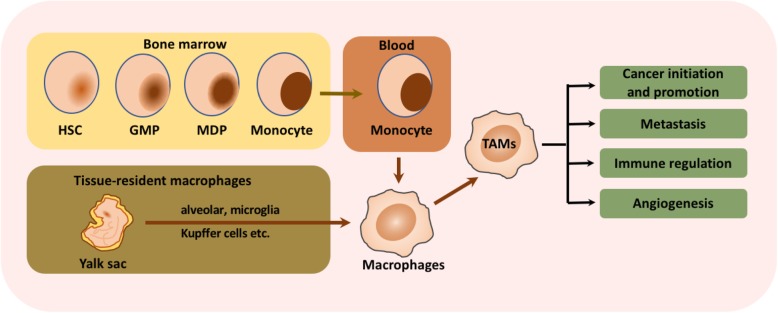
Fig. 1
Fig. 1
Cellular origins and functions of TAMs. As the major primary resource of macrophages, monocytes are generated from hematopoietic stem cells (HSCs) that differentiate into granulocyte-macrophage progenitors (GMPs) and then into monocyte-dendritic cell progenitors (MDPs). Besides, tissue-resident macrophage stem from yolk sac progenitors are another key resources of macrophages, which proliferate or differentiate in situ, such as alveolar macrophages, brain macrophages, and Kupffer cells. The mature monocytes released in the blood and tissue-resident macrophages are recruited and activated by various signals in the TME and then exhibit dramatic impacts on the tumor initiation and promotion, metastasis, immune regulation and angiogenesis
Fig. 2
Fig. 2
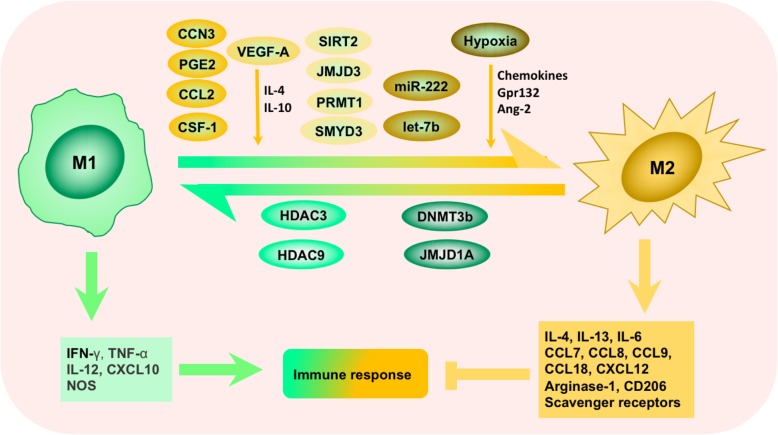
Tumor-associated macrophages (TAMs) polarization and its regulatory networks. Polarization of TAMs is regulated by multiple microenvironmental cytokines, growth factors, epigenetic regulators, and other signals derived from tumor and stromal cells. Two types of macrophages (M1/M2) secrete different immune markers, metabolic characteristics, and gene expression profiles to exert different functions
Fig. 3
Fig. 3
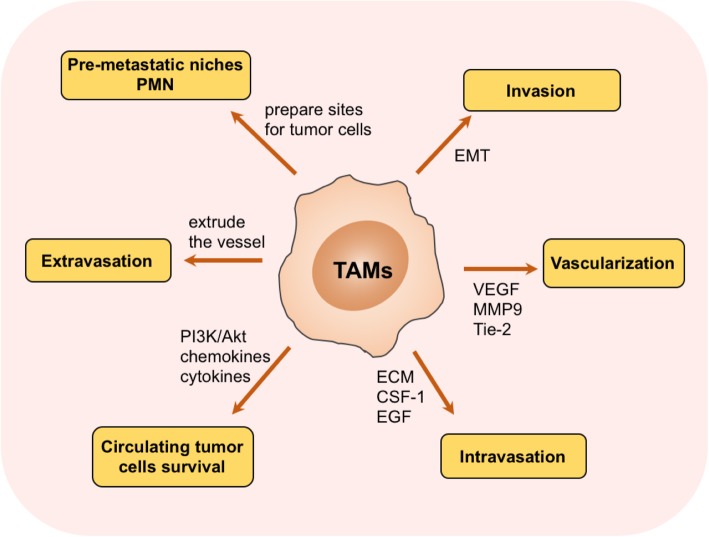
Mechanisms of tumor-associated macrophages (TAMs) in tumor metastasis. TAMs affect virtually almost every step of tumor cells metastasis, including invasion, vascularization, intravasation, extravasation, establishing pre-metastatic niches, and protecting circulating tumor cells survival

References

    1. Seyfried TN, Huysentruyt LC. On the origin of cancer metastasis. Crit Rev Oncog. 2013;18(1-2):43–73. doi: 10.1615/CritRevOncog.v18.i1-2.40. - DOI - PMC - PubMed
    1. Scully OJ, Bay BH, Yip G, Yu YN. Breast cancer metastasis. Cancer Genomics Proteomics. 2012;9(5):311–320. - PubMed
    1. Fidler IJ, Kripke ML. The challenge of targeting metastasis. Cancer Metastasis Rev. 2015;34(4):635–641. doi: 10.1007/s10555-015-9586-9. - DOI - PMC - PubMed
    1. Paget S. The distribution of secondary growths in cancer of the breast. 1889. Cancer Metastasis Rev. 1989;8(2):98–101. - PubMed
    1. Quail DF, Joyce JA. Microenvironmental regulation of tumor progression and metastasis. Nat Med. 2013;19(11):1423–1437. doi: 10.1038/nm.3394. - DOI - PMC - PubMed

Publication types

MeSH terms

LinkOut - more resources