


Timing Of Primary Surgery for cleft palate (TOPS): protocol for a randomised trial of palate surgery at 6 months versus 12 months of age
- PMID: 31300507
- PMCID: PMC6629401
- DOI: 10.1136/bmjopen-2019-029780
Timing Of Primary Surgery for cleft palate (TOPS): protocol for a randomised trial of palate surgery at 6 months versus 12 months of age
Abstract
Introduction: Cleft palate is among the most common birth abnormalities. The success of primary surgery in the early months of life is crucial for successful feeding, speech, hearing, dental development and facial growth. Over recent decades, age at palatal surgery in infancy has reduced. This has led to palatal closure in one-stage procedures being carried out around the age of 12 months, but in some cases as early as 6 months. The primary objective of the Timing Of Primary Surgery for Cleft Palate (TOPS)trial is to determine whether surgery for cleft palate performed at 6 or 12 months of age is most beneficial for speech outcomes.
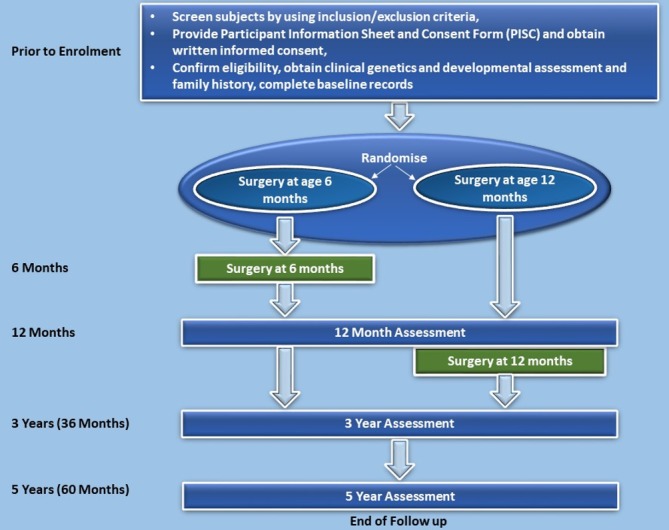
Methods and analysis: Infants with a diagnosis of non-syndromic isolated cleft palate will be randomised to receive standardised primary surgery (Sommerlad technique) for closure of the cleft at either 6 months or 12 months, corrected for gestational age. The primary outcome will be perceived insufficient velopharyngeal function at 5 years of age. Secondary outcomes measured across 12 months, 3 years and 5 years will include growth, safety of the procedure, dentofacial development, speech, hearing level and middle ear function. Video and audio recordings of speech will be collected in a standardised age-appropriate manner and analysed independently by multiple speech and language therapists. The trial aims to recruit and follow-up 300 participants per arm. Data will be analysed according to the intention-to-treat principle using a 5% significance level. All analyses will be prespecified within a full and detailed statistical analysis plan.
Ethics and dissemination: Ethical approval has been sought in each participating country according to country-specific procedures. Trial results will be presented at conferences, published in peer-reviewed journals and disseminated through relevant patient support groups.
Trial registration number: NCT00993551; Pre-results.
Keywords: Sommerlad technique; palatal surgery; randomised clinical trial; syllable inventory; unilateral cleft palate; velopharyngeal function.
© Author(s) (or their employer(s)) 2019. Re-use permitted under CC BY-NC. No commercial re-use. See rights and permissions. Published by BMJ.
Conflict of interest statement
Competing interests: None declared.
Figures
References
-
- Peterson-Falzone S. Optimal age for palatoplasty to faclitate normal speech development: What is the evidence? : Berkowitz S, Cleft Lip and Palate. Berlin: Springer, 2006:691–700.
-
- Friede H, Persson EC, Lilja J, et al. Maxillary dental arch and occlusion in patients with repaired clefts of the secondary palate. Influence of push back palatal surgery. Scand J Plast Reconstr Surg Hand Surg 1993;27:297–305. - PubMed
Publication types
MeSH terms
Associated data
Grants and funding
LinkOut - more resources
Full Text Sources
Medical
