


Parent/Caregiver Responses to Gender Identity Associated With HIV-Related Sexual Risk Behavior Among Young Trans Women in San Francisco
- PMID: 31303553
- PMCID: PMC6755058
- DOI: 10.1016/j.jadohealth.2019.04.032
Parent/Caregiver Responses to Gender Identity Associated With HIV-Related Sexual Risk Behavior Among Young Trans Women in San Francisco
Abstract
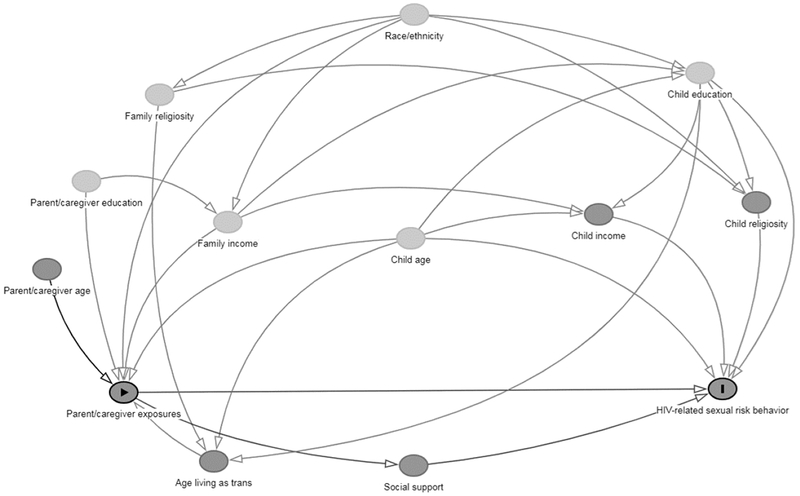
Purpose: Young trans women (YTW) carry a disproportionate burden of HIV. The developmental context of HIV risk for YTW is underexamined. The aim of this analysis was to examine whether parent/caregiver responses to gender identity were associated with engagement in HIV-related sexual risk behavior for YTW and whether these associations varied by racial/ethnic identity or age.
Methods: Baseline data from the SHINE study (n = 300) at San Francisco Department of Public Health (2012-2014) were analyzed. Multivariable Poisson binomial regression models characterized relationships between parent/caregiver responses to gender identity and HIV-related sexual risk behaviors, adjusting for select participant demographics. Statistically significant interactions (by race/ethnicity or age) were plotted using marginal predicted probabilities of sexual risk behaviors.
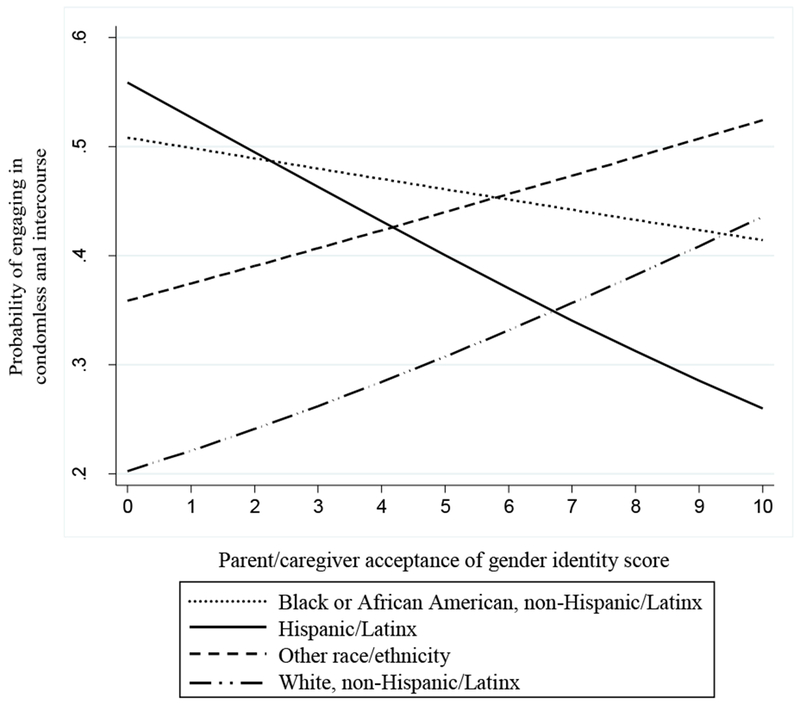
Results: Thirty-seven percent of YTW engaged in any condomless anal intercourse; 12% reported income from sex work in the last month. Ever moving away from family and friends because of gender identity was associated with condomless anal intercourse (adjusted prevalence ratio [PR] = 1.44, 95% confidence interval [CI] = 1.08-1.92, p = .01) and sex work (PR = 2.07, 95% CI = 1.14-3.75, p=.02). Ever receiving poor treatment from parents/caregivers because of gender identity was associated with sex work (PR = 3.47, 95% CI = 1.52-7.95, p < .01). Greater parent/caregiver acceptance of gender identity was associated with lower adjusted prevalence of condomless anal intercourse for Hispanic/Latinx YTW.
Conclusions: Negative parent/caregiver exposures related to YTW's gender identities were associated with increased HIV-related sexual risk behaviors, whereas parent/caregiver acceptance of gender identity was protective against condomless anal intercourse for Hispanic/Latinx YTW. There is a need for additional studies that inform interventions for YTW focusing on parent/caregiver relationships to prevent HIV-related risk behavior.
Keywords: HIV risk behavior; Intersectionality; Parents/caregivers; Sexual risk behavior; Young trans women.
Published by Elsevier Inc.
Conflict of interest statement
Declarations of competing interests: The authors declare that they have no competing interests.
Figures
References
-
- Flores AR, Herman J, Brown TN, et al. Age of individuals who identify as transgender in the United States. Williams Institute, UCLA School of Law; 2017.
-
- Garofalo R, Deleon J, Osmer E, et al. Overlooked, misunderstood and at-risk: exploring the lives and HIV risk of ethnic minority male-to-female transgender youth. J Adolesc Health. 2006;38(3):230–6. DOI: S1054-139X(05)00204-1. - PubMed
Publication types
MeSH terms
Grants and funding
LinkOut - more resources
Full Text Sources
Medical
Research Materials
