Comparative Study
. 2020 Jan-Feb;14(1):44-54.
doi: 10.1016/j.jcct.2019.06.008. Epub 2019 Jun 25.

Long-term health outcomes and cost-effectiveness of coronary CT angiography in patients with suspicion for acute coronary syndrome

Affiliations
Comparative Study

Long-term health outcomes and cost-effectiveness of coronary CT angiography in patients with suspicion for acute coronary syndrome

Alexander Goehler et al. J Cardiovasc Comput Tomogr. 2020 Jan-Feb.

Abstract

Background: Randomized trials have shown favorable clinical outcomes for coronary CT angiography (CTA) in patients with suspected acute coronary syndrome (ACS). Our goal was to estimate the cost-effectiveness of coronary CTA as compared to alternative management strategies for ACP patients over lifetime.

Methods: Markov microsimulation model was developed to compare cost-effectiveness of competitive strategies for ACP patients: 1) coronary CTA, 2) standard of care (SOC), 3) AHA/ACC Guidelines, and 4) expedited emergency department (ED) discharge protocol with outpatient testing. ROMICAT-II trial was used to populate the model with low to intermediate risk of ACS patient data, whereas diagnostic test-, treatment effect-, morbidity/mortality-, quality of life- and cost data were obtained from the literature. We predicted test utilization, costs, 1-, 3-, 10-year and over lifetime cardiovascular morbidity/mortality for each strategy. We determined quality adjusted life years (QALY) and incremental cost-effectiveness ratio. Observed outcomes in ROMICAT-II were used to validate the short-term model.

Results: Estimated short-term outcomes accurately reflected observed outcomes in ROMICAT-II as coronary CTA was associated with higher costs ($4,490 vs. $2,513-$4,144) and revascularization rates (5.2% vs. 2.6%-3.7%) compared to alternative strategies. Over lifetime, coronary CTA dominated SOC and ACC/AHA Guidelines and was cost-effective compared to expedited ED protocol ($49,428/QALY). This was driven by lower cardiovascular mortality (coronary CTA vs. expedited discharge: 3-year: 1.04% vs. 1.10-1.17; 10-year: 5.06% vs. 5.21-5.36%; respectively).

Conclusion: Coronary CTA in patients with suspected ACS renders affordable long-term health benefits as compared to alternative strategies.

Keywords: Acute chest pain; Acute coronary syndrome; Coronary CTA; Cost-effectiveness analysis; Markov microsimulation model.


Figures

Fig. 1.
Fig. 1.
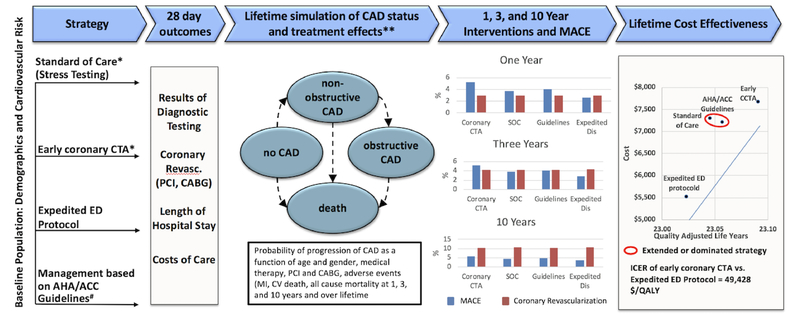
Markov microsimulation model with data sources for short and long term health and economic outcomes of four competing ED management strategies. Baseline population characteristics as observed in the ROMICAT-II Trial. Short term model validation based on 28 day management and outcomes observed in the ROMICAT-II. MACE (dark grey bars) includes myocardial infarction and cardiovascular death, wherease Coronary Revascularization (light grey bars) represents PCI and CABG. Major model inputs for long term simulation: ROMICAT-II, Ottawa cohort of stable chest pain and literature. CABG = Coronary artery bypass graft; CAD = Coronary artery disease; CTA = Computed tomography angiography; ED = Emergency Department; MACE = Major adverse cardiovascular events; PCI = Percutan coronary intervention.
Fig. 2.
Fig. 2.
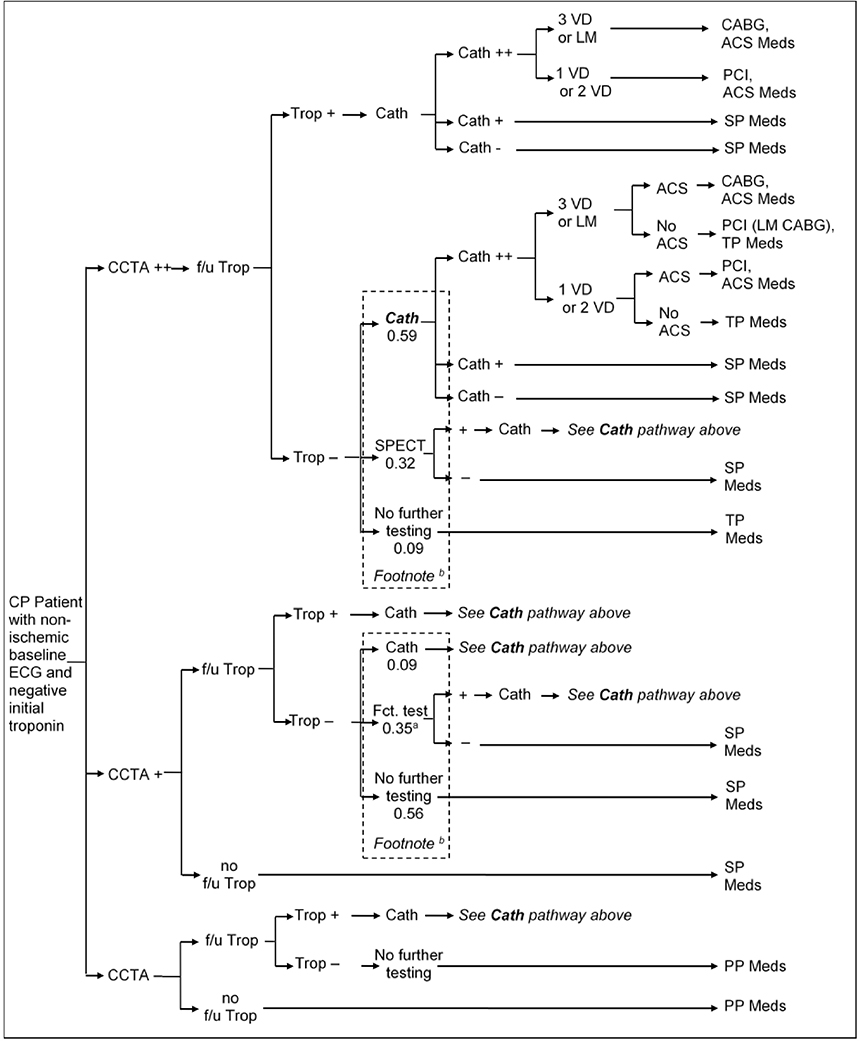
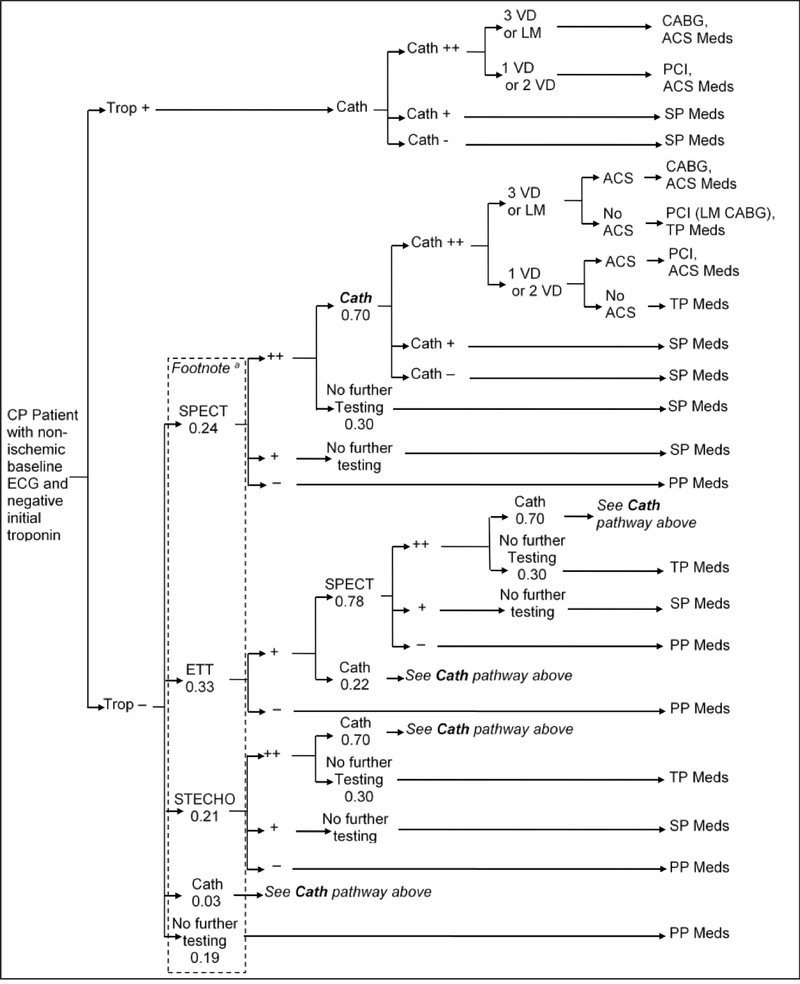
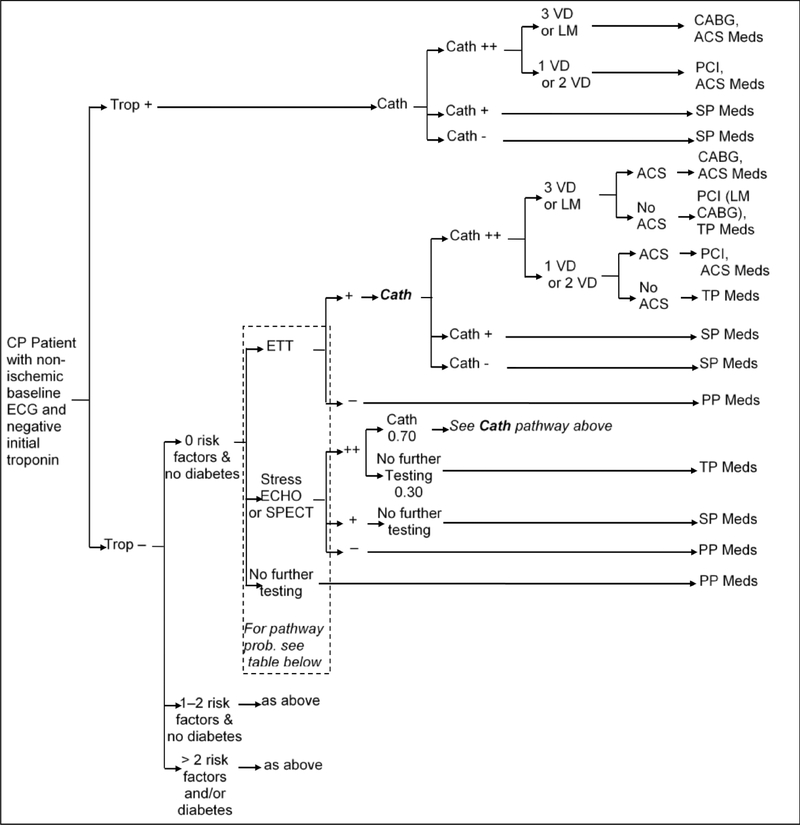
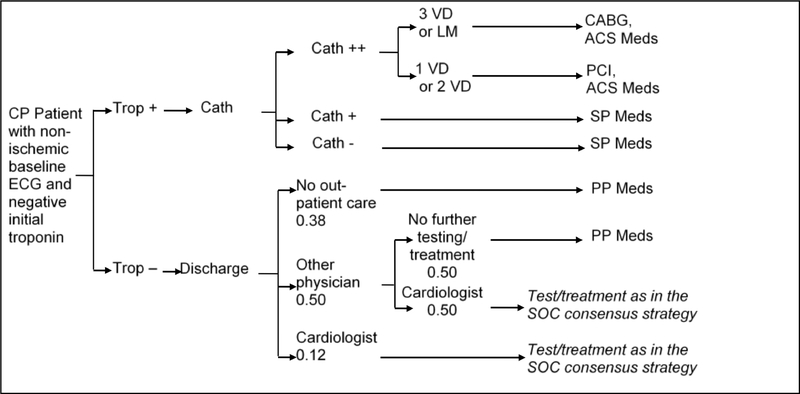
A. Diagnostic Pathways in coronary CTA Strategy. a: Functional tests: 0.23 SPECT, 0.06 stress ECHO, 0.06 ETT. b: Average pathway probabilities; Patients undergo pathways according to a split based on risk factors. ACS = Acute coronary syndrome; CABG = Coronary artery bypass graft; Cath = Coronary catheterization (++ = significant stenosis (> 70%), + = mild stenosis); CCTA=Coronary computed tomographic angiography (++ = significant stenosis, + = mild stenosis) f/u = follow up; ECHO = Echocardiography; ETT = Exercise tolerance test; LM = Left-main disease; PCI = Percutaneous coronary intervention; SPECT = Single-photon emission computed tomography; Trop = Troponin test; VD=Vessel disease. PP Meds = Primary prevention medication: Aspirin and Statin (for patients with hypertension, diabetes, or dyslipidemia), SP Meds = Secondary prevention medication: Aspirin and Statin, TP Meds = Tertiary prevention medication: Aspirin, Statin, and Betablocker (non-diabetic patient) or ACE (diabetic patient), ACS Meds = ACS medication: Aspirin, high-dose Statin, Clopidogrel (one year only), Beta blocker and ACE. B. Diagnostic Pathways in the Standard of Care Strategy. a: Average pathway probabilities; Patients undergo pathways according to their propensity score. ACS = Acute coronary syndrome; CABG = Coronary artery bypass graft; Cath = Coronary catheterization (++ = significant stenosis (> 50%), + = mild stenosis); CP = Chest pain; ECG = Electrocardiogram; ETT = Exercise tolerance test; LM = Left-main disease; PCI = Percutaneous coronary intervention; SPECT = Singlephoton emission computed tomography; STECHO = Stress echocardiography; Trop = Troponin test; VD = Vessel disease. PP Meds = Primary prevention medication: Aspirin and Statin (for patients with hypertension, diabetes, or dyslipidemia), SP Meds = Secondary prevention medication: Aspirin and Statin, TP Meds = Tertiary prevention medication: Aspirin, Statin, and Betablocker (non-diabetic patient) or ACE (diabetic patient), ACS Meds = ACS medication: Aspirin, high-dose Statin, Clopidogrel (one year only), Beta blocker, and ACE. C. Diagnostic Pathways per AHA/ACC Guidelines. Per AHA/ACC guidelines patient management after stress testing is guided by the presence of traditional risk factors and diabetes. The table at the bottom of the figure demonstrates the probabilities to receive type of functional testing. ACS = Acute coronary syndrome; CABG = Coronary artery bypass graft; Cath = Coronary catheterization (++ = significant stenosis (> 50%), + = mild stenosis); CP = Chest pain; ECG = Electrocardiogram; ECHO = Echocardiography; ETT = Exercise tolerance test; LM = Left-main disease; PCI = Percutaneous coronary intervention; SPECT = Single-photon emission computed tomography; Trop = Troponin test; Txt = Treatment; VD = Vessel disease. PP Meds = Primary prevention medication: Aspirin and Statin (for patients with hypertension, diabetes, or dyslipidemia), SP Meds = Secondary prevention medication: Aspirin and Statin, TP Meds = Tertiary prevention medication: Aspirin, Statin, and Betablocker (non-diabetic patient) or ACE (diabetic patient), ACS Meds = ACS medication: Aspirin, high-dose Statin, Clopidogrel (one year only), Beta blocker, and ACE. D2. Diagnostic Pathways in the Standard of Care Expedited ED Protocol Strategy. ACS=Acute coronary syndrome; CABG=Coronary artery bypass graft; Cath=Coronary catheterization (++ = significant stenosis (> 50%), + = mild stenosis); CP=Chest pain; ECG=Electrocardiogram; LM=Left-main disease; PCI=Percutaneous coronary intervention; Trop=Troponin test; VD=Vessel disease. PP Meds=Primary prevention medication: Aspirin and Statin (for patients with hypertension, diabetes, or dyslipidemia), SP Meds=Secondary prevention medication: Aspirin and Statin, ACS Meds=ACS medication: Aspirin, high-dose Statin, Clopidogrel (one year only), Beta blocker, and ACE.
Fig. 2.
Fig. 2.
A. Diagnostic Pathways in coronary CTA Strategy. a: Functional tests: 0.23 SPECT, 0.06 stress ECHO, 0.06 ETT. b: Average pathway probabilities; Patients undergo pathways according to a split based on risk factors. ACS = Acute coronary syndrome; CABG = Coronary artery bypass graft; Cath = Coronary catheterization (++ = significant stenosis (> 70%), + = mild stenosis); CCTA=Coronary computed tomographic angiography (++ = significant stenosis, + = mild stenosis) f/u = follow up; ECHO = Echocardiography; ETT = Exercise tolerance test; LM = Left-main disease; PCI = Percutaneous coronary intervention; SPECT = Single-photon emission computed tomography; Trop = Troponin test; VD=Vessel disease. PP Meds = Primary prevention medication: Aspirin and Statin (for patients with hypertension, diabetes, or dyslipidemia), SP Meds = Secondary prevention medication: Aspirin and Statin, TP Meds = Tertiary prevention medication: Aspirin, Statin, and Betablocker (non-diabetic patient) or ACE (diabetic patient), ACS Meds = ACS medication: Aspirin, high-dose Statin, Clopidogrel (one year only), Beta blocker and ACE. B. Diagnostic Pathways in the Standard of Care Strategy. a: Average pathway probabilities; Patients undergo pathways according to their propensity score. ACS = Acute coronary syndrome; CABG = Coronary artery bypass graft; Cath = Coronary catheterization (++ = significant stenosis (> 50%), + = mild stenosis); CP = Chest pain; ECG = Electrocardiogram; ETT = Exercise tolerance test; LM = Left-main disease; PCI = Percutaneous coronary intervention; SPECT = Singlephoton emission computed tomography; STECHO = Stress echocardiography; Trop = Troponin test; VD = Vessel disease. PP Meds = Primary prevention medication: Aspirin and Statin (for patients with hypertension, diabetes, or dyslipidemia), SP Meds = Secondary prevention medication: Aspirin and Statin, TP Meds = Tertiary prevention medication: Aspirin, Statin, and Betablocker (non-diabetic patient) or ACE (diabetic patient), ACS Meds = ACS medication: Aspirin, high-dose Statin, Clopidogrel (one year only), Beta blocker, and ACE. C. Diagnostic Pathways per AHA/ACC Guidelines. Per AHA/ACC guidelines patient management after stress testing is guided by the presence of traditional risk factors and diabetes. The table at the bottom of the figure demonstrates the probabilities to receive type of functional testing. ACS = Acute coronary syndrome; CABG = Coronary artery bypass graft; Cath = Coronary catheterization (++ = significant stenosis (> 50%), + = mild stenosis); CP = Chest pain; ECG = Electrocardiogram; ECHO = Echocardiography; ETT = Exercise tolerance test; LM = Left-main disease; PCI = Percutaneous coronary intervention; SPECT = Single-photon emission computed tomography; Trop = Troponin test; Txt = Treatment; VD = Vessel disease. PP Meds = Primary prevention medication: Aspirin and Statin (for patients with hypertension, diabetes, or dyslipidemia), SP Meds = Secondary prevention medication: Aspirin and Statin, TP Meds = Tertiary prevention medication: Aspirin, Statin, and Betablocker (non-diabetic patient) or ACE (diabetic patient), ACS Meds = ACS medication: Aspirin, high-dose Statin, Clopidogrel (one year only), Beta blocker, and ACE. D2. Diagnostic Pathways in the Standard of Care Expedited ED Protocol Strategy. ACS=Acute coronary syndrome; CABG=Coronary artery bypass graft; Cath=Coronary catheterization (++ = significant stenosis (> 50%), + = mild stenosis); CP=Chest pain; ECG=Electrocardiogram; LM=Left-main disease; PCI=Percutaneous coronary intervention; Trop=Troponin test; VD=Vessel disease. PP Meds=Primary prevention medication: Aspirin and Statin (for patients with hypertension, diabetes, or dyslipidemia), SP Meds=Secondary prevention medication: Aspirin and Statin, ACS Meds=ACS medication: Aspirin, high-dose Statin, Clopidogrel (one year only), Beta blocker, and ACE.
Fig. 2.
Fig. 2.
A. Diagnostic Pathways in coronary CTA Strategy. a: Functional tests: 0.23 SPECT, 0.06 stress ECHO, 0.06 ETT. b: Average pathway probabilities; Patients undergo pathways according to a split based on risk factors. ACS = Acute coronary syndrome; CABG = Coronary artery bypass graft; Cath = Coronary catheterization (++ = significant stenosis (> 70%), + = mild stenosis); CCTA=Coronary computed tomographic angiography (++ = significant stenosis, + = mild stenosis) f/u = follow up; ECHO = Echocardiography; ETT = Exercise tolerance test; LM = Left-main disease; PCI = Percutaneous coronary intervention; SPECT = Single-photon emission computed tomography; Trop = Troponin test; VD=Vessel disease. PP Meds = Primary prevention medication: Aspirin and Statin (for patients with hypertension, diabetes, or dyslipidemia), SP Meds = Secondary prevention medication: Aspirin and Statin, TP Meds = Tertiary prevention medication: Aspirin, Statin, and Betablocker (non-diabetic patient) or ACE (diabetic patient), ACS Meds = ACS medication: Aspirin, high-dose Statin, Clopidogrel (one year only), Beta blocker and ACE. B. Diagnostic Pathways in the Standard of Care Strategy. a: Average pathway probabilities; Patients undergo pathways according to their propensity score. ACS = Acute coronary syndrome; CABG = Coronary artery bypass graft; Cath = Coronary catheterization (++ = significant stenosis (> 50%), + = mild stenosis); CP = Chest pain; ECG = Electrocardiogram; ETT = Exercise tolerance test; LM = Left-main disease; PCI = Percutaneous coronary intervention; SPECT = Singlephoton emission computed tomography; STECHO = Stress echocardiography; Trop = Troponin test; VD = Vessel disease. PP Meds = Primary prevention medication: Aspirin and Statin (for patients with hypertension, diabetes, or dyslipidemia), SP Meds = Secondary prevention medication: Aspirin and Statin, TP Meds = Tertiary prevention medication: Aspirin, Statin, and Betablocker (non-diabetic patient) or ACE (diabetic patient), ACS Meds = ACS medication: Aspirin, high-dose Statin, Clopidogrel (one year only), Beta blocker, and ACE. C. Diagnostic Pathways per AHA/ACC Guidelines. Per AHA/ACC guidelines patient management after stress testing is guided by the presence of traditional risk factors and diabetes. The table at the bottom of the figure demonstrates the probabilities to receive type of functional testing. ACS = Acute coronary syndrome; CABG = Coronary artery bypass graft; Cath = Coronary catheterization (++ = significant stenosis (> 50%), + = mild stenosis); CP = Chest pain; ECG = Electrocardiogram; ECHO = Echocardiography; ETT = Exercise tolerance test; LM = Left-main disease; PCI = Percutaneous coronary intervention; SPECT = Single-photon emission computed tomography; Trop = Troponin test; Txt = Treatment; VD = Vessel disease. PP Meds = Primary prevention medication: Aspirin and Statin (for patients with hypertension, diabetes, or dyslipidemia), SP Meds = Secondary prevention medication: Aspirin and Statin, TP Meds = Tertiary prevention medication: Aspirin, Statin, and Betablocker (non-diabetic patient) or ACE (diabetic patient), ACS Meds = ACS medication: Aspirin, high-dose Statin, Clopidogrel (one year only), Beta blocker, and ACE. D2. Diagnostic Pathways in the Standard of Care Expedited ED Protocol Strategy. ACS=Acute coronary syndrome; CABG=Coronary artery bypass graft; Cath=Coronary catheterization (++ = significant stenosis (> 50%), + = mild stenosis); CP=Chest pain; ECG=Electrocardiogram; LM=Left-main disease; PCI=Percutaneous coronary intervention; Trop=Troponin test; VD=Vessel disease. PP Meds=Primary prevention medication: Aspirin and Statin (for patients with hypertension, diabetes, or dyslipidemia), SP Meds=Secondary prevention medication: Aspirin and Statin, ACS Meds=ACS medication: Aspirin, high-dose Statin, Clopidogrel (one year only), Beta blocker, and ACE.
Fig. 2.
Fig. 2.
A. Diagnostic Pathways in coronary CTA Strategy. a: Functional tests: 0.23 SPECT, 0.06 stress ECHO, 0.06 ETT. b: Average pathway probabilities; Patients undergo pathways according to a split based on risk factors. ACS = Acute coronary syndrome; CABG = Coronary artery bypass graft; Cath = Coronary catheterization (++ = significant stenosis (> 70%), + = mild stenosis); CCTA=Coronary computed tomographic angiography (++ = significant stenosis, + = mild stenosis) f/u = follow up; ECHO = Echocardiography; ETT = Exercise tolerance test; LM = Left-main disease; PCI = Percutaneous coronary intervention; SPECT = Single-photon emission computed tomography; Trop = Troponin test; VD=Vessel disease. PP Meds = Primary prevention medication: Aspirin and Statin (for patients with hypertension, diabetes, or dyslipidemia), SP Meds = Secondary prevention medication: Aspirin and Statin, TP Meds = Tertiary prevention medication: Aspirin, Statin, and Betablocker (non-diabetic patient) or ACE (diabetic patient), ACS Meds = ACS medication: Aspirin, high-dose Statin, Clopidogrel (one year only), Beta blocker and ACE. B. Diagnostic Pathways in the Standard of Care Strategy. a: Average pathway probabilities; Patients undergo pathways according to their propensity score. ACS = Acute coronary syndrome; CABG = Coronary artery bypass graft; Cath = Coronary catheterization (++ = significant stenosis (> 50%), + = mild stenosis); CP = Chest pain; ECG = Electrocardiogram; ETT = Exercise tolerance test; LM = Left-main disease; PCI = Percutaneous coronary intervention; SPECT = Singlephoton emission computed tomography; STECHO = Stress echocardiography; Trop = Troponin test; VD = Vessel disease. PP Meds = Primary prevention medication: Aspirin and Statin (for patients with hypertension, diabetes, or dyslipidemia), SP Meds = Secondary prevention medication: Aspirin and Statin, TP Meds = Tertiary prevention medication: Aspirin, Statin, and Betablocker (non-diabetic patient) or ACE (diabetic patient), ACS Meds = ACS medication: Aspirin, high-dose Statin, Clopidogrel (one year only), Beta blocker, and ACE. C. Diagnostic Pathways per AHA/ACC Guidelines. Per AHA/ACC guidelines patient management after stress testing is guided by the presence of traditional risk factors and diabetes. The table at the bottom of the figure demonstrates the probabilities to receive type of functional testing. ACS = Acute coronary syndrome; CABG = Coronary artery bypass graft; Cath = Coronary catheterization (++ = significant stenosis (> 50%), + = mild stenosis); CP = Chest pain; ECG = Electrocardiogram; ECHO = Echocardiography; ETT = Exercise tolerance test; LM = Left-main disease; PCI = Percutaneous coronary intervention; SPECT = Single-photon emission computed tomography; Trop = Troponin test; Txt = Treatment; VD = Vessel disease. PP Meds = Primary prevention medication: Aspirin and Statin (for patients with hypertension, diabetes, or dyslipidemia), SP Meds = Secondary prevention medication: Aspirin and Statin, TP Meds = Tertiary prevention medication: Aspirin, Statin, and Betablocker (non-diabetic patient) or ACE (diabetic patient), ACS Meds = ACS medication: Aspirin, high-dose Statin, Clopidogrel (one year only), Beta blocker, and ACE. D2. Diagnostic Pathways in the Standard of Care Expedited ED Protocol Strategy. ACS=Acute coronary syndrome; CABG=Coronary artery bypass graft; Cath=Coronary catheterization (++ = significant stenosis (> 50%), + = mild stenosis); CP=Chest pain; ECG=Electrocardiogram; LM=Left-main disease; PCI=Percutaneous coronary intervention; Trop=Troponin test; VD=Vessel disease. PP Meds=Primary prevention medication: Aspirin and Statin (for patients with hypertension, diabetes, or dyslipidemia), SP Meds=Secondary prevention medication: Aspirin and Statin, ACS Meds=ACS medication: Aspirin, high-dose Statin, Clopidogrel (one year only), Beta blocker, and ACE.
Fig. 3.
Fig. 3.
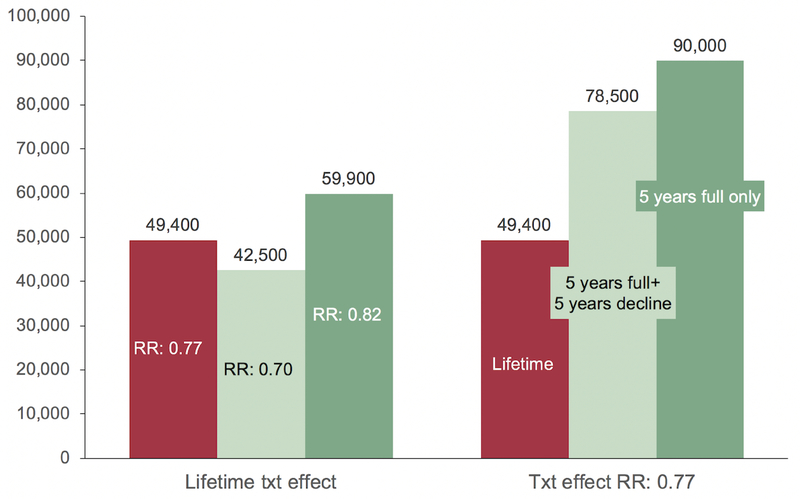
Treatment effect of agressive medical theraphy for obstructive CAD. Left side: Treatment effect of agressive medical theraphy for obstructive CAD (> 50%): light grey column: baseline case assuming that life time statin therapy reduces CAD mortality by 23% (22); mild and dark grey column: sensitivity analysis using the upper (30%) and lower (18%) bounds of the confidence in-terval of relative risk reduction. Right side: Sensitivity analyses for validations in treatment compliance: light grey column: baseline case assuming that life time statin therapy reduces CAD mortality by 23% (22); mild grey column: 5 years of full compliance followed by 5 years of decining compliance (in monthly steps with none of the patients on statins after 10 years); dark grey: full com-pliance for 5 years and no treatment effect afterwards. CAD = Coronary artery disease, RR = Risk reduction.

References

    1. Litt HI, Gatsonis C, Snyder B, Singh H, Miller CD, Entrikin DW, Leaming JM, Gavin LJ, Pacella CB and Hollander JE. CT angiography for safe discharge of patients with possible acute coronary syndromes. N Engl J Med. 2012;366:1393–403. - PubMed
    1. Hoffmann U, Truong QA, Schoenfeld DA, Chou ET, Woodard PK, Nagurney JT, Pope JH, Hauser TH, White CS, Weiner SG, Kalanjian S, Mullins ME, Mikati I, Peacock WF, Zakroysky P, Hayden D, Goehler A, Lee H, Gazelle GS, Wiviott SD, Fleg JL, Udelson JE and Investigators R-I. Coronary CT angiography versus standard evaluation in acute chest pain. N Engl J Med. 2012;367:299–308. - PMC - PubMed
    1. Goldstein JA, Chinnaiyan KM, Abidov A, Achenbach S, Berman DS, Hayes SW, Hoffmann U, Lesser JR, Mikati IA, O’Neil BJ, Shaw LJ, Shen MY, Valeti US and Raff GL. The CT-STAT (Coronary Computed Tomographic Angiography for Systematic Triage of Acute Chest Pain Patients to Treatment) trial. J Am Coll Cardiol. 2011;58:1414–22. - PubMed
    1. Schlett CL, Banerji D, Siegel E, Bamberg F, Lehman SJ, Ferencik M, Brady TJ, Nagurney JT, Hoffmann U and Truong QA. Prognostic value of CT angiography for major adverse cardiac events in patients with acute chest pain from the emergency department: 2-year outcomes of the ROMICAT trial. JACC Cardiovasc Imaging. 2011;4:481–491. - PMC - PubMed
    1. Jones RL, Thomas DM, Barnwell ML, Fentanes E, Young AN, Barnwell R, Foley AT, Hilliard M, Hulten EA, Villines TC, Cury RC and Slim AM. Safe and rapid disposition of low-to-intermediate risk patients presenting to the emergency department with chest pain: a 1-year high-volume single-center experience. J Cardiovasc Comput Tomogr. 2014;8:375–83. - PubMed

Publication types

MeSH terms