Prevalence and determinants of self referrals to a District-Regional Hospital in KwaZulu Natal, South Africa: a cross sectional study
- PMID: 31303949
- PMCID: PMC6607454
- DOI: 10.11604/pamj.2019.33.4.16963
Prevalence and determinants of self referrals to a District-Regional Hospital in KwaZulu Natal, South Africa: a cross sectional study
Abstract
Introduction: Self-referrals to inappropriate levels of care result in an increased patient waiting time, overburdening of higher levels of care, reduced primary healthcare utilisation rate and increasing healthcare costs. Furthermore, self-referral places an additional encumbrance on various levels of care as allocation of resources and infrastructure cannot be accurately planned, based on the facility catchment population. The aim of this study was to determine the prevalence and determinants of patient self-referral at the out-patient department of Stanger Hospital, KwaZulu-Natal between January and June 2017.
Methods: A cross-sectional study was conducted at the out-patient department in Stanger Hospital, using interviewer administered questionnaires to collect information from 385 patients, through convenience sampling, between January and June 2017. Multivariable regression analysis was used to test for factors associated with self-referral.
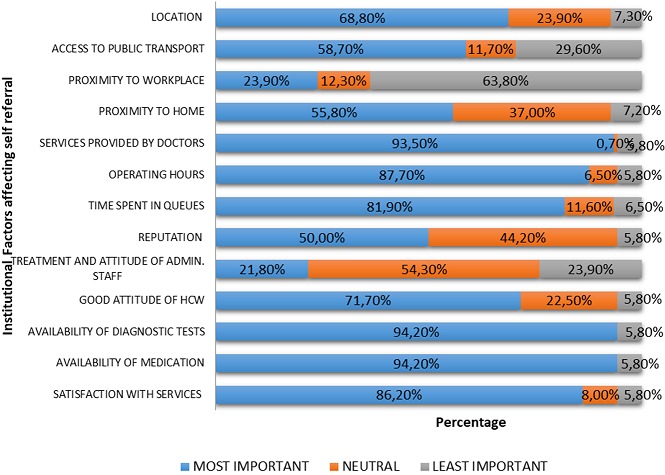
Results: of the 385 patients interviewed 36% (n = 138) were self-referrals. Most of the self-referrals were male (51.5%) and of the African race (57.2%). Five institutional factors namely: care received from healthcare workers (91.3%); waiting times (88.4%); help offered (87%); treatment and attitude of healthcare workers (63%) and availability of medication (55.8%) were considered as the main drivers of self-referral. Multivariable regression analysis established a significant positive association between patient self-referral and age (40 years and below), attitude of healthcare workers, quality of care received form healthcare workers, waiting times and the availability of diagnostic tests.
Conclusion: This study indicates that most patients attending Stanger Hospital do comply with the prescribed referral pathway, however a significant proportion still bypass the referral system.
Keywords: Self referrals; institutional factors; primary health care.
Conflict of interest statement
The authors declare no competing interests.
Figures
References
-
- United Nations . Transforming our world: the 2030 Agenda for Sustainable Development. Geneva: United Nations; 2015.
-
- National Planning Commission . National Development Plan 2030. Pretoria: the Presidency; 2012.
-
- National Department of Health . National Health Insurance Policy for South Africa. Pretoria: National Department of Health; 2017.
-
- World Health Organisation . White paper on the transformation of the health system. Pretoria: Government Gazette; 2017. Accessed on December 2017.
-
- National Department of Health . White paper on the transformation of the health system. Pretoria: Government Gazette; 1997.
MeSH terms
LinkOut - more resources
Full Text Sources