. 2019 May 20;10(6):1007-1017.
doi: 10.1039/c9md00224c. eCollection 2019 Jun 1.

New N-phenyl-4,5-dibromopyrrolamides as DNA gyrase B inhibitors

Affiliations

New N-phenyl-4,5-dibromopyrrolamides as DNA gyrase B inhibitors

Nace Zidar et al. Medchemcomm. .

Abstract

Due to the rapid development of antimicrobial resistance, the discovery of new antibacterials is essential in the fight against potentially lethal infections. The DNA gyrase B (GyrB) subunit of bacterial DNA gyrase is an excellent target for the design of antibacterials, as it has been clinically validated by novobiocin. However, there are currently no drugs in clinical use that target GyrB. We prepared a new series of N-phenyl-4,5-dibromopyrrolamides and evaluated them against DNA gyrase and against the structurally and functionally similar enzyme, topoisomerase IV. The most active compound, 28, had an IC50 of 20 nM against Escherichia coli DNA gyrase. The IC50 values of 28 against Staphylococcus aureus DNA gyrase, and E. coli and S. aureus topoisomerase IV were in the low micromolar range. However, the compounds evaluated did not show significant antibacterial activities against selected Gram-positive and Gram-negative bacteria. Our results indicate that for potent inhibition of DNA gyrase, a combination of polar groups on the carboxylic end of the molecule and substituents that reach into the 'lipophilic floor' of the enzyme is required.


Figures
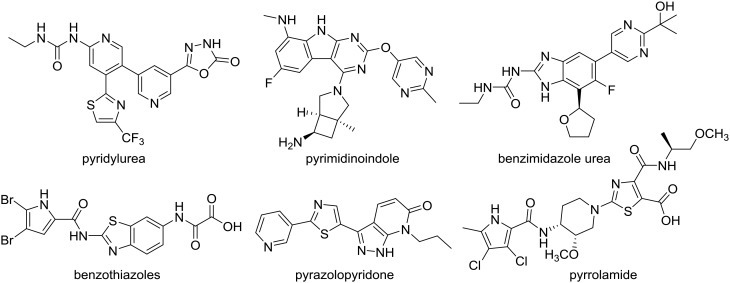
Fig. 1
Fig. 1. Representative ATP-competitive DNA gyrase and topoisomerase IV inhibitors.
Fig. 2
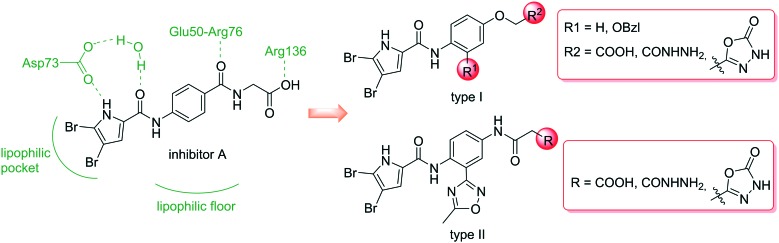
Fig. 2. General structures of type I and type II compounds as potential DNA gyrase B inhibitors, designed using the X-ray structure of inhibitor A bound to E. coli GyrB (PDB code: ; 4ZVI) as template.
Scheme 1
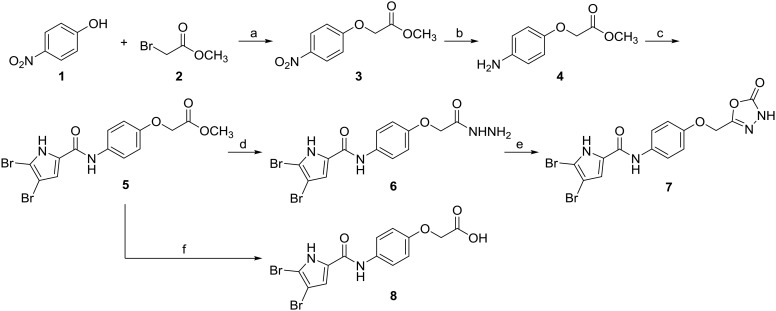
Scheme 1. Reagents and conditions: (a) K2CO3, CH3CN, rt, 15 h; (b) H2, Pd/C, tetrahydrofuran, rt, 5 h; (c) 4,5-dibromo-pyrrole-2-carboxylic acid, TBTU, N-methylmorpholine, CH2Cl2, 50 °C, 15 h; (d) hydrazine monohydrate, ethanol, 80 °C, 15 h; (e) 1,1-carbonyldiimidazole, 1,4-dioxane, 101 °C, 15 h; (f) 2 M NaOH, tetrahydrofuran, rt, 15 h.
Scheme 2
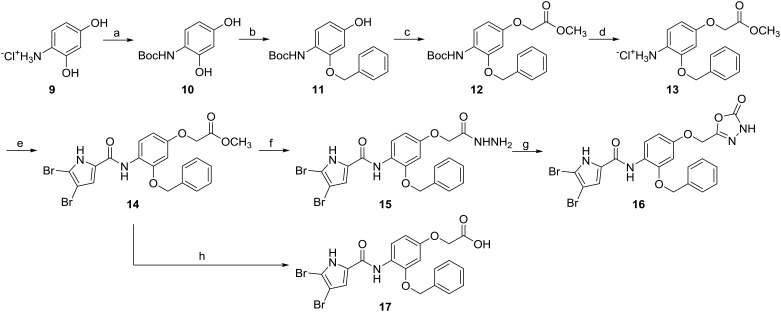
Scheme 2. Reagents and conditions: (a) Boc2O, Et3N, methanol, 0 °C → rt, 15 h; (b) benzyl bromide, K2CO3, CH3CN, 0 °C → rt, 15 h; (c) methyl bromoacetate, K2CO3, CH3CN, 0 °C → rt, 15 h; (d) HCl(g), diethyl ether, rt, 15 h; (e) 4,5-dibromo-pyrrole-2-carboxylic acid, TBTU, N-methylmorpholine, CH2Cl2, 50 °C, 16 h; (f) hydrazine monohydrate, ethanol, 80 °C, 15 h; (g) 1,1-carbonyldiimidazole, 1,4-dioxane, 101 °C, 15 h; (h) 2 M NaOH, tetrahydrofuran, rt, 15 h.
Scheme 3
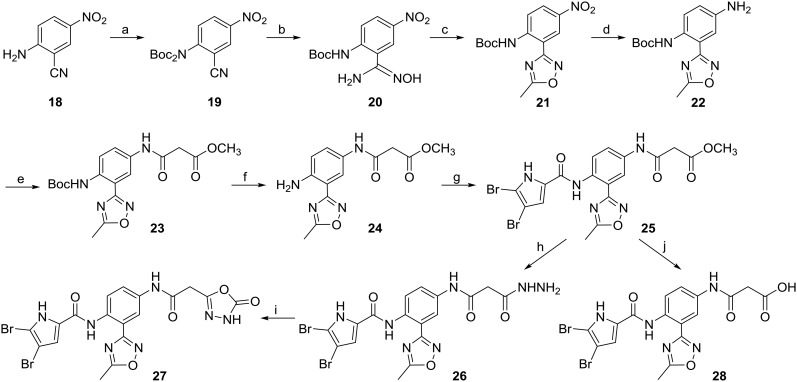
Scheme 3. Reagents and conditions: (a) Boc2O, DMAP, CH2Cl2/CH3CN, 70 °C, 24 h; (b) hydroxylamine hydrochloride, Et3N, ethanol, 65 °C, 15 h; (c) acetic anhydride, acetic acid, 85 °C, 15 h; (d) tin(ii) chloride, ethanol/ethyl acetate, 70 °C, 6 h; (e) methyl malonyl chloride, K2CO3, CH3CN, 0 °C, 12 h; (f) 4 M HCl in 1,4-dioxane, rt, 15 h; (g) 4,5-dibromo-pyrrole-2-carboxylic acid, oxalyl chloride, CH2Cl2, 15 h, then ii) 24, pyridine, CH2Cl2, rt, 6 h; (h) hydrazine monohydrate, ethanol/tetrahydrofuran, 80 °C, 15 h; (i) 1,1-carbonyldiimidazole, 1,4-dioxane/dimethylformamide, 100 °C, 15 h; (j) 2 M NaOH, THF, rt, 15 h.
Fig. 3
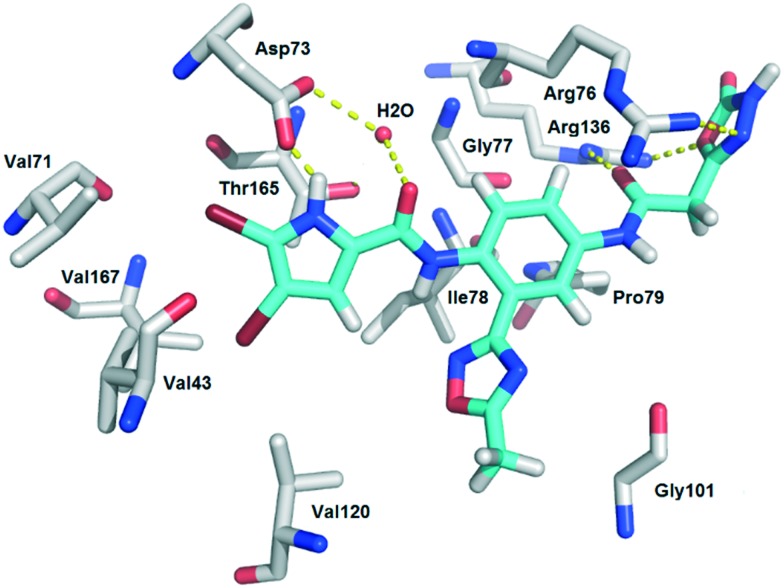
Fig. 3. Binding mode of compound 27 (cyan) in the E. coli GyrB (grey) (PDB code: ; 4DUH), as predicted with GOLD. The crystal water molecule is shown as a red sphere. The predicted H-bonds are given as yellow dotted lines. The fig. was prepared using PyMOL.

References

    1. Klahn P. and Brönstrup M., in How to Overcome the Antibiotic Crisis : Facts, Challenges, Technologies and Future Perspectives, ed. M. Stadler and P. Dersch, Springer International Publishing, Cham, 2016, pp. 365–417.
    1. Brown E. D., Wright G. D. Nature. 2016;529:336–343. - PubMed
    1. Tagliabue A., Rappuoli R. Front. Immunol. 2018;9:1068. - PMC - PubMed
    1. Bisacchi G. S., Manchester J. I. ACS Infect. Dis. 2015;1:4–41. - PubMed
    1. Collin F., Karkare S., Maxwell A. Appl. Microbiol. Biotechnol. 2011;92:479–497. - PMC - PubMed