


Impact of sit-stand desks at work on energy expenditure, sitting time and cardio-metabolic risk factors: Multiphase feasibility study with randomised controlled component
- PMID: 31304079
- PMCID: PMC6603239
- DOI: 10.1016/j.pmedr.2018.11.012
Impact of sit-stand desks at work on energy expenditure, sitting time and cardio-metabolic risk factors: Multiphase feasibility study with randomised controlled component
Abstract
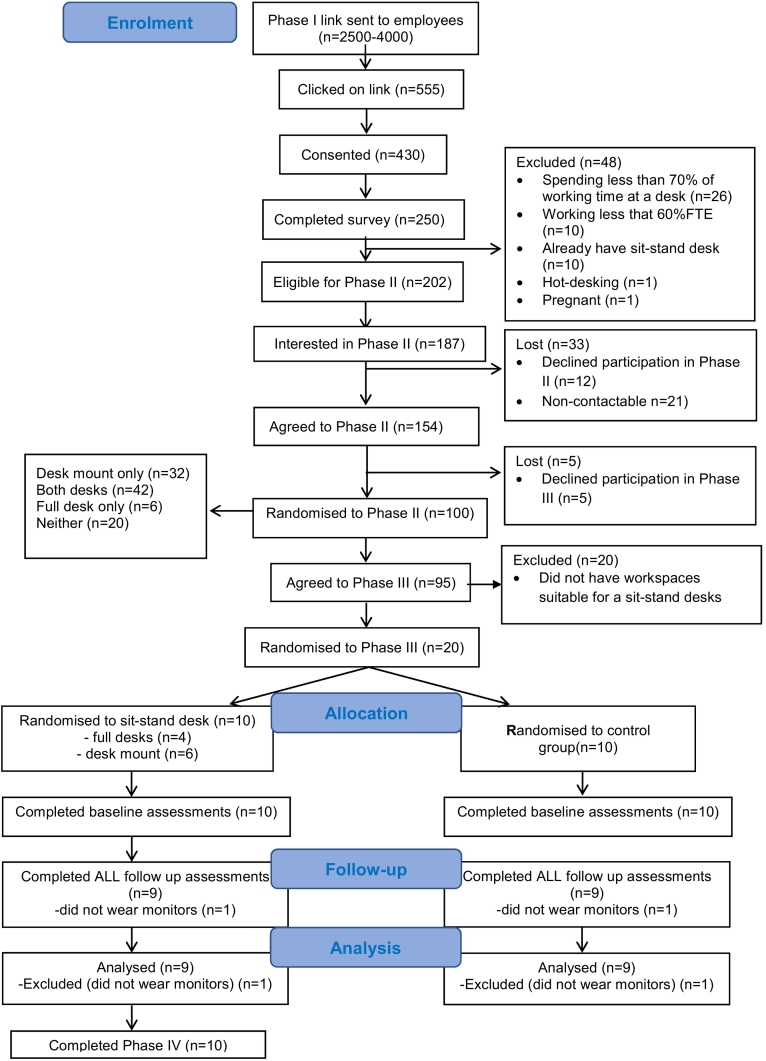
Uncertainties remain about the overall effect of sit-stand desks for reducing prolonged sitting among office-based workers. This study assessed the feasibility of a randomised controlled trial of the impact of workplace sit-stand desks on overall energy expenditure, sitting time and cardio-metabolic outcomes. It involved four phases: Phase I: online survey; Phase II: workspace auditing; Phase III: randomised intervention (provision of sit-stand desks at work for 3 months); Phase IV: qualitative component. Participants were offıce-based employees of two companies in Cambridge, England. Among Phase I participants interested in the trial, 100 were randomised to Phase II. Of those with workspaces suitable for sit-stand desks, 20 were randomised to Phase III. Those allocated to the intervention completed Phase IV. Outcomes included: trial participation interest, desk-type (full desks/desk mounts) and assessment location (work/laboratory/home) preferences (Phase I); proportion of workspaces permitting sit-stand desk installation (Phase II); energy expenditure, sitting time and cardio-metabolic outcomes (Phase III); study participation experiences (Phase IV). Data were collected between May 2015 and December 2016. Recruitment and trial implementation were feasible: 92% of survey respondents expressed participation interest; 80% of workspaces could accommodate sit-stand desks; assessments were done in workplaces, preferred by 71%. Sit-stand desk provision reduced workplace sitting time by 94 min/day (95% CI 17.7-170.7). Their impact on energy expenditure and cardio-metabolic outcomes is unclear. The results confirm the feasibility of a trial assessing sit-stand desks' impact on energy expenditure, sitting time and cardio-metabolic outcomes, which should reduce uncertainty concerning the intervention's potential to reduce the health risks of prolonged sitting. Trial registration ISRCTN44827407.
Keywords: Energy expenditure; Feasibility study; Height-adjustable desks; Sedentary behaviour; Sit-stand desks; Sitting; Standing; Standing desks.
Figures
References
-
- Adeleke S.O., Healy G.N., Smith C., Goode A.D., Clark B.K. Effect of a workplace-driven sit–stand initiative on sitting time and work outcomes. Translational Journal of the American College of Sports Medicine. 2017;2(3):20–26.
-
- Alkhajah T.A., Reeves M.M., Eakin E.G., Winkler E.A., Owen N., Healy G.N. Sit–stand workstations: a pilot intervention to reduce office sitting time. Am. J. Prev. Med. 2012;43(3):298–303. - PubMed
-
- Bentley I. School of Health Sciences Queen Margaret University; 2011. Comparison of the Accuracy of the ActivPAL Activity Monitor, the Actigraph GT1M Activity Monitor and the Actigraph GT3X Activity Monitor During Activities Of Daily Living.
-
- Biswas A., Oh P.I., Faulkner G.E. Sedentary time and its association with risk for disease incidence, mortality, and hospitalization in adults: a systematic review and meta-analysis sedentary time and disease incidence, mortality, and hospitalization. Ann. Intern. Med. 2015;162(2):123–132. - PubMed
Grants and funding
LinkOut - more resources
Full Text Sources
