


The prevalence of poor sleep quality and its associated factors in patients with interstitial lung disease: a cross-sectional analysis
- PMID: 31304178
- PMCID: PMC6612606
- DOI: 10.1183/23120541.00062-2019
The prevalence of poor sleep quality and its associated factors in patients with interstitial lung disease: a cross-sectional analysis
Abstract
Background: Many patients with interstitial lung disease (ILD) experience poor sleep quality, which may contribute to decreased quality of life. Sleep disordered breathing is commonly associated with ILD but there is less information on other factors that may contribute to poor sleep quality.
Methods: We conducted a cross-sectional analysis of 101 patients with a diagnosis of ILD at a pulmonary rehabilitation assessment clinic. We assessed the prevalence of poor sleep quality using the Pittsburgh Sleep Quality Index (PSQI) and performed multivariable logistic regression analysis to determine factors independently associated with poor sleep quality.
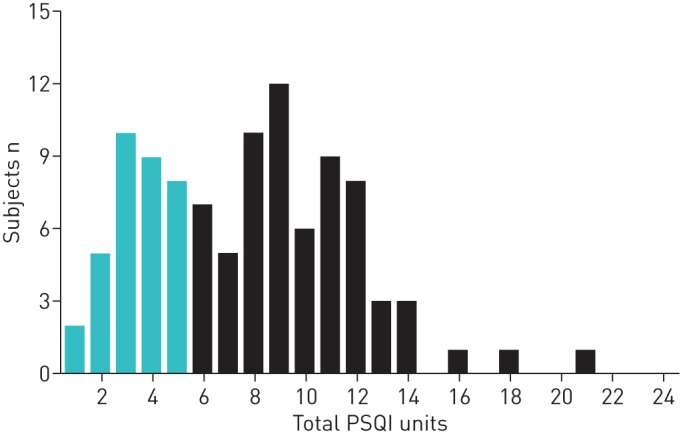
Results: Median forced expiratory volume in 1 s was 64% predicted (interquartile range (IQR) 50-77%) and vital capacity was 62% predicted (IQR 48-78%). 67 (66%) out of 101 patients reported poor sleep quality. The median PSQI was 8 units (IQR 4-11 units). There were no significant differences in physical or physiological parameters including age, sex distribution, body mass index or spirometry values between subjects with good sleep quality and those with poor sleep quality (all p>0.1). Multivariable logistic regression showed that depression (p=0.003) and Epworth Sleepiness Scale (p=0.03) were independently associated with poor sleep quality.
Conclusion: Poor sleep quality is common in patients with ILD and is independently associated with increasing symptoms of depression and sleepiness. Routine assessment of sleep quality should be undertaken and interventions targeting depression and coexisting sleep disorders may be required in symptomatic patients to determine if sleep quality and ultimately, health-related quality of life improves as a result.
Conflict of interest statement
Conflict of interest: J-G. Cho has nothing to disclose. Conflict of interest: A. Teoh has nothing to disclose. Conflict of interest: M. Roberts has nothing to disclose. Conflict of interest: J. Wheatley has nothing to disclose.
Figures
References
-
- King TE., Jr Clinical advances in the diagnosis and therapy of the interstitial lung diseases. Am J Respir Crit Care Med 2005; 172: 268–279. - PubMed
-
- Chang JA, Curtis JR, Patrick DL, et al. Assessment of health-related quality of life in patients with interstitial lung disease. Chest 1999; 116: 1175–1182. - PubMed
-
- Bajwah S, Higginson IJ, Ross JR, et al. Specialist palliative care is more than drugs: a retrospective study of ILD patients. Lung 2012; 190: 215–220. - PubMed
-
- Bajwah S, Higginson IJ, Ross JR, et al. The palliative care needs for fibrotic interstitial lung disease: a qualitative study of patients, informal caregivers and health professionals. Palliat Med 2013; 27: 869–876. - PubMed
LinkOut - more resources
Full Text Sources