


Finding missed cases of familial hypercholesterolemia in health systems using machine learning
- PMID: 31304370
- PMCID: PMC6550268
- DOI: 10.1038/s41746-019-0101-5
Finding missed cases of familial hypercholesterolemia in health systems using machine learning
Abstract
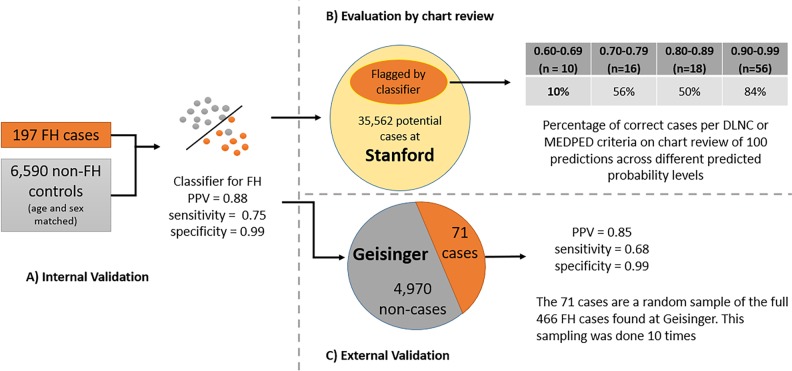
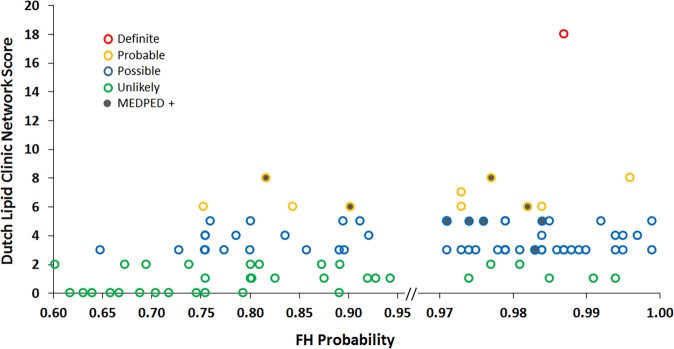
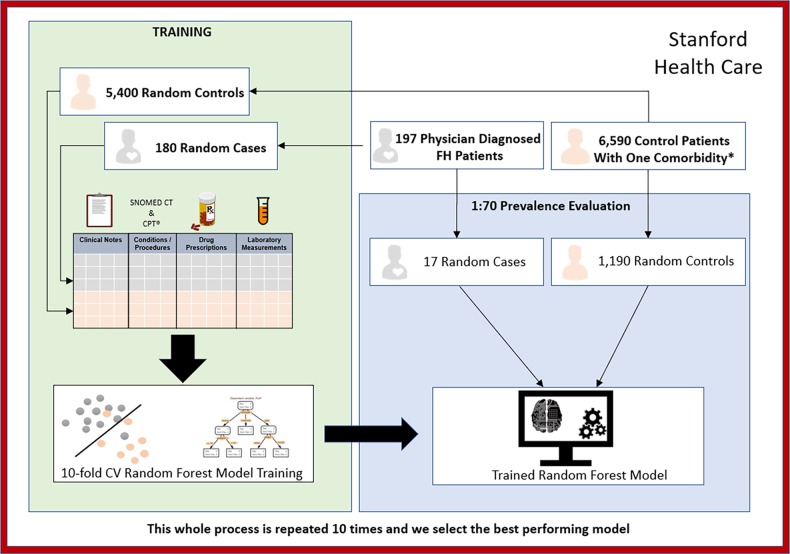
Familial hypercholesterolemia (FH) is an underdiagnosed dominant genetic condition affecting approximately 0.4% of the population and has up to a 20-fold increased risk of coronary artery disease if untreated. Simple screening strategies have false positive rates greater than 95%. As part of the FH Foundation's FIND FH initiative, we developed a classifier to identify potential FH patients using electronic health record (EHR) data at Stanford Health Care. We trained a random forest classifier using data from known patients (n = 197) and matched non-cases (n = 6590). Our classifier obtained a positive predictive value (PPV) of 0.88 and sensitivity of 0.75 on a held-out test-set. We evaluated the accuracy of the classifier's predictions by chart review of 100 patients at risk of FH not included in the original dataset. The classifier correctly flagged 84% of patients at the highest probability threshold, with decreasing performance as the threshold lowers. In external validation on 466 FH patients (236 with genetically proven FH) and 5000 matched non-cases from the Geisinger Healthcare System our FH classifier achieved a PPV of 0.85. Our EHR-derived FH classifier is effective in finding candidate patients for further FH screening. Such machine learning guided strategies can lead to effective identification of the highest risk patients for enhanced management strategies.
Keywords: Health care; Translational research.
Conflict of interest statement
Competing interestsS.M. is an employee of Atomo LLC. M.M. has received personal fees from InVitae and Merck, and grant funding from Regeneron, outside the submitted work. K.M. is the founder of Atomo LLC. The remaining authors declare no competing interests. The FH Foundation (EIN 45-4597425) is a 501(c)3 public charity and research advocacy organization receiving funding from a diverse set of program sponsors including Amgen, Inc.
Figures
References
-
- Besseling J, et al. Selection of individuals for genetic testing for familial hypercholesterolaemia: development and external validation of a prediction model for the presence of a mutation causing familial hypercholesterolaemia. Eur. Heart J. 2017;38:565–573. - PubMed
-
- Nordestgaard BG, et al. Familial hypercholesterolaemia is underdiagnosed and undertreated in the general population: guidance for clinicians to prevent coronary heart disease: consensus statement of the European Atherosclerosis Society. Eur. Heart J. 2013;34:3478–90a. doi: 10.1093/eurheartj/eht273. - DOI - PMC - PubMed
Grants and funding
LinkOut - more resources
Full Text Sources
Other Literature Sources
Research Materials
Miscellaneous
