


Effect of paired-pulse stimulus parameters on the two phases of short interval intracortical inhibition in the quadriceps muscle group
- PMID: 31306142
- PMCID: PMC6995364
- DOI: 10.3233/RNN-180894
Effect of paired-pulse stimulus parameters on the two phases of short interval intracortical inhibition in the quadriceps muscle group
Abstract
Background: Short interval intracortical inhibition (SICI) is commonly used to assess inhibition in the motor cortex and is known to be affected by the paired-pulse stimulus parameters (i.e., interstimulus interval [ISI], conditioning stimulus intensity [CSI] and test stimulus intensity [TSI]) used during testing. While the effects of stimulus parameters are well-studied in the upper-extremity, evidence in the lower-extremity is lacking.
Objective: To comprehensively examine the effects of alterations in paired-pulse stimulus parameters on the two phases of SICI in the quadriceps muscle group.
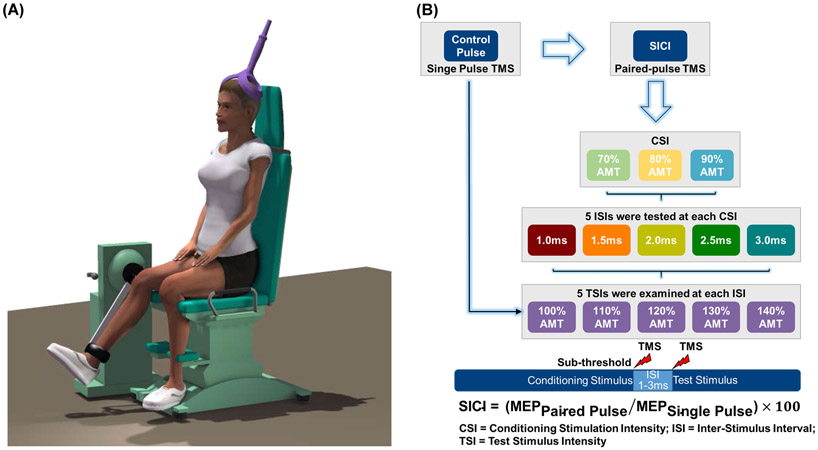
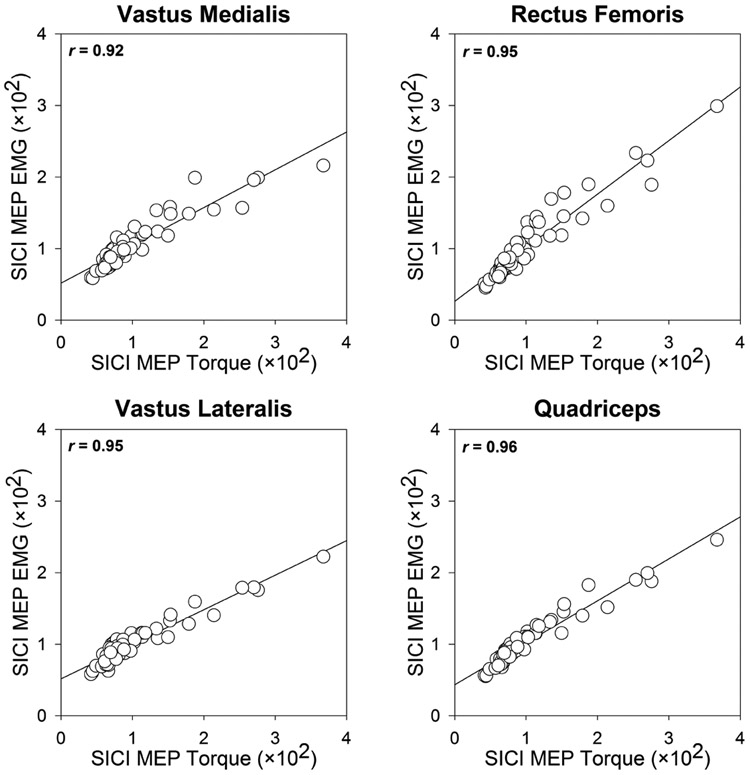
Methods: Seventeen adults (8 males, 9 females) volunteered to participate in this study. SICI was examined over a range of CSIs (70-90% active motor threshold [AMT]), TSIs (100-140% AMT), and ISIs (1.0-3.0 ms) using both EMG and torque responses elicited by transcranial magnetic stimulation (TMS).
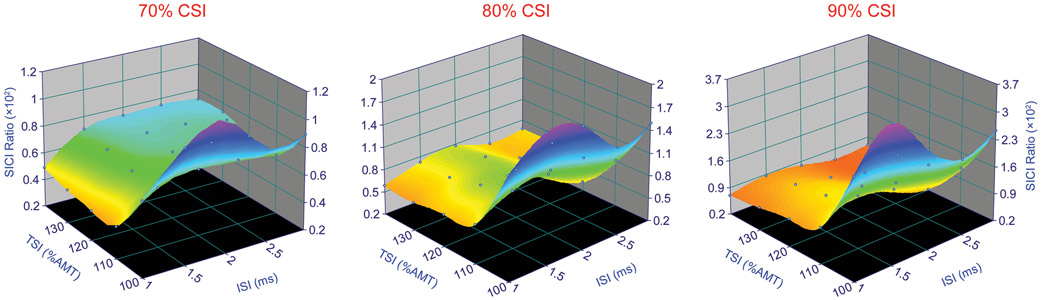
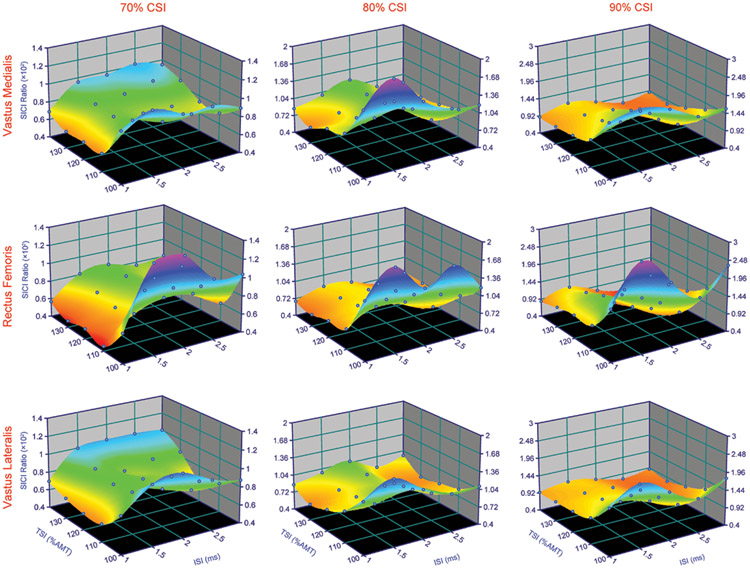
Results: The results indicated that SICI at 1.0 ms ISI was best revealed with a CSI of 70% and TSI ≥110% AMT, whereas SICI at 2.5 ms ISI was best revealed with a CSI of 80-90% and a TSI of ≥130% AMT. Unlike upper-extremity muscles, evaluating SICI with a CSI of 70% AMT and an ISI of 1.0 ms produced the greatest inhibition for all TSIs. In general, inhibitory effects were contaminated by facilitatory effects when using a TSI of 100% AMT.
Conclusions: The amount of inhibition was dependent on the stimulation parameters used during testing. A CSI of 70% AMT, ISI of 1.0 ms, and TSI of ≥110% AMT appear to be optimal for measuring SICI in the quadriceps muscle; however, other parameters can be used if careful consideration is given to the described interaction between the parameters.
Keywords: Cortical excitability; bayesian; knee; paired-pulse stimulation; twitch; two phases.
Figures
References
-
- Akima H, Saito A, Watanabe K & Kouzaki M (2012). Alternate muscle activity patterns among synergists of the quadriceps femoris including the vastus intermedius during low-level sustained contraction in men. Muscle and Nerve, 46(1), 86–95. - PubMed
-
- Bashir S, Vernet M, Najib U, Perez J, Alonso-Alonso M, Knobel M, Yoo WK, Edwards D & Pascual-Leone A (2016). Enhanced motor function and its neurophysiological correlates after navigated low-frequency repetitive transcranial magnetic stimulation over the contralesional motor cortex in stroke. Restorative Neurology and Neuroscience, 34(4), 677–689. - PMC - PubMed
-
- Bawa P & Murnaghan C (2009). Motor unit rotation in a variety of human muscles. Journal of Neurophysiology, 102(4), 2265–2272. - PubMed
-
- Benjamini Y & Hochberg Y (1995). Controlling the false discovery rate: a practical and powerful approach to multiple testing. Journal of the Royal statistical society: series B (Methodological), 57(1), 289–300.
-
- Brownstein CG, Ansdell P, Skarabot J, Frazer A, Kidgell D, Howatson G, Goodall S & Thomas K (2018a). Motor cortical and corticospinal function differ during an isometric squat compared with isometric knee extension. Experimental Physiology. - PubMed
Publication types
MeSH terms
Grants and funding
LinkOut - more resources
Full Text Sources
