


Buprenorphine prescribing for opioid use disorder in medical practices: can office-based out-patient care address the opiate crisis in the United States?
- PMID: 31307111
- PMCID: PMC6800773
- DOI: 10.1111/add.14733
Buprenorphine prescribing for opioid use disorder in medical practices: can office-based out-patient care address the opiate crisis in the United States?
Abstract
Background and aims: Opioid use disorder (OUD) remains a serious public health issue, and treating adults with OUD is a major priority in the United States. Little is known about trends in the diagnosis of OUD and in buprenorphine prescribing by physicians in office-based medical practices. We sought to characterize OUD diagnoses and buprenorphine prescribing among adults with OUD in the United States between 2006 and 2015.
Design and settings: We used a repeated cross-sectional design, based on data from the 2006-15 National Ambulatory Medical Care Surveys that surveyed nationally representative samples of office-based out-patient physician visits.
Participants: Adult patients aged 18 years or older with a diagnosis of OUD (n = 1034 unweighted) were included.
Measurements: Buprenorphine prescribing was defined by whether visits involved buprenorphine or buprenorphine-naloxone, or not. We also examined other covariates (e.g. age, gender, race and psychiatric comorbidities).
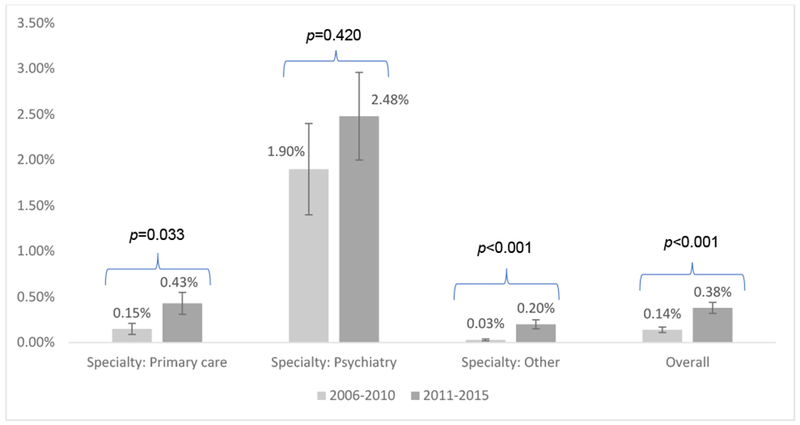
Findings: We observed an almost tripling of the diagnosis of OUD from 0.14% in 2006-10 to 0.38% in 2011-15 in office-based medical practices (P < 0.001). Among adults diagnosed with OUD, buprenorphine prescribing increased from 56.1% in 2006-10 to 73.6% in 2011-15 (P = 0.126). Adults with OUD were less likely to receive buprenorphine prescriptions if they were Hispanic [adjusted odds ratio (aOR) = 0.26; 95% confidence interval (CI) = 0.11, 0.60], had Medicaid insurance (aOR = 0.27; 95% CI = 0.10, 0.74) or were diagnosed with other psychiatric disorders (aOR = 0.45; 95% CI = 0.25, 0.83) or substance use disorders (aOR = 0.19; 95% CI = 0.09, 0.41).
Conclusions: In office-based medical practices in the United States, diagnoses for opioid use disorder and buprenorphine prescriptions for adults with opioid use disorder increased from 0.14 and 56.1%, respectively, in 2006-10 to 0.38 and 73.6% in 2011-15.
Keywords: Buprenorphine; opioid; opioid use disorder; out-patient care; prescribing trends; treatment patterns.
© 2019 Society for the Study of Addiction.
Conflict of interest statement
Figures
Comment in
-
Commentary on Rhee & Rosenheck (2019): Buprenorphine prescribing for opioid use disorder in medical practice - can office-based out-patient care address the opiate crisis in the United States?Addiction. 2020 Apr;115(4):786-787. doi: 10.1111/add.14907. Epub 2020 Jan 12. Addiction. 2020. PMID: 31762128 No abstract available.
References
-
- Quinnones S Dreamland: The true tale of America’s opiate epidemic. Bloomsbury Press; 2016.
-
- Rudd RA, Seth P, David F, Scholl L. Increases in Drug and Opioid-Involved Overdose Deaths - United States, 2010-2015. MMWR Morb Mortal Wkly Rep 2016;65(5051):1445–1452. - PubMed
-
- Centers for Disease Control and Prevention. Drug Overdose Death Data. https://www.cdc.gov/drugoverdose/data/statedeaths.html. Published 2018. Accessed May 17, 2019.
-
- Centers for Disease Control and Prevention. CDC Guideline for Prescribing Opioids for Chronic Pain. https://www.cdc.gov/drugoverdose/prescribing/guideline.html. Published 2017. Accessed July 3, 2018.
-
- IQVIA. Medicine use and spending in the U.S.: A review of 2017 and outlook to 2022. https://www.iqvia.com/institute/reports/medicine-use-and-spending-in-the.... Published 2018. Accessed July 3, 2018.
Publication types
MeSH terms
Substances
Grants and funding
LinkOut - more resources
Full Text Sources
Medical
