Targeting MUC1-C Inhibits TWIST1 Signaling in Triple-Negative Breast Cancer
- PMID: 31308076
- PMCID: PMC6774902
- DOI: 10.1158/1535-7163.MCT-19-0156
Targeting MUC1-C Inhibits TWIST1 Signaling in Triple-Negative Breast Cancer
Abstract
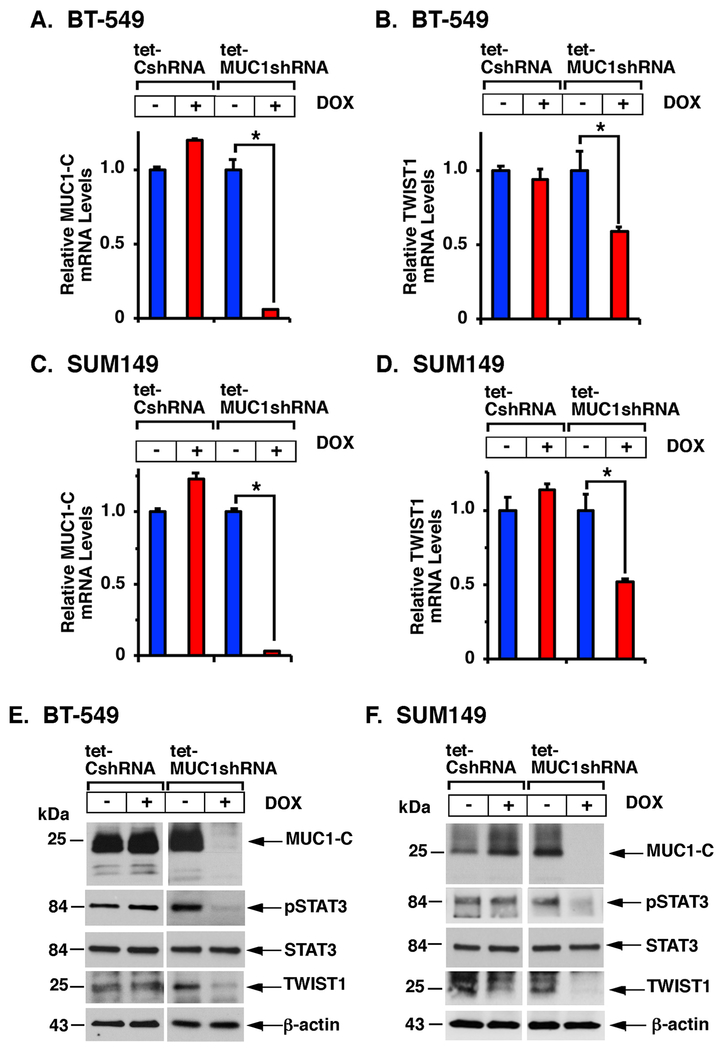
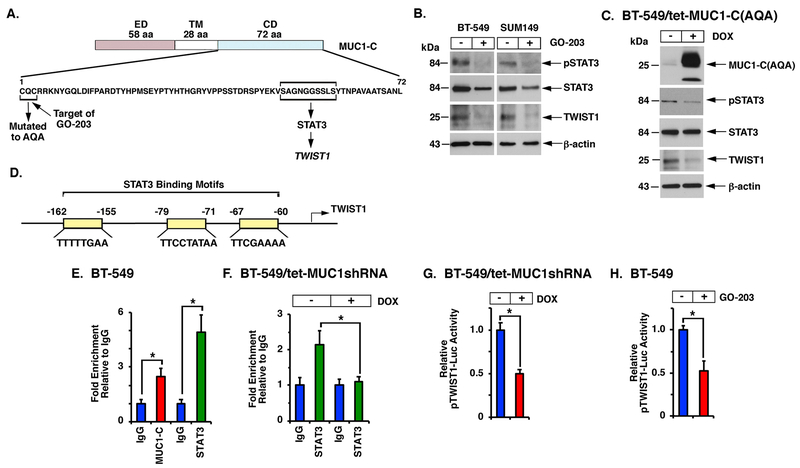
The oncogenic MUC1-C protein and the TWIST1 epithelial-mesenchymal transition transcription factor (EMT-TF) are aberrantly expressed in triple-negative breast cancer (TNBC) cells. However, there is no known association between MUC1-C and TWIST1 in TNBC or other cancer cells. Here, we show that MUC1-C activates STAT3, and that MUC1-C and pSTAT3 drive induction of the TWIST1 gene. In turn, MUC1-C binds directly to TWIST1, and MUC1-C/TWIST1 complexes activate MUC1-C expression in an autoinductive circuit. The functional significance of the MUC1-C/TWIST1 circuit is supported by the demonstration that this pathway is sufficient for driving (i) the EMT-TFs, ZEB1 and SNAIL, (ii) multiple genes in the EMT program as determined by RNA-seq, and (iii) the capacity for cell invasion. We also demonstrate that the MUC1-C/TWIST1 circuit drives (i) expression of the stem cell markers SOX2, BMI1, ALDH1, and CD44, (ii) self-renewal capacity, and (iii) tumorigenicity. In concert with these results, we show that MUC1-C and TWIST1 also drive EMT and stemness in association with acquired paclitaxel (PTX) resistance. Of potential therapeutic importance, targeting MUC1-C and thereby TWIST1 reverses the PTX refractory phenotype as evidenced by synergistic activity with PTX against drug-resistant cells. These findings uncover a master role for MUC1-C in driving the induction of TWIST1, EMT, stemness, and drug resistance, and support MUC1-C as a highly attractive target for inhibiting TNBC plasticity and progression.
©2019 American Association for Cancer Research.
Conflict of interest statement
Figures


References
-
- Thiery JP. Epithelial-mesenchymal transitions in tumour progression. Nat Rev Cancer 2002;2(6):442–54. - PubMed
-
- Thiery JP, Acloque H, Huang RY, Nieto MA. Epithelial-mesenchymal transitions in development and disease. Cell 2009;139(5):871–90. - PubMed
-
- Li R, Liang J, Ni S, Zhou T, Qing X, Li H, et al. A mesenchymal-to-epithelial transition initiates and is required for the nuclear reprogramming of mouse fibroblasts. Cell Stem Cell 2010;7(1):51–63. - PubMed
-
- De Craene B, Berx G. Regulatory networks defining EMT during cancer initiation and progression. Nat Rev Cancer 2013;13(2):97–110. - PubMed
-
- Skrypek N, Goossens S, De Smedt E, Vandamme N, Berx G. Epithelial-to-mesenchymal transition: epigenetic reprogramming driving cellular plasticity. Trends Genet 2017;33(12):943–59. - PubMed
Publication types
MeSH terms
Substances
Grants and funding
LinkOut - more resources
Full Text Sources
Research Materials
Miscellaneous