. 2019 Jul 15;9(1):10217.
doi: 10.1038/s41598-019-46712-9.

The Evolutionary History of The Orexin/Allatotropin GPCR Family: from Placozoa and Cnidaria to Vertebrata

Affiliations

The Evolutionary History of The Orexin/Allatotropin GPCR Family: from Placozoa and Cnidaria to Vertebrata

María Eugenia Alzugaray et al. Sci Rep. .

Abstract

Peptidic messengers constitute a highly diversified group of intercellular messengers widely distributed in nature that regulate a great number of physiological processes in Metazoa. Being crucial for life, it seem that they have appeared in the ancestral group from which Metazoa evolved, and were highly conserved along the evolutionary process. Peptides act mainly through G-protein coupled receptors (GPCRs), a family of transmembrane molecules. GPCRs are also widely distributed in nature being present in metazoan, but also in Choanoflagellata and Fungi. Among GPCRs, the Allatotropin/Orexin (AT/Ox) family is particularly characterized by the presence of the DRW motif in the second intracellular loop (IC Loop 2), and seems to be present in Cnidaria, Placozoa and in Bilateria, suggesting that it was present in the common ancestor of Metazoa. Looking for the evolutionary history of this GPCRs we searched for corresponding sequences in public databases. Our results suggest that AT/Ox receptors were highly conserved along evolutionary process, and that they are characterized by the presence of the E/DRWYAI motif at the IC Loop 2. Phylogenetic analyses show that AT/Ox family of receptors reflects evolutionary relationships that agree with current phylogenetic understanding in Actinopterygii and Sauropsida, including also the largely discussed position of Testudines.


Conflict of interest statement

The authors declare no competing interests.

Figures
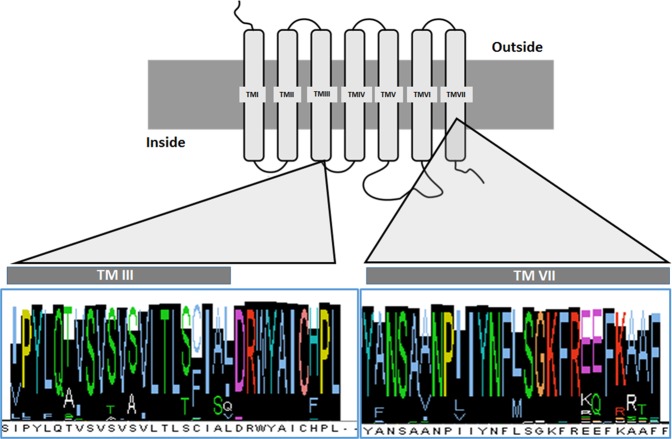
Figure 1
Figure 1
Schematic view of a generalized GPCR showing the two highly conserved domains, and the corresponding consensus after a multiple sequence alignment of sequences pertaining to the Allatotropin/orexin family of receptors. The alignment includes species pertaining to Placozoa, Cnidaria, Arthropoda, Mollusca, Annelida, Brachiopoda and Chordata.
Figure 2
Figure 2
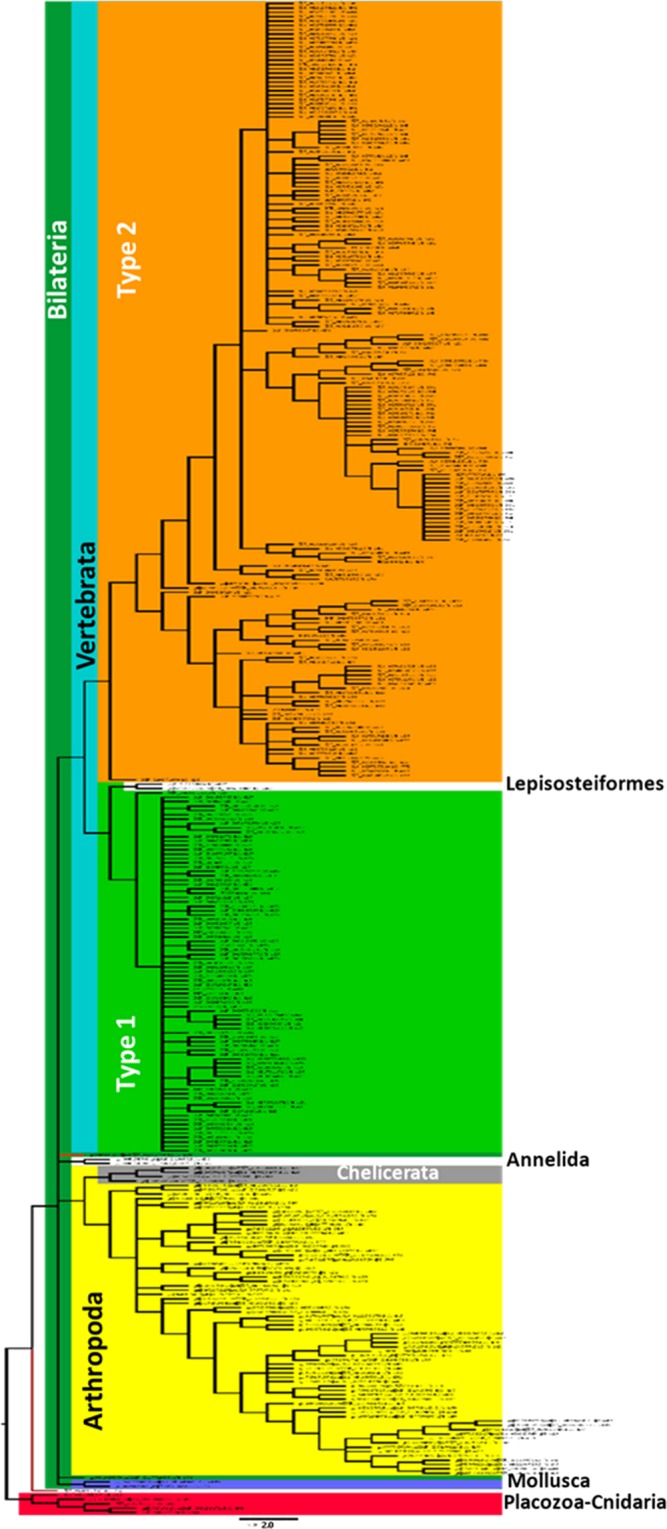
Evolutionary history of the Allatotropin/orexin family of receptors. All the sequences included present the seven transmembrane domains and the corresponding N-terminal and C-terminal domains. The tree was inferred by the Neighbour-Joining method. The cut-off value of replicate trees in which the associated taxa clustered together after a bootstrap test (1000 replicates) was 50%.
Figure 3
Figure 3
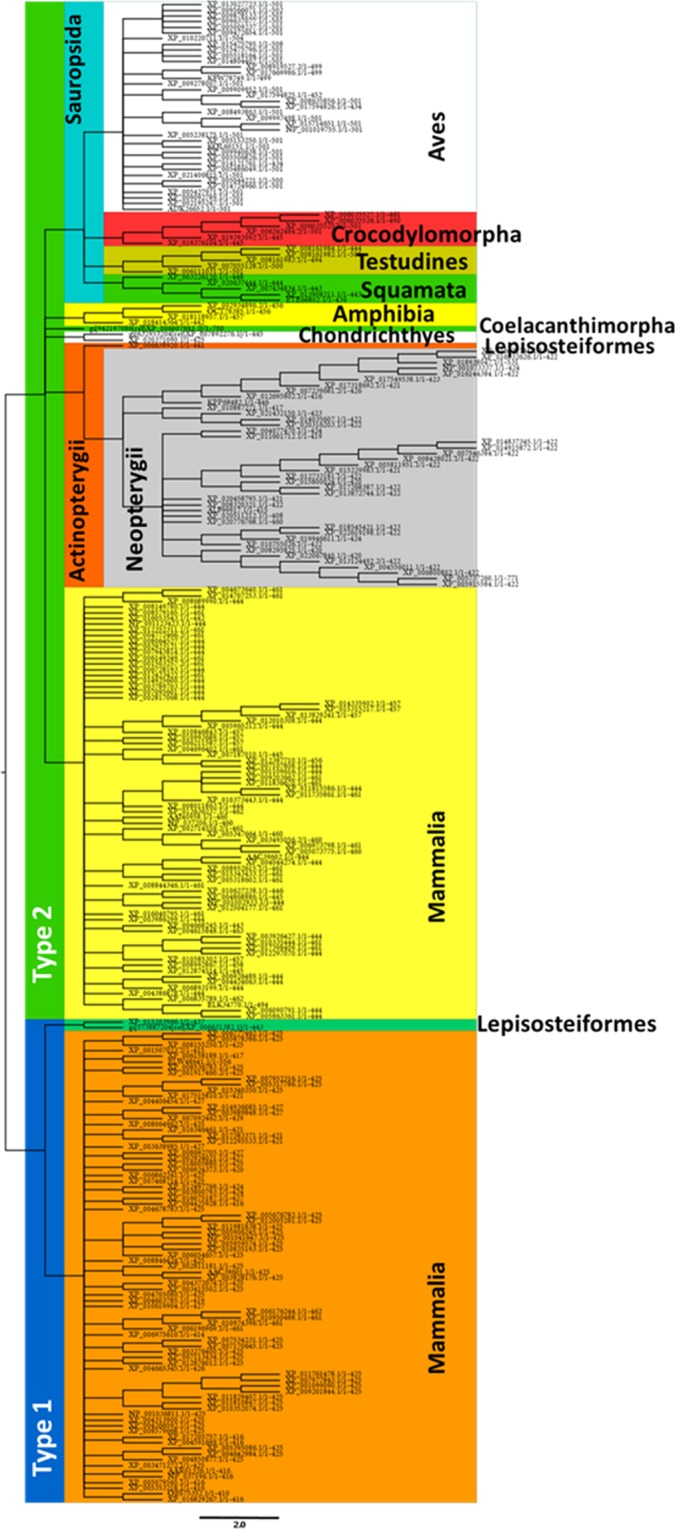
Phylogenetic relationships of Vertebrata. The tree was inferred by the Maximum Likelihood method. The cut-off value of replicate trees in which the associated taxa clustered together after a bootstrap test (1000 replicates) was 50%. Note that both kind of orexin receptors (Type 1 and Type 2) group independently. Type 2 receptor is present in all the groups of vertebrates included in the analysis. Type 1 receptor is only present in mammals with the exception of Lepisosteiformes (Actinopteygii: Neopterygii), suggesting that this kind of receptor could have appeared more than once along the evolution of Vertebrata.
Figure 4
Figure 4
Maximum Likelihood analysis of Sauropsida. The phylogeny is clearly represented showing Lepidosauromorpha as the sister group of Archosauria. The main groups of Aves are also represented. Two orders of Neoaves (Passeriformes and Psittasiformes) are recognized. Furthermore, in Passeriformes, the best represented group, two families can be recognized by signature motifs. Testudines appears as the sister group of Archosauria in agreement with the current accepted hypothesis that recognize them as Diapsida, resembling also the currently proposed group of Archelosauria.
Figure 5
Figure 5
Analysis of Maximum Likelihood of sequences of Orexin receptor corresponding to Actinopterygii. All the species pertain to Neopterygii being represented the two extant groups (Lepisosteiformes and Halecostomi), which appear as the sister group of Chondrichthyes. Currently proposed groups are clearly represented at higher taxonomic levels. The analysis also recognizes taxa at lower levels including families defined by characteristic motifs that might be considered as signatures.

References

    1. Alzugaray ME, et al. Allatotropin: An ancestral myotropic neuropeptide involved in feeding. Plos One. 2013;8:e77520. doi: 10.1371/journal.pone.0077520. - DOI - PMC - PubMed
    1. Alzugaray ME, Hernández-Martínez S, Ronderos JR. Somatostatin signaling system as an ancestral mechanism: Myoregulatory activity of an Allatostatin-C peptide in Hydra. Peptides. 2016;82:67–75. doi: 10.1016/j.peptides.2016.05.011. - DOI - PubMed
    1. Alzugaray ME, Ronderos JR. Allatoregulatory-like systems and changes in cytosolic Ca2+ modulate feeding behavior in. Hydra. Gen. Comp. Endocrinol. 2018;258:70–78. doi: 10.1016/j.ygcen.2017.07.020. - DOI - PubMed
    1. Grimmelikhuijzen CJP, Hauser F. Mini-review: The evolution of neuropeptide signaling. Regul. Pept. 2012;177:S6–S9. doi: 10.1016/j.regpep.2012.05.001. - DOI - PubMed
    1. Nikitin M. Bioinformatic prediction of Trichoplax adhaerens regulatory peptides. Gen. Comp. Endocrinol. 2015;212:145–155. doi: 10.1016/j.ygcen.2014.03.049. - DOI - PubMed

Publication types