. 2019 Aug;572(7767):112-115.
doi: 10.1038/s41586-019-1370-5. Epub 2019 Jul 15.

Elemental signatures of Australopithecus africanus teeth reveal seasonal dietary stress

Affiliations

Elemental signatures of Australopithecus africanus teeth reveal seasonal dietary stress

Renaud Joannes-Boyau et al. Nature. 2019 Aug.

Abstract

Reconstructing the detailed dietary behaviour of extinct hominins is challenging1-particularly for a species such as Australopithecus africanus, which has a highly variable dental morphology that suggests a broad diet2,3. The dietary responses of extinct hominins to seasonal fluctuations in food availability are poorly understood, and nursing behaviours even less so; most of the direct information currently available has been obtained from high-resolution trace-element geochemical analysis of Homo sapiens (both modern and fossil), Homo neanderthalensis4 and living apes5. Here we apply high-resolution trace-element analysis to two A. africanus specimens from Sterkfontein Member 4 (South Africa), dated to 2.6-2.1 million years ago. Elemental signals indicate that A. africanus infants predominantly consumed breast milk for the first year after birth. A cyclical elemental pattern observed following the nursing sequence-comparable to the seasonal dietary signal that is seen in contemporary wild primates and other mammals-indicates irregular food availability. These results are supported by isotopic evidence for a geographical range that was dominated by nutritionally depauperate areas. Cyclical accumulation of lithium in A. africanus teeth also corroborates the idea that their range was characterized by fluctuating resources, and that they possessed physiological adaptations to this instability. This study provides insights into the dietary cycles and ecological behaviours of A. africanus in response to food availability, including the potential cyclical resurgence of milk intake during times of nutritional challenge (as observed in modern wild orangutans5). The geochemical findings for these teeth reinforce the unique place of A. africanus in the fossil record, and indicate dietary stress in specimens that date to shortly before the extinction of Australopithecus in South Africa about two million years ago.


Conflict of interest statement

The authors declare no competing financial interests.

Figures

Extended data Figure 1 -
Extended data Figure 1 -. The Sterkfontein surface excavation and fossil teeth specimen.
Plan view of the Sterkfontein surface excavation adapted from Kuman, K., and Clark, R. J. 35, showing the association between the Type Site excavation and Member 4 deposits. (B) Photo of fossil teeth specimen StS 28; (C) upper first molar (M1) StS 28B; (D) permanent lower first molar (M1) StS 28C after being sectioned in two with a diamond low speed high precision rotary saw. (E) Photo of fossil teeth specimen StS 51; (F) permanent premolar (P3) StS 51A; (G) permanent canine (LC) StS 51B after being sectioned in two with a diamond low speed high precision rotary saw. The two teeth still embedded in the breccia were not sectioned.
Extended data Figure 2 -
Extended data Figure 2 -. Elemental mapping by LA-ICPMS protocol:
(A) Sketch of a fossil Pongo sp. second molar tooth dentine and enamel section with indication of biogenic accentuated lines (green); Elemental mapping of both dental tissues using laser ablation-inductively coupled plasma-mass spectrometry shows (B) strontium distribution following the incremental growth pattern of the tooth, typical of biogenic signals, contrary to post-mortem diagenetic processes (C) (uranium diffusion during burial).
Extended data Figure 3 -
Extended data Figure 3 -. Elemental mapping of A. africanus StS 28.
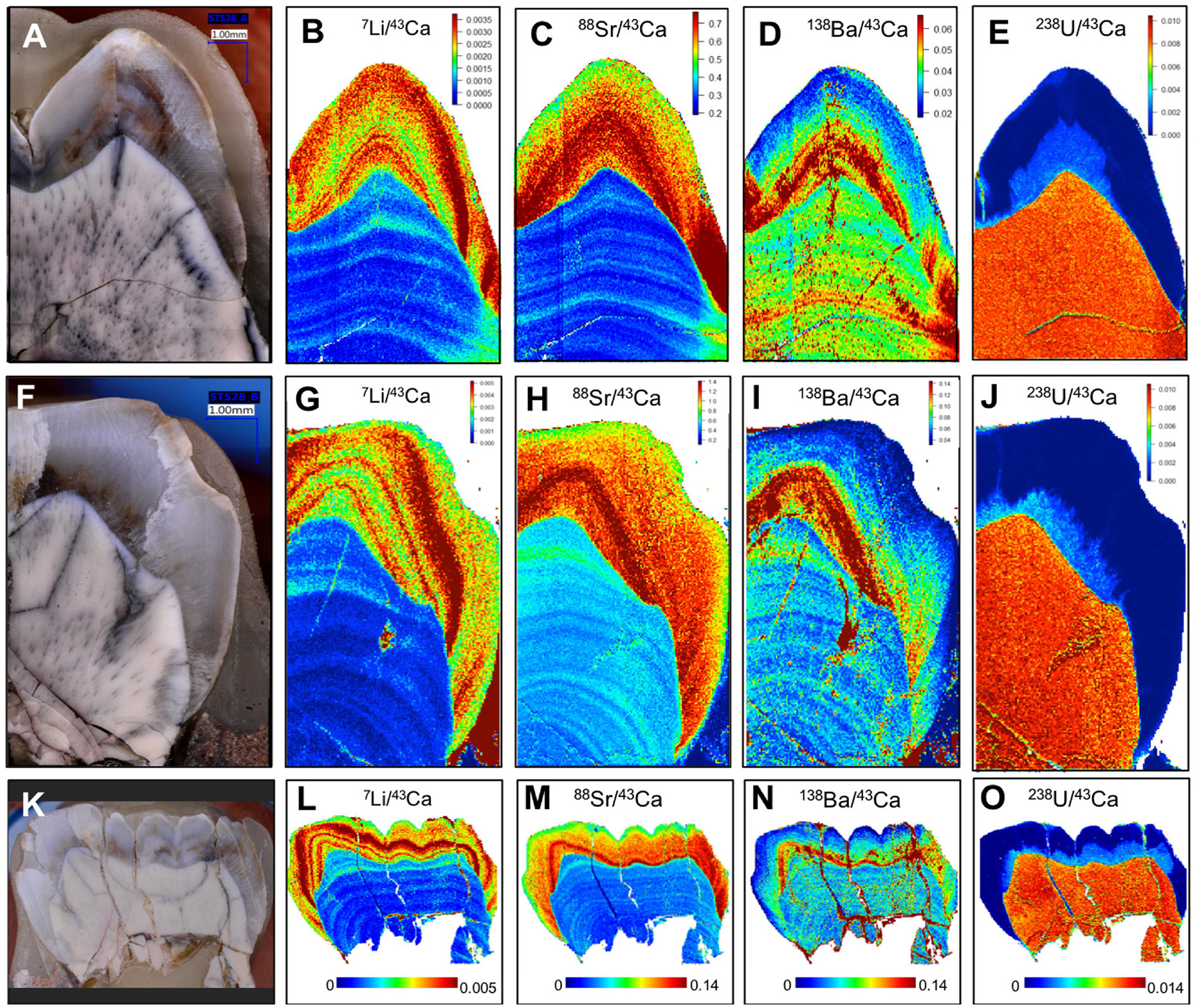
Elemental mapping of (top) upper first molar cusp (StS 28B); and (middle and bottom) lower first molar (StS 28C) showing records of cyclical banding between 0 and 7 years at crown completion. The broad repeated banding pattern is attributed to seasonal dietary shifts and potentially to cyclical nursing during long weaning periods. The identical elemental banding pattern found in both StS 28B and StS 28C first permanent molars confirm beyond any doubt the biogenic nature of the signal observed (compare B, C and D with G, H and I respectively). The typical patchy and spreading diffusion pathways of uranium in the dentine and the enamel can be observed (E, J, O) with characteristic accumulation or depletion in cracks and at the enamel-dentine junction, very different to the biogenic Li, Sr and Ba banding.
Extended data Figure 4 -
Extended data Figure 4 -. Elemental mapping of A. africanus StS 51.
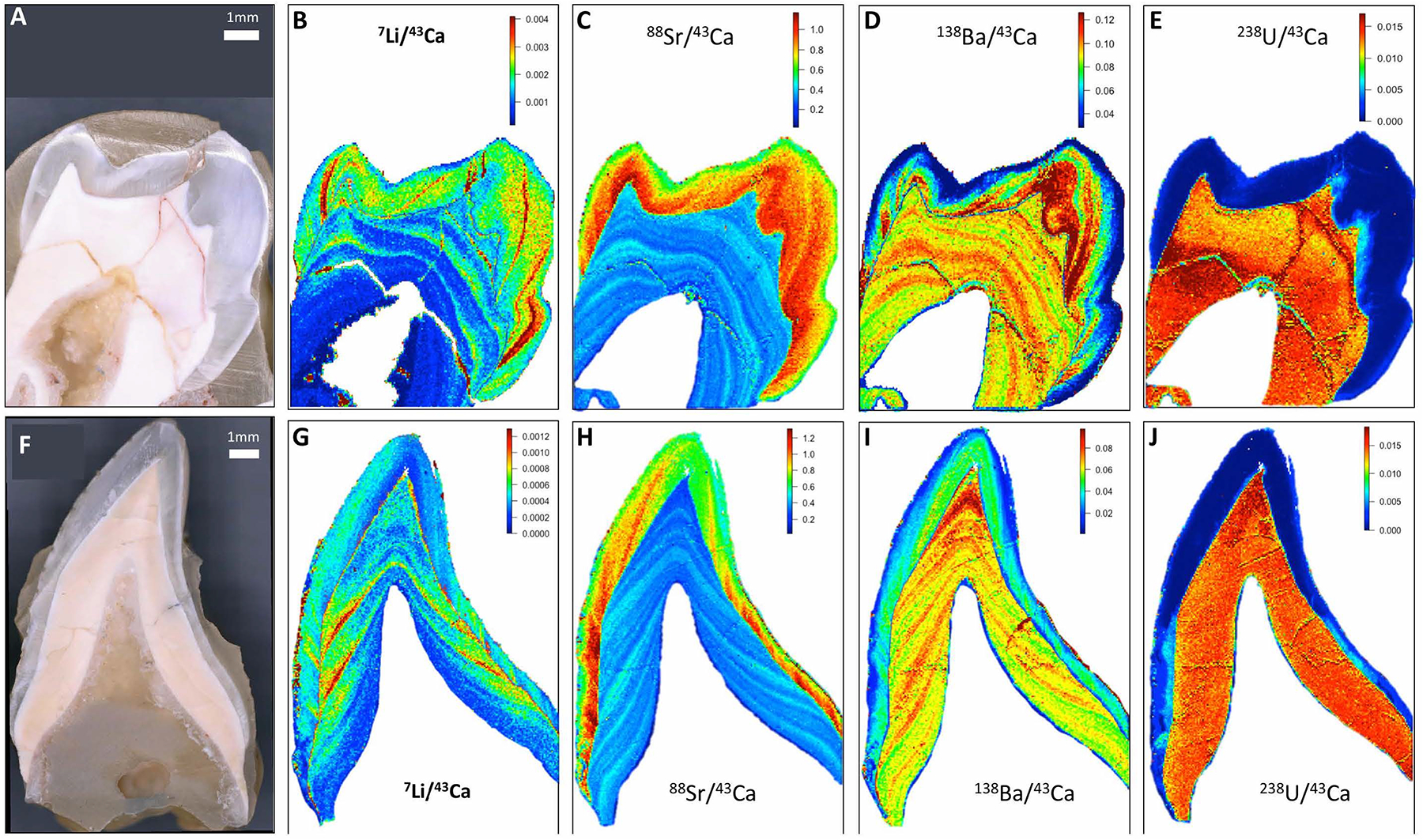
Elemental mapping of (A) permanent premolar (StS 51A) (B) Li/Ca banding, (C) Sr/Ca banding, (D) Ba/Ca banding and (E) U/Ca diffusion; (F) permanent canine (StS 51B) (G) Li/Ca banding, (H) Sr/Ca banding, (I) Ba/Ca banding and (J) U/Ca diffusion; The strontium signal shows additional discreet lines most likely associated stress episodes compared to Li/Ca and Ba/Ca. Uranium distribution shows a typical and rather uniform diffusion pattern with enrichment close to the EDJ and in fractures and cracks.
Extended data Figure 5 -
Extended data Figure 5 -. LA-ICPMS trace element mapping of primate and non-primate mammals:
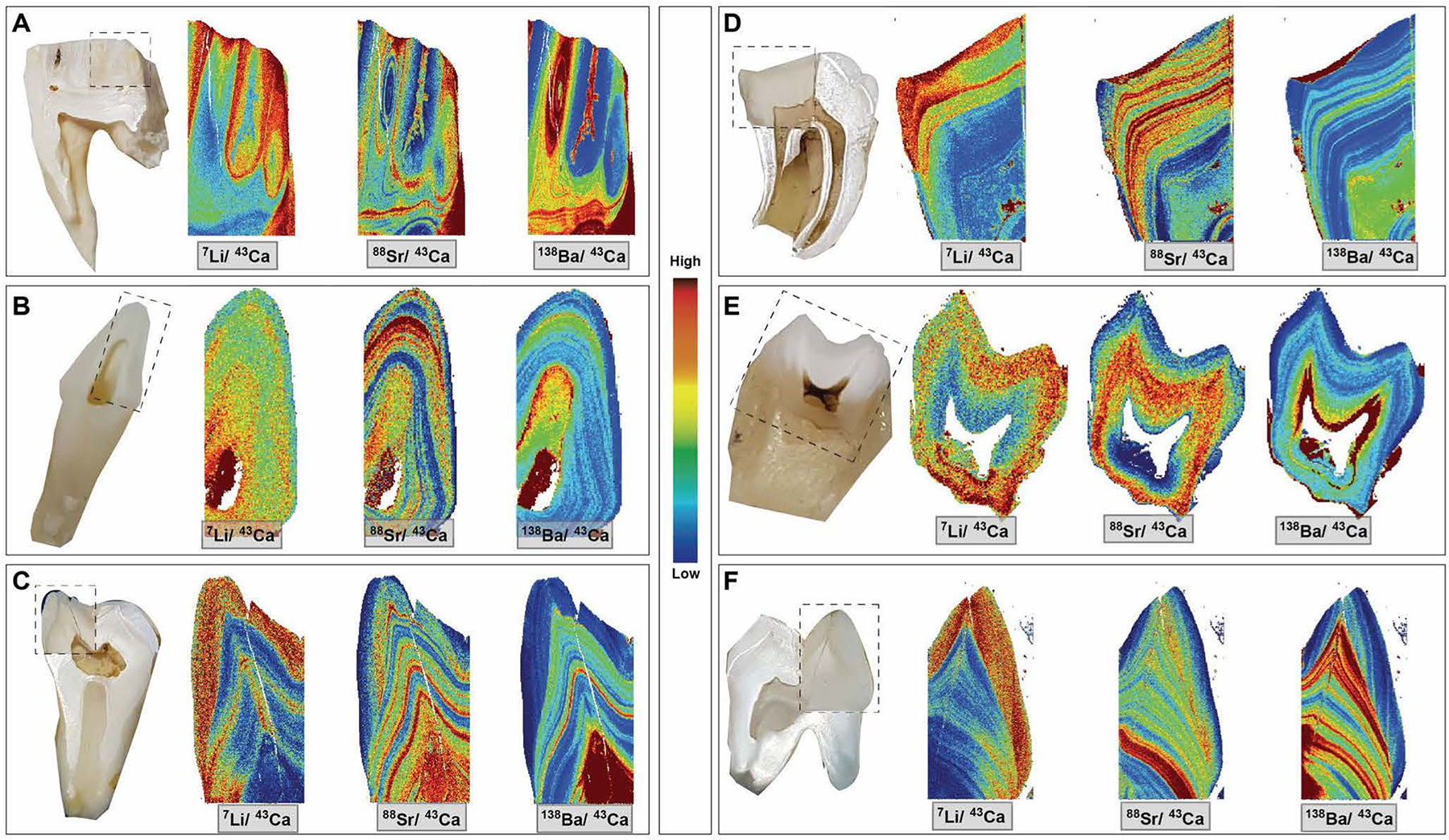
All teeth specimens are from the grassland-dominated ecosystem of South Africa (frequently referred as savanna) and were recovered from wild modern animals. (A) Antidorcas marsupialis (M2) - Herbivore; (B) Caracal caracal premolar (P4) - Carnivore; (C) Papio ursinus third molar (M3) – Omnivore/opportunistic; (D) Potamochoerus porcus first premolar (P3) - Omnivore; (E) Otocyon megalotis second molar (M2) - Carnivore; (F) Papio ursinus first molar (M1) - Omnivore/opportunistic. All mammals exhibit Ba/Ca and Sr/Ca banding (except for (E) where no Sr lines can be observed). Li/Ca banding is absent from animal teeth except from the two Baboon teeth (C and F) and perhaps the hog tooth (D). In fact, the Ba/Ca banding pattern in Papio is very similar to the one observed in A. africanus, apart from the lack of clear periodicity, the baboon teeth are comparable to those of the australopiths. Baboons have a unique nursing cycle and an opportunistic seasonal feeding habit.
Extended data Figure 6 -
Extended data Figure 6 -. 138Ba/43Ca and 88Sr/43Ca distribution in the enamel parallel to the Dentine-Enamel Junction (DEJ).
(A) StS 51 canine: The Ba/Ca and Sr/Ca ratios comparison show an inverse correlation towards the end of exclusive breastfeeding [A]. This pattern is repeated at [B] and [C] approximately 6 months apart, which may indicate cyclical milk intake. The concurrent increase in Sr/Ca with decreasing Ba/Ca at [A] indicates an increase in the predominance of solid food in the diet and indicates a food source with more bioavailable Sr than milk. Timing for the tooth development was approximated using estimated A. africanus species values, and assuming linear growth rate of the enamel. (B) modern baboon molars: The Ba/Ca and Sr/Ca ratios along the DEJ of a first (left and ED Fig. 5F) and a third molar (right and ED Fig. 5C) of a modern baboon was compared giving several years of record. While both teeth had clear banding, the M1 display more intense fluctuations compare to the pattern observed in the third molar, potentially attributed to an additional nursing signal in M1, with exclusive breastfeeding for the first 4–6 months until being completely weaned just after a year.
Extended data Figure 7 -
Extended data Figure 7 -. LA-ICPMS trace element mapping of modern humans:
The 7Li/43Ca, 88Sr/43Ca and 138Ba/43Ca for each modern human specimen (Homo sapiens) HT01 (UM1), HT02 (LM1) and HT03 (UM1) (left to right respectively). The distribution pattern of all three elements is notably different to the signal observed in A. africanus, with an enrichment towards the pulp cavity for both 88Sr/43Ca and 138Ba/43Ca, likely associated with blood flow. An important difference is the absence of a repeated pattern observable for all three elemental ratios. While some features could be interpreted as banding, such as the 88Sr/43Ca root signal of HT03, the isolated pattern is not mirrored in the other elemental distribution.
Extended data Figure 8 -
Extended data Figure 8 -. Comparison of temporal occurrence of Li and Ba banding in StS 28C upper first molar.
The Li/Ca banding (A) when placed over the Ba/Ca bands (B) shows (C) a slight offset of the lithium banding. The lighter element (red dotted line marking the start of the Li deposition) appears to occur immediately before and during the deposition of Ba/Ca (blue shading lines). It is hypothesised that Li location in the hydrosphere of the bone is more rapidly reabsorbed and transported into the bloodstream than Ba.
Extended data Figure 9 -
Extended data Figure 9 -. Strontium isotopic ratio distribution:
Location of the laser ablation spot (150 microns) along the enamel and dentine for StS 51A (A) and StS 28C (B). Circles with red filling correspond to the first point (1) and yellow filling to the last point (9 for enamel and 6 for dentine). The table below shows the 87Sr/86Sr isotopic ratio and associated errors for each laser ablation spot measured above. All values measured in both teeth (including Dentine 6 of StS 28 with associated error) correspond to the Malmani dolomite values surrounding Sterkfontein (87Sr/86Sr 0.723 < Malmani dolomite < 0.734), showing limited mobility for both specimens.
Extended data Figure 10 -
Extended data Figure 10 -. Permanent second molar of a modern Pongo specimen from the Perth Zoo.
The animal was born in captivity in 1975 in the Singapore Zoo, and join the Perth zoo later still as an immature individual. There appears to be no Ba/Ca banding pattern indicating cyclical milk consumption during crown completion. The captive orangutan Hsing Hsing, was born in captivity in 1975 at Singapore Zoo and was parent raised (although additional human feeding cannot be definitively excluded) before being relocated to Perth Zoo in 1983. His diet would have been significantly different to orangutans living in the wild, with limited seasonal influence and no periods of food scarcity. It is expected that the animal and his parents would have had abundant and guaranteed access to food, which would likely have led the specimen to be prematurely weaned compare to wild Pongo. On this basis, it is unlikely that Hsing Hsing would have had recurrent breastfeeding cycles and therefore the absence of Ba banding in this specimen is expected. The discreet banding observed for the Sr/Ca and the two Ba/Ca are likely stress related accentuated lines. No clear banding was observed in the enamel of this specimen.
FIG. 1:
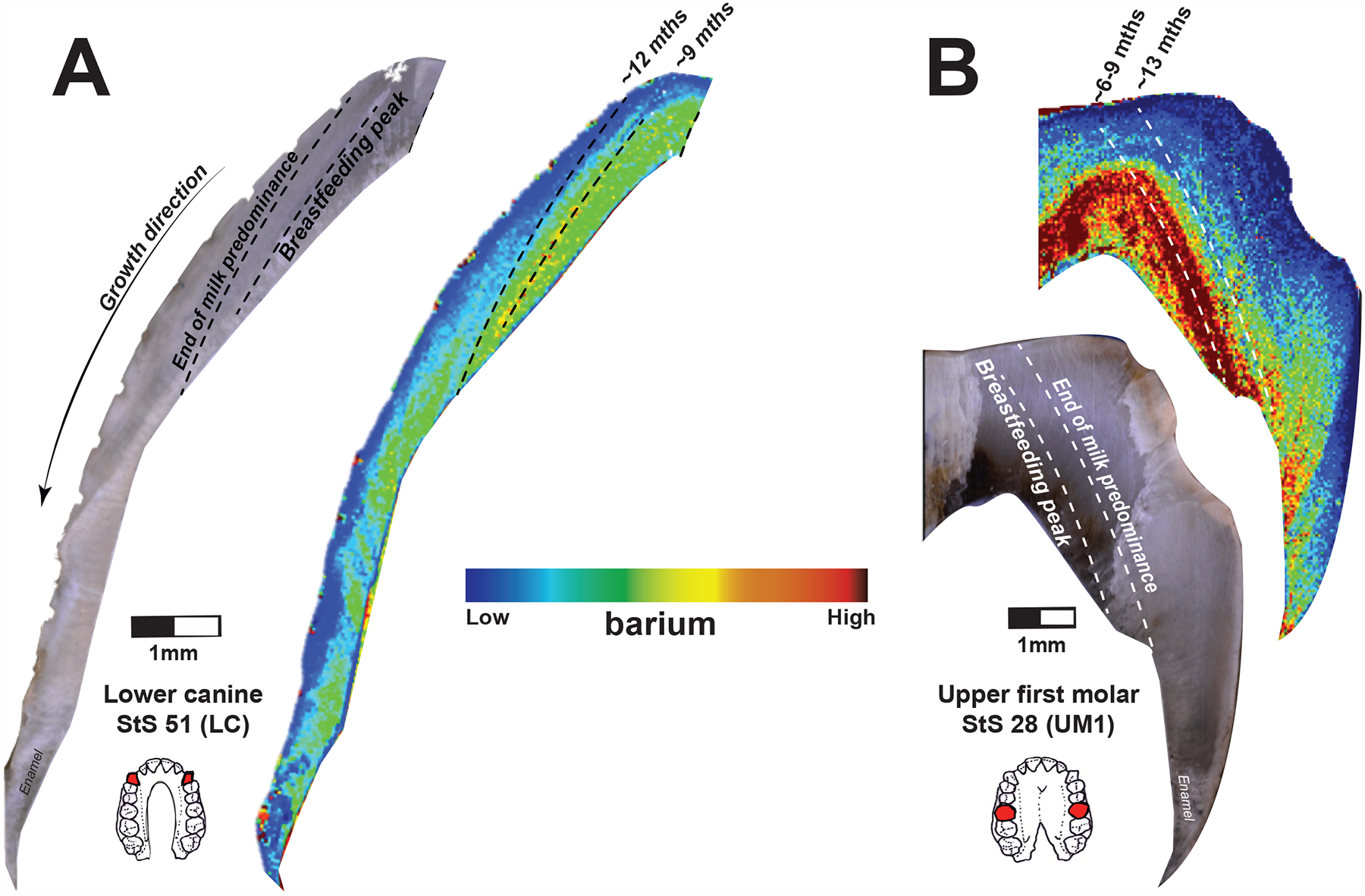
FIG. 1:. Breastfeeding period of A. africanus:
(A) section of enamel lower canine of StS 51 and associated 138Ba/43Ca elemental mapping. (B) section of enamel upper first molar of StS 28 and associated 138Ba/43Ca elemental mapping. The dotted lines indicate the beginning of enamel calcification, the time at which the breastfeeding peaked and the date at which the infant A. africanus breast milk intake decreased in profit to solid food. A period of approximately ~12 months and ~13 months for StS 51 and StS 28 of predominant breastfeeding was estimated using the distance between the identified lines and the average rate of calcification of the species (5.5 μm/d),,
FIG. 2:
FIG. 2:. Elemental mapping of A. africanus StS 28 and StS 51 fossil teeth:
Micrograph (×10) of (A) StS 28C permanent first molar and (B) StS 51A permanent first premolar (P3). Associated elemental mapping of 7Li/43Ca (B) StS 28 and (C) StS 51 and 138Ba/43Ca (E) StS 28 and (F) StS 51. Assuming similar timing in A. africanus and in Homo, crown formation of the permanent first molar would correspond to an early-life record from birth to about 7 years of age, while crown formation of the permanent first premolar (P3) would correspond to an early life record from 1.5 years to about 5 years of age.
FIG. 3:
FIG. 3:. Elemental mapping of StS 51 A. africanus canine:
(A) Micrograph (×10) of StS 51B permanent lower canine. (B) Associated elemental mapping of 7Li/43Ca and (C) 138Ba/43Ca. Permanent canine teeth develop only a few months after birth, with completion of the crown between 3 and 4 years of age. (D) Comparison of the temporal periodicity of Ba/Ca (black line and diamonds) and Li/Ca (red line and Xs) accentuated lines 1, 2, 3 and 4, along the transect (A). Li/Ca recurrence shows a slight temporal offset compared to Ba/Ca periodicity.

References

    1. Balter V, Braga J, Télouk P & Thackeray JF. Evidence for dietary change but not landscape use in South African early hominins. Nature 489, 558–562 (2012). - PubMed
    1. Ungar PS & Sponheimer M The Diets of Early Hominins. Science 334, 190–3 (2011). - PubMed
    1. Copeland SR et al. Strontium isotope evidence for landscape use by early hominins. Nature 474, 76–78 (2011). - PubMed
    1. Austin C et al. Barium distributions in teeth reveal early-life dietary transitions in primates. Nature 498, 216–219 (2013). - PMC - PubMed
    1. Smith TM, Austin C, Hinde K, Vogel ER & Arora M Cyclical nursing patterns in wild orang-utans. Science Advances 3 (5), e1601517 (2017). - PMC - PubMed