. 2019 Jul 10;5(2):vez017.
doi: 10.1093/ve/vez017. eCollection 2019 Jul.

Evolutionary persistence of insect bunyavirus infection despite host acquisition and expression of the viral nucleoprotein gene

Affiliations

Evolutionary persistence of insect bunyavirus infection despite host acquisition and expression of the viral nucleoprotein gene

Matthew J Ballinger et al. Virus Evol. .

Abstract

How insects combat RNA virus infection is a subject of intensive research owing to its importance in insect health, virus evolution, and disease transmission. In recent years, a pair of potentially linked phenomena have come to light as a result of this work-first, the pervasive production of viral DNA from exogenous nonretroviral RNA in infected individuals, and second, the widespread distribution of nonretroviral integrated RNA virus sequences (NIRVs) in the genomes of diverse eukaryotes. The evolutionary consequences of NIRVs for viruses are unclear and the field would benefit from studies of natural virus infections co-occurring with recent integrations, an exceedingly rare circumstance in the literature. Here, we provide evidence that a novel insect-infecting phasmavirus (Order Bunyavirales) has been persisting in a phantom midge host, Chaoborus americanus, for millions of years. Interestingly, the infection persists despite the host's acquisition (during the Pliocene), fixation, and expression of the viral nucleoprotein gene. We show that virus prevalence and geographic distribution are high and broad, comparable to the host-specific infections reported in other phantom midges. Short-read mapping analyses identified a lower abundance of the nucleoprotein-encoding genome segment in this virus relative to related viruses. Finally, the novel virus has facilitated the first substitution rate estimation for insect-infecting phasmaviruses. Over a period of approximately 16 million years, we find rates of (0.6 - 1.6) × 10-7 substitutions per site per year in protein coding genes, extraordinarily low for negative-sense RNA viruses, but consistent with the few estimates produced over comparable evolutionary timescales.

Keywords: EVEs; NIRVs; insect immunity; paleovirology; substitution rates.


Figures
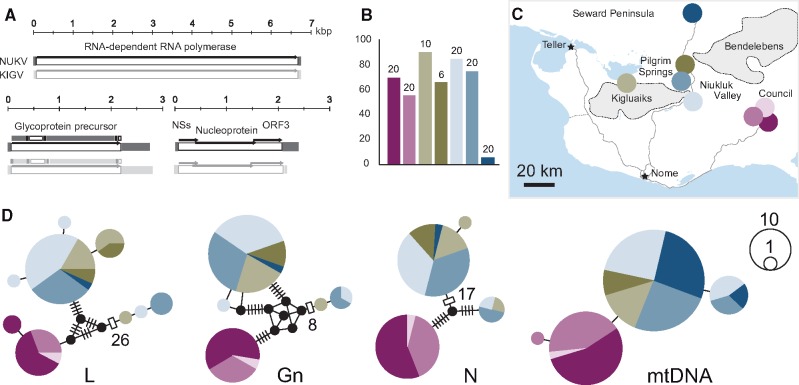
Figure 1.
Figure 1.
Genome structure, prevalence, and genetic diversity of Niukluk phantom orthophasmavirus. (A) NUKV exhibits standard phasmavirus genome organization. The structure of each of the three genomic segments is shown above a reference segment from the related virus, KIGV. Untranslated regions are shown as filled rectangles and ORFs are shown as arrows. Above the M, predicted external (filled) and internal (hollow) regions of the viral glycoprotein are mapped. (B) NUKV infects Alaskan populations of Chaoborus americanus at high frequency. Bar graphs display prevalence in larvae collected from each of seven freshwater ponds. Numbers above plots refer to larvae screened per population. One fewer location is shown here relative to (C), as the eighth location in that panel is the source of the C. americanus RNA library. (C) Chaoborus americanus were collected from seven recently-colonized populations on the Seward Peninsula, Alaska. (D) Networks display structure of NUKV and C. americanus genetic diversity in the recently invaded study region. Pies represent unique haplotypes and bars indicate substitutions. Both organisms display limited genetic diversity and weak structure between populations, but divergence between haplotypes is greater for NUKV owing to elevated evolutionary rates.
Figure 2.
Figure 2.
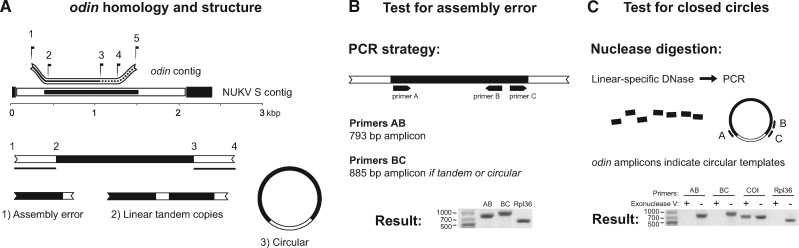
The captured viral nucleoprotein, odin, is encoded in tandem copies in the genome of Chaoborus americanus. (A) The odin-encoding contig aligned to the NUKV S genomic segment. Homologous regions are limited to within the nucleoprotein coding region, shown as a solid black bar in the NUKV S segment. In odin, all sequences are derived from NUKV but only region 2–4 is one contiguous copy of the nucleoprotein gene. At position 3, perfect nucleotide identity with position 1 begins. Possible explanations for odin’s contig structure are (1) assembly error, (2) tandem copies, and (3) circular structure. (B) PCR primers directed inward and outward were used to confirm the accuracy of the repeat structure in our assembly. (C) Exonuclease V does not digest nicked or supercoiled circular DNA but does digest linear single- and double-stranded DNA; incubation with exonuclease five prior to PCR removed templates for odin and a nuclear gene, rpl36, but not a mitochondrial target, COI.
Figure 3.
Figure 3.
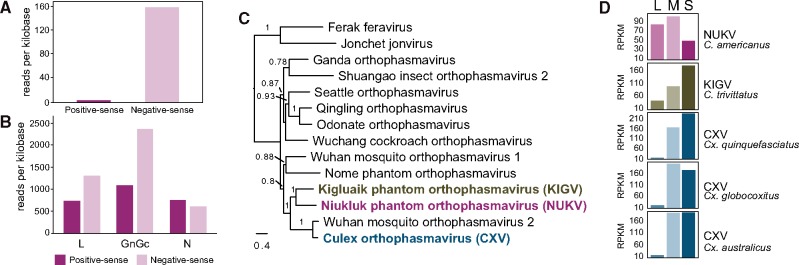
Unusual genome segment abundance of NUKV in Chaoborus americanus. (A) Short-read mapping to the odin sequence shows that the gene is transcribed in antisense. (B) Short-reads mapping to the NUKV L and GnGc transcripts and genomes (negative sense) are more abundant than those of N—genome sequences appear to be disproportionately reduced. (C) A maximum likelihood phylogram of full-length L protein amino acid sequences shows evolutionary relationships between viruses in the family Phasmaviridae. KIGV and CXV are emphasized in bold typeface. Branches are labeled with SH-like approximate likelihood ratio test scores greater than 0.75. (D) Short-read mapping to full genome segment sequences reveals S segments are highly abundant in phasmaviruses related to NUKV (Ballinger et al. 2014; Shi et al. 2017).
Figure 4.
Figure 4.
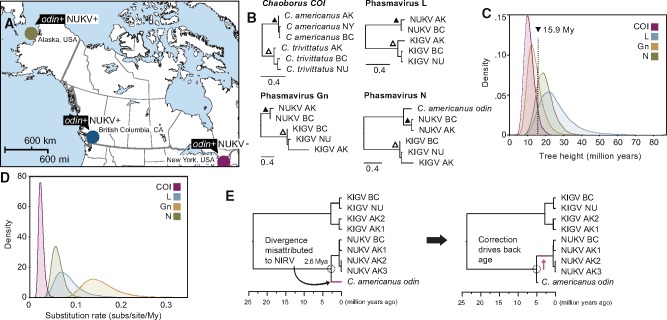
Molecular evolution of Chaoborus phasmaviruses and odin. (A) A map of North America shows collection sites and NUKV infection status of Chaoborus americanus. (B) Maximum likelihood phylograms for host and phasmavirus genes. Nodes that were calibrated to 0.7 and 2.67 My based on COI sequence divergence are marked with filled and hollow triangles, respectively. Note that odin was not present in the N alignment used for virus divergence and rate estimation. Scale bars display nucleotide distance. (C) Marginal density plots of tree heights for each gene tree in panel B following BEAST divergence analysis. Distributions for all loci overlap between 10 and 20 My, indicating virus and host have been diverging for similar timescales. (D) Marginal density plots of substitution rates estimated during BEAST divergence analysis show rates 3–10 times faster than the host mitochondrial gene, indicating a relatively slow long-term evolutionary rate for phasmaviruses. (E) The Bayesian consensus tree following BEAST divergence time analysis of phasmavirus N sequences and the odin gene displays an integration estimate of ∼2.6 My. Because this analysis did not account for the slowed evolutionary rate of odin after integration, the second tree illustrates that the effect of correcting for equal rates is to drive the true odin acquisition date further into the past.

References

    1. Aiewsakun P. Katzourakis A. (2016) ‘Time-Dependent Rate Phenomenon in Viruses’, Journal of Virology, 90: 7184–95. - PMC - PubMed
    1. Altschul S. F. et al. (1990) ‘Basic Local Alignment Search Tool’, Journal of Molecular Biology, 215: 403–10. - PubMed
    1. Aswad A. Katzourakis A. (2012) ‘Paleovirology and Virally Derived Immunity’, Trends in Ecology & Evolution, 27: 627–36. - PubMed
    1. Ballinger M. J. et al. (2014) ‘Discovery and Evolution of Bunyavirids in Arctic Phantom Midges and Ancient Bunyavirid-Like Sequences in Insect Genomes’, Journal of Virology, 88: 8783–94. - PMC - PubMed
    1. Ballinger M. J. et al. (2017) ‘Unexpected Differences in the Population Genetics of Phasmavirids (Bunyavirales) from Subarctic Ponds’, Virus Evolution, 3: vex015. - PMC - PubMed