Review
. 2019 Dec;198(3):326-340.
doi: 10.1111/cei.13349. Epub 2019 Aug 14.

Islet-immune interactions in type 1 diabetes: the nexus of beta cell destruction

Affiliations
Review

Islet-immune interactions in type 1 diabetes: the nexus of beta cell destruction

L Peters et al. Clin Exp Immunol. 2019 Dec.

Abstract

Recent studies in Type 1 Diabetes (T1D) support an emerging model of disease pathogenesis that involves intrinsic β-cell fragility combined with defects in both innate and adaptive immune cell regulation. This combination of defects induces systematic changes leading to organ-level atrophy and dysfunction of both the endocrine and exocrine portions of the pancreas, ultimately culminating in insulin deficiency and β-cell destruction. In this review, we discuss the animal model data and human tissue studies that have informed our current understanding of the cross-talk that occurs between β-cells, the resident stroma, and immune cells that potentiate T1D. Specifically, we will review the cellular and molecular signatures emerging from studies on tissues derived from organ procurement programs, focusing on in situ defects occurring within the T1D islet microenvironment, many of which are not yet detectable by standard peripheral blood biomarkers. In addition to improved access to organ donor tissues, various methodological advances, including immune receptor repertoire sequencing and single-cell molecular profiling, are poised to improve our understanding of antigen-specific autoimmunity during disease development. Collectively, the knowledge gains from these studies at the islet-immune interface are enhancing our understanding of T1D heterogeneity, likely to be an essential component for instructing future efforts to develop targeted interventions to restore immune tolerance and preserve β-cell mass and function.

Keywords: autoimmunity; diabetes; human; inflammation; islet.


Conflict of interest statement

The authors declare that no conflicts of interest exist pertaining to this manuscript.

Figures
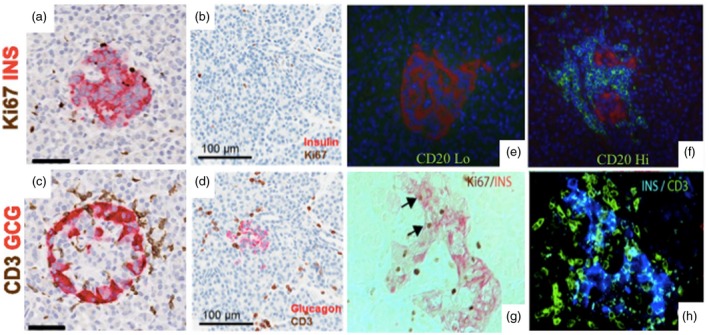
Figure 1
Figure 1
Heterogeneous islet morphology and immune cell infiltration across disease duration and according to age of T1D onset. Representative islets were imaged from serial paraffin sections stained for Ki67 plus insulin (INS) and CD3 plus glucagon (GCG) for a 13‐year‐old donor at T1D onset (nPOD 6228; a & c) and a 6 year old with 3 years T1D duration (nPOD 69; b & d) 47, 48. CD3+ infiltrate is present in both donors (c, d), though insulin containing islets are only observed in the first donor (a, b). Scale bars: a and c, 50μm; b and d, 100μm 47, 48. Pancreas samples from donors with recent‐onset T1D stained for CD20 (green) and glucagon (red), and nuclei (DAPI) exhibit differences in infiltrate composition, which can separate subjects based on hyper‐immune CD20Hi (nPOD 6052; e) and pauci‐immune CD20Lo profiles (nPOD 6070; f) 50. Histology of a 46 year old donor with ≥3 islet AAb shows both Ins+Ki67 β‐cells and Ins+Ki67+ cells replicating β‐cells (g, arrows) within islets that contain CD3+ T cell infiltrate (h) 51. Figures have been reprinted with permission from the American Diabetes Association 47, 48, 50, 51.
Figure 2
Figure 2
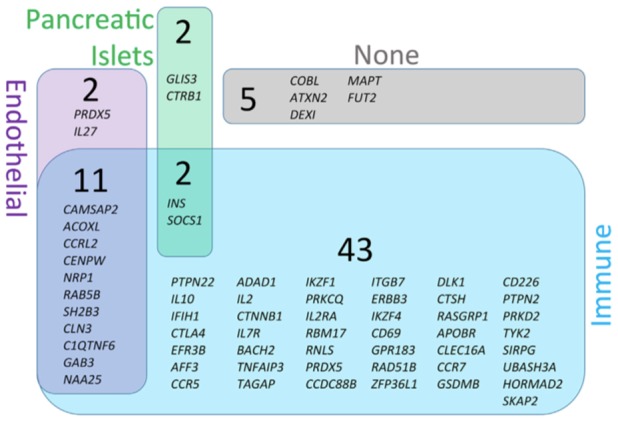
T1D candidate genes are highly expressed in endothelial, islet, and immune tissues. T1D risk loci were collected from ImmunoBase (http://www.immunobase.org), tissue expression was identified per tissue (genevisible.com/search), and a venn diagram was created based on relative abundance of expression in immune (blue), endothelial (purple), and pancreatic islet tissue (green) 61. Figure has been reprinted with permission from Frontiers in Endocrinology 61.
Figure 3
Figure 3
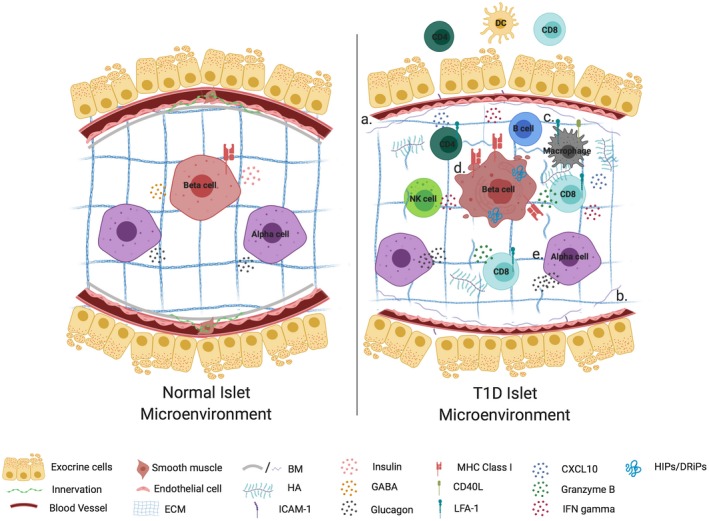
Islet–immune interactions and their impact on β‐cell function in health and T1D. An islet in a normal microenvironment is surrounded by intact extracellular matrix and exocrine tissue, while provided sufficient vascularization and innervation to promote glucose homeostasis and immunoregulation through insulin and glucagon secretion and release of GABA (left). In T1D (a) reduced vessel diameter and innervation impair islet‐cell function, while morphological dysfunction in the form of (b) loss of basement membrane (BM) and extracellular matrix (ECM) integrity as well as hyaluronan (HA) accumulation permit (c) the infiltration and activation of lymphocytes in both the exocrine and intra‐islet tissue. These immune cells make use of chemokine gradients and promote a diabetogenic milieu through the release of pro‐inflammatory mediators. Cumulatively these defects contribute toward β‐cell dysfunction in the form of (d) MHC class I hyperexpression, loss of insulin and GABA expression. They also may serve to magnify endogenous β‐cell stress presented as protein processing defects, which in turn function as neoantigens to exacerbate immune activation, all of which culminate in β‐cell death. In addition to β‐cell defects, α‐cell dysfunction (e) contributes to impaired glucose homeostasis in T1D through hyperglucagonemia or failed counterregulatory responses. Figure created with Biorender.

References

    1. Atkinson M. Type 1 Diabetes. Lancet 2013; 383:69–82. - PMC - PubMed
    1. Lohr M, Kloppel G. Residual insulin positivity and pancreatic atrophy in relation to duration of chronic type 1 (insulin‐dependent) diabetes mellitus and microangiopathy. Diabetologia 1987; 30:757–62. - PubMed
    1. Oram RA, Jones AG, Besser RE et al The majority of patients with long‐duration type 1 diabetes are insulin microsecretors and have functioning beta cells. Diabetologia 2014; 57:187–91. - PMC - PubMed
    1. Achenbach P, Bonifacio E, Koczwara K, Ziegler A‐G. Natural History of Type 1. Diabetes 2005; 54:S25–S31. - PubMed
    1. Pearson JA, Wong FS, Wen L. The importance of the Non Obese Diabetic (NOD) mouse model in autoimmune diabetes. J Autoimmun 2016; 66:76–88. - PMC - PubMed

Publication types