An official website of the United States government
The .gov means it’s official.
Federal government websites often end in .gov or .mil. Before
sharing sensitive information, make sure you’re on a federal
government site.
The site is secure.
The https:// ensures that you are connecting to the
official website and that any information you provide is encrypted
and transmitted securely.
1 National Institute on Drug Abuse, National Institutes of Health, 6001 Executive Blvd, Rm 4269, MSC 9555, Bethesda, MD, 20892, USA. valentinorj@nida.nih.gov.
2 National Institute on Drug Abuse, National Institutes of Health, 6001 Executive Blvd, Rm 4269, MSC 9555, Bethesda, MD, 20892, USA.
1 National Institute on Drug Abuse, National Institutes of Health, 6001 Executive Blvd, Rm 4269, MSC 9555, Bethesda, MD, 20892, USA. valentinorj@nida.nih.gov.
2 National Institute on Drug Abuse, National Institutes of Health, 6001 Executive Blvd, Rm 4269, MSC 9555, Bethesda, MD, 20892, USA.
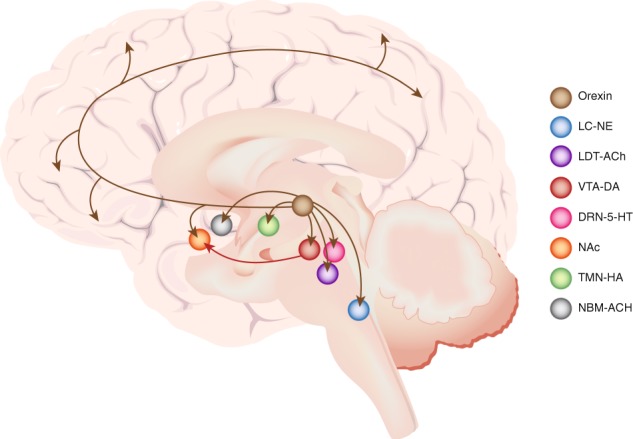
Schematic depicting efferent projections of lateral hypothalamic orexin neurons. The orexin system is…
Fig. 1
Schematic depicting efferent projections of lateral hypothalamic orexin neurons. The orexin system is positioned to influence cognitive function, arousal, and reward. Orexin neurons have broad forebrain projections. Cortical projections may modulate cognitive aspects of substance use behavior such as decision-making. In addition, they project to arousal-related nuclei, including the locus coeruleus (LC), which expresses norepinephrine (NE), dorsal raphe nucleus (DRN), which expresses serotonin (5-HT), lateral dorsotegmental nucleus (LDT), which expresses acetylcholine (ACh), tuberomammillary nucleus (TMN), which expresses histamine (HA), and nucleus basalis of Meynert (NBM), which expresses ACh. These nuclei in turn have diffuse projections throughout the forebrain. Orexin neuronal projections to the ventral tegmental area (VTA) and nucleus accumbens (NAc) are poised to modulate reward and to make rewarding stimuli arousing

Angarita GA, Emadi N, Hodges S, Morgan PT. Sleep abnormalities associated with alcohol, cannabis, cocaine, and opiate use: a comprehensive review. Addict Sci Clin Pr. 2016;11:9. doi: 10.1186/s13722-016-0056-7.
-
DOI
-
PMC
-
PubMed
Dunn KE, Finan PH, Andrew Tompkins D, Strain EC. Frequency and correlates of sleep disturbance in methadone and buprenorphine-maintained patients. Addict Behav. 2018;76:8–14. doi: 10.1016/j.addbeh.2017.07.016.
-
DOI
-
PMC
-
PubMed
Ashare RL, Lerman C, Tyndale RF, Hawk LW, George TP, Cinciripini P, et al. Sleep disturbance during smoking cessation: withdrawal or side effect of treatment? J Smok Cessat. 2017;12:63–70. doi: 10.1017/jsc.2016.11.
-
DOI
-
PMC
-
PubMed
Dolsen MR, Harvey AG. Life-time history of insomnia and hypersomnia symptoms as correlates of alcohol, cocaine and heroin use and relapse among adults seeking substance use treatment in the United States from 1991 to 1994. Addiction. 2017;112:1104–11. doi: 10.1111/add.13772.
-
DOI
-
PMC
-
PubMed
Aston-Jones G, Bloom FE. Activity of norepinephrine-containing locus coeruleus neurons in behaving rats anticipates fluctuations in the sleep-waking cycle. J Neurosci. 1981;1:876–86. doi: 10.1523/JNEUROSCI.01-08-00876.1981.
-
DOI
-
PMC
-
PubMed