Review
. 2019 Jul;14(14):1911-1927.
doi: 10.2217/nnm-2018-0448. Epub 2019 Jul 17.

Envisioning the innovations in nanomedicine to combat visceral leishmaniasis: for future theranostic application

Affiliations
Review

Envisioning the innovations in nanomedicine to combat visceral leishmaniasis: for future theranostic application

Om Prakash Singh et al. Nanomedicine (Lond). 2019 Jul.

Abstract

Visceral leishmaniasis (VL) is a life-threatening parasitic disease affecting impoverished people of the developing world; and much effort has been spent on the early case detection and treatment. However, current diagnostics and treatment options are not sufficient for appropriate surveillance in VL elimination setting. Hence, there is a dire need to develop highly sensitive diagnostics and less toxic effective treatments for proper management of cases and to achieve the sustained disease elimination. Although, promising results have been observed with nanomedicines in leishmaniasis; there are great challenges ahead especially in translating this to clinical setting. This review provides updated progress of nanomedicines in VL, and discussed how these innovations and future directions play vital role in achieving VL elimination.

Keywords: diagnostics; drug resistance; leishmaniasis; nano drug delivery; nanodiagnostics; nanomedicine; nanoparticles; nanotheranostics; treatment; visceral leishmaniasis.


Conflict of interest statement

Financial & competing interests disclosure

This work was supported by Department of Science & Technology (SR/NM/NS-57/2016), New Delhi (under nano-mission), and in part by the Extramural Program of the National Institute of Allergy and Infectious Diseases, National Institutes of Health (NIH) as part of Tropical Medicine Research Centre award (Grant number U19AI074321). SLM is supported by the Department of Science and Technology (DST), Govt. of India (ECR/2016/00097).The funders had no role in design, decision to publish or preparation of the report. The authors have no other relevant affiliations or financial involvement with any organization or entity with a financial interest in or financial conflict with the subject matter or materials discussed in the manuscript apart from those disclosed.

No writing assistance was utilized in the production of this manuscript.

Figures
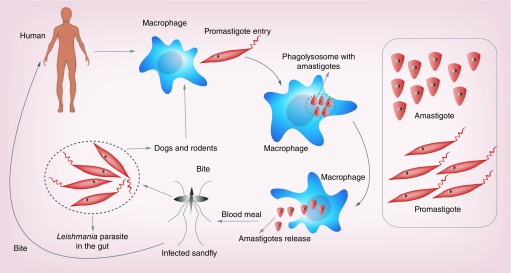
Figure 1.
Figure 1.. Life cycle of the Leishmania parasite inside the host (human), reservoir (dogs & rodents) and vector (sand fly).
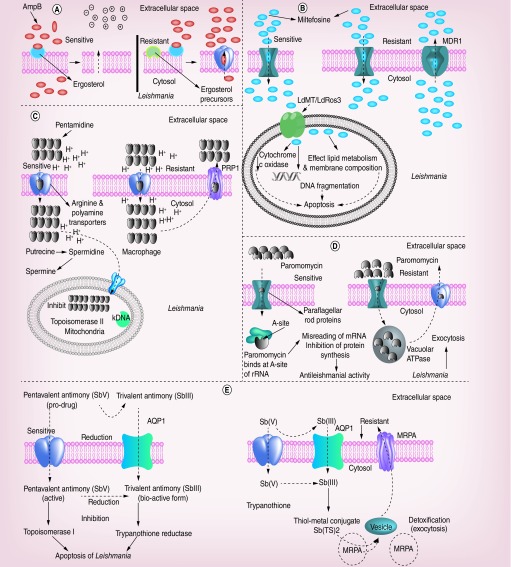
Figure 2.
Figure 2.. The mode of action of conventional drugs against leishmaniasis and the mechanisms of drug resistance in Leishmania species.
(A) Amphotericin B affects both stages of the parasite, that is, promastigote and amastigote, mainly by binding parasite cell membrane ergosterol, which enhances cell permeability and ions influx leading to compromised cellular integrity, which eventually results in death of the parasite. In some species due to the different class of ergosterol precursor Amphotericin B fails to bind with parasites membrane leading to drug resistance. (B) Miltefosine works by inhibiting cytochrome-c oxidase beside affecting the membrane potential of mitochondria leading to the death of the parasite through apoptosis. The presence of MDR1 efflux out miltefosine drug from parasites leading to drug resistance beside poor uptake and inactivation of the drug. (C) The inhibition of active transport system through pentamidine is believed to be the mode of action of this drug, which enters the Leishmania parasite through the arginine and polyamine transporters, and gets accumulated in the mitochondria that eventually inhibits topoisomerase II. The poor accumulation of pentamidine in the mitochondria alongside drug effluxed out of the parasite through PRP1; an ATP Binding Cassette (ABC) transporter, which eventually leads to drug resistance.(D) Paromomycin inhibits protein synthesis by binding to the A-site of ribosomal RNA altering the membrane potential of mitochondria, which eventually leads to misreading of mRNA causing the parasite death. An increased vacuolar ATPase activity, which eventually efflux paromomycin out (exocytosis) of the cell in case of resistant strains. (E) Trivalent (SbIII) and pentavalent (Sbv) form of antimony inhibits trypanothione reductase and topoisomerase I enzymes that eventually leads to apoptosis of the Leishmania parasite. The enhanced levels of trypanothione (TSH) conjugates with the tri (SbIII) and pentavalent (Sbv) antimony compounds forming thiol metal conjugates that may eventually form vesicles and these vesicles are effluxed out via multidrug resistance-associated protein ABC transporter (MRPA) during antimony resistance.
Figure 3.
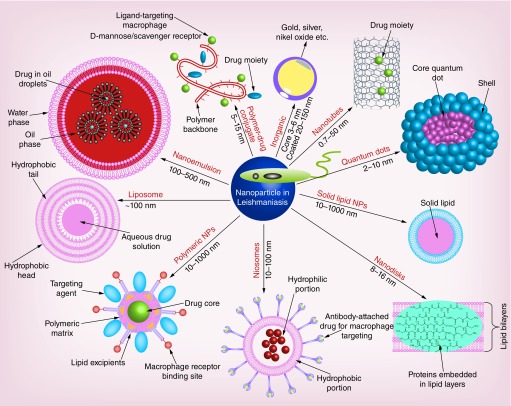
Figure 3.. Nanotheranostics/nanomedicines for leishmaniasis.
Nanoparticle-based diagnostics and drug delivery system that include liposomes, nanoemulsions, niosomes, lipid cochleates, nanodiscs, solid lipid NPs, polymer NPs, polysaccharide polymers, polymeric micelles, quantum dots and inorganic compounds, which have shown encouraging results in detection and delivery against the Leishmania parasite both at the in vitro and in vivo levels.
Figure 4.
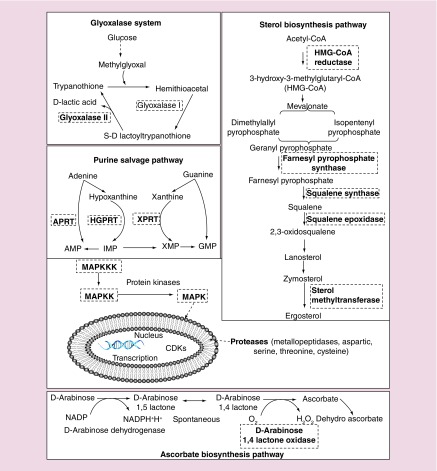
Figure 4.. An overview of several possible drug targets (bold inside the dotted box) in Leishmania species, which can be targeted through nanoformulations.
Glyoxalase system, sterol biosynthesis pathway, ascorbate biosynthesis pathway, purine salvage pathway, protein kinases and proteases are some of the important and possible drug targets that may affect the parasite. APRT: Adenine phosphoribosyltransferase; CDK: Cyclin-dependent kinase; HGPRT: Hypoxanthineguanine phosphoribosyltransferase; MAPKK: MAPK kinase, MAPKKK: MAPK kinase kinase; XPRT: Xanthine phosphoribosyltransferase.

References

    1. Tiwari N, Gedda MR, Tiwari VK, Singh SP, Singh RK. Limitations of current therapeutic options, possible drug targets and scope of natural products in control of leishmaniasis. Mini Rev. Med. Chem. 18(1), 26–41 (2018). - PubMed
    1. Sundar S, Singh OP. Molecular diagnosis of visceral leishmaniasis. Mol. Diagn. Ther. 22(4), 443–457 (2018). - PMC - PubMed
    2. •• Expert opinion on visceral leishmaniasis (VL) diagnostics.

    1. Alvar J, Velez ID, Bern C. et al. Leishmaniasis worldwide and global estimates of its incidence. PLoS ONE 7(5), e35671 (2012). - PMC - PubMed
    2. • Report on global incidence of leishmaniasis.

    1. Sundar S, Chakravarty J. Recent advances in the diagnosis and treatment of kala-azar. Natl Med. J. India 25(2), 85 (2012). - PubMed
    1. WHO. WHO Expert Committee on specifications for pharmaceutical preparations. : World Health Organ Technical Report Series. Geneva, Switzerland: 1–387 (2014). - PubMed

Publication types

MeSH terms

LinkOut - more resources