US Food and Drug Administration Reports of Pregnancy and Pregnancy-Related Adverse Events Associated With Isotretinoin
- PMID: 31314041
- PMCID: PMC6647001
- DOI: 10.1001/jamadermatol.2019.1388
US Food and Drug Administration Reports of Pregnancy and Pregnancy-Related Adverse Events Associated With Isotretinoin
Abstract
Importance: iPLEDGE is a rigorous program initiated in 2006 to reduce fetal exposure to isotretinoin, a disease-modifying medication for acne that carries a risk of teratogenesis. Despite the imposition of iPLEDGE requirements on patients and clinicians, the scope of isotretinoin-related adverse events is unknown.
Objective: To determine the frequency and rate of pregnancy and pregnancy-related adverse events among women taking isotretinoin reported to the US Food and Drug Administration (FDA).
Design, setting, and participants: Pregnancy reports from the FDA Adverse Event Reporting System, a public database of medication adverse event reports filed by prescribers, consumers, and manufacturers, were used to perform a retrospective analysis of pregnancy-related adverse events associated with isotretinoin from January 1, 1997, to December 31, 2017. Each individual reporting any pregnancy-related adverse event signified 1 pregnancy. Abortions, pregnancies that occurred while contraception was used, and fetal defects were counted as subgroups of total pregnancy events.
Main outcomes and measures: The frequency of pregnancy and of pregnancy-related events (abortions, pregnancies that occurred while using contraception, and fetal defects) were stratified by year that the FDA was notified of the event and by age. The rates of adverse events were calculated using isotretinoin prescribing data.
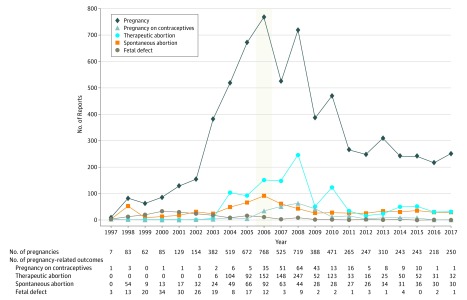
Results: There was a total of 6740 pregnancies among women taking isotretinoin reported to the FDA from 1997 to 2017, peaking in 2006 (768 pregnancies) before settling into a range of 218 to 310 annual reports of pregnancy after 2011. The mean (SD) age of the women was 24.6 (7.1) years. The rate of pregnancy for females of childbearing potential was between 0.33% (388 of 115 925) and 0.65% (768 of 117 784), with a peak in 2006. Although pregnancies, abortions, and fetal defects among women taking isotretinoin have decreased since the initiation of iPLEDGE in 2006, all 3 persist.
Conclusions and relevance: The number of reports of pregnancies, abortions, and fetal defects among women taking isotretinoin has decreased since peaking around the initiation of iPLEDGE in 2006. Explanations for this trend include a broader national decrease in teenage pregnancies and abortion rates, improvements in access to effective long-term and emergency contraception, stringent iPLEDGE requirements, and reporting fatigue over time. Despite the decrease, persistent reporting of pregnancy-related events in the last decade warrants investigation into the efficacy of iPLEDGE and exploration of new approaches for lowering fetal exposure to isotretinoin.
Conflict of interest statement
Figures
Comment in
-
Contradictory iPledge Requirements Hinder Physician Practice and Patient Care.JAMA Dermatol. 2020 Feb 1;156(2):222. doi: 10.1001/jamadermatol.2019.4026. JAMA Dermatol. 2020. PMID: 31895417 No abstract available.
-
Contradictory iPledge Requirements Hinder Physician Practice and Patient Care-Reply.JAMA Dermatol. 2020 Feb 1;156(2):222-223. doi: 10.1001/jamadermatol.2019.3651. JAMA Dermatol. 2020. PMID: 31895435 No abstract available.
References
-
- Slatko GH. Risk evaluation and mitigation strategy (REMS): FDA perspective on what physicians need to know. Am Fam Physician. 2015;92(9):771-772. - PubMed