


Neutrophil-to-lymphocyte ratio evolution is an independent predictor of early progression of second-line nivolumab-treated patients with advanced non-small-cell lung cancers
- PMID: 31314761
- PMCID: PMC6636729
- DOI: 10.1371/journal.pone.0219060
Neutrophil-to-lymphocyte ratio evolution is an independent predictor of early progression of second-line nivolumab-treated patients with advanced non-small-cell lung cancers
Abstract
Introduction: Although second-line immunotherapy obtained better outcomes than chemotherapy for patients with advanced non-small-cell lung cancers (NSCLCs), it is expensive and only a minority of patients seem to benefit, based on early tumor progression post-immunotherapy. Notable host inflammation, characterized by biomarkers (e.g. neutrophil-to-lymphocyte ratio (NLR])), prolongs overall survival (OS) of surgery-, chemotherapy- and immunotherapy-treated patients. To our knowledge, no previous studies used biomarker evolution to analyze the immunotherapy impact on host inflammation. Immunotherapy mainly exerts its activity by lymphocyte reactivation.
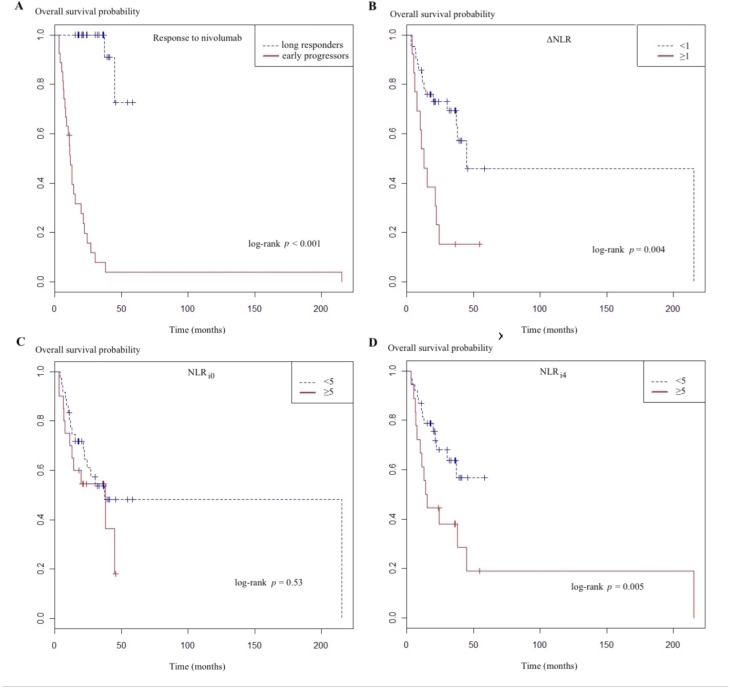
Methods: This retrospective study was conducted on patients, selected by their progression status just before their 4th nivolumab injection, and treated at Bordeaux and Limoges University Hospitals. A comparative group of at least 1-year responders was also selected. Clinical parameters and hematological data just before the 1st (baseline) and 4th nivolumab infusions were collected to calculate the NLR change (ΔNLR) between those two infusions. The combined impact of the different known prognostic factors was also analyzed with multivariable analyses.
Results: Fifty-nine patients were included. The 29 early progressors had significantly more frequent ΔNLR > 1 (p = 0.0007), OR 18.08 [95% CI 2.96-246.24] with progressive disease as best response to prior treatment line (p = 0.0014). ΔNLR < 1 prolonged OS (HR 0.001 [0.0007-0.18], p = 0.001); as did a partial response to prior line of systemic treatment (HR 0.14 [0.03--0.56], p = 0.005).
Conclusion: Based on selected early progressors given second-line immunotherapy for advanced NSCLC, progression as best response to prior treatment and ΔNLR > 1 characterized the early progressors and shortened OS after starting nivolumab. This phenomenon questions nivolumab utility in patients with a major host neutrophil inflammation.
Conflict of interest statement
The authors have read the journal’s policy and the authors of this manuscript have the following competing interests: TE is a paid advisory board member for Bristol-Myers Squibb, Merck-Sharp and Dohme, and Hoffmann-La Roche. RV is a paid expert for Bristol-Myers Squibb and Merck-Sharp and Dohme. He received honoraria from Bristol-Myers Squibb, and Merck-Sharp and Dohme for consultancy and board membership, and received reimbursement for congress registration from Bristol-Myers Squibb and Merck-Sharp and Dohme outside the present study. AV is a paid expert board member for Bristol-Myers Squibb, Merck-Sharp and Dohme, and Hoffmann-La Roche. He received honoraria from Bristol-Myers Squibb, Merck-Sharp and Dohme, Hoffmann-La Roche, Pierre Fabre Oncologie, and AstraZeneca for consultancy and board membership. AV also received reimbursement for congress registration from Pierre Fabre Oncologie and AstraZeneca outside the present study. There are no patents, products in development or marketed products associated with this research to declare. This does not alter our adherence to PLOS ONE policies on sharing data and materials.
Figures
References
-
- Messerschmidt JL, Prendergast GC, Messerschmidt GL. How Cancers Escape Immune Destruction and Mechanisms of Action for the New Significantly Active Immune Therapies: Helping Nonimmunologists Decipher Recent Advances. The Oncologist. 2016. February 1;21[2]:233–43. 10.1634/theoncologist.2015-0282 - DOI - PMC - PubMed
Publication types
MeSH terms
Substances
LinkOut - more resources
Full Text Sources
Medical
