Multicenter Study
. 2019 Jul 17;14(7):e0219385.
doi: 10.1371/journal.pone.0219385. eCollection 2019.

Association of MAOA genetic variants and resilience with psychosocial stress: A longitudinal study of Syrian refugees

Affiliations
Multicenter Study

Association of MAOA genetic variants and resilience with psychosocial stress: A longitudinal study of Syrian refugees

Christopher J Clukay et al. PLoS One. .

Abstract

Early childhood trauma can have profound and lifelong effects on adult mental health and psychosocial wellbeing. Nevertheless, responses to trauma are highly variable. Genetic variants may help explain variation in responses to trauma by identifying alleles that associate with changes in mental health measures. Protective factors, such as resilience, likely also play an important role in responses to trauma. The effects of genetic variants, in combination with protective factors, on psychosocial health are not well understood, particularly in non-Western contexts. In this study, we test the relative influence of genetic variants of monoamine oxidase A (MAOA, a gene proposed to influence the impact of childhood trauma on adult violence and antisocial behavior), levels of resilience, and exposure to traumatic events on psychosocial stress and mental health trajectories over time. We use data from a cohort of 12-18-year-old Syrian refugees who were forcibly displaced to neighboring Jordan (n = 399). DNA samples and survey data on trauma exposure, resilience (CYRM-12), and psychosocial stress were collected at three time points: baseline, ~13 weeks, and ~48 weeks. Using multilevel models, we identified an association of MAOA variant, in males only, with symptom scores of psychosocial stress on the Perceived Stress Scale (PSS) over time (p = 8.1 x 10⁻⁴). We also found that resilience is strongly associated with PSS (p = 7.9 x 10⁻⁹), underscoring the importance of protective factors in influencing levels of psychosocial stress. Furthermore, there was an additive effect wherein the sharpest reductions in perceived psychosocial stress are seen in low-activity MAOA males with low trauma exposure or high resilience levels. Our results highlight the value of studies that integrate genetic and psychosocial factors to better understand complex phenotypes, such as responses to trauma in contexts of high trauma exposure.


Conflict of interest statement

The authors have declared that no competing interests exist.

Figures
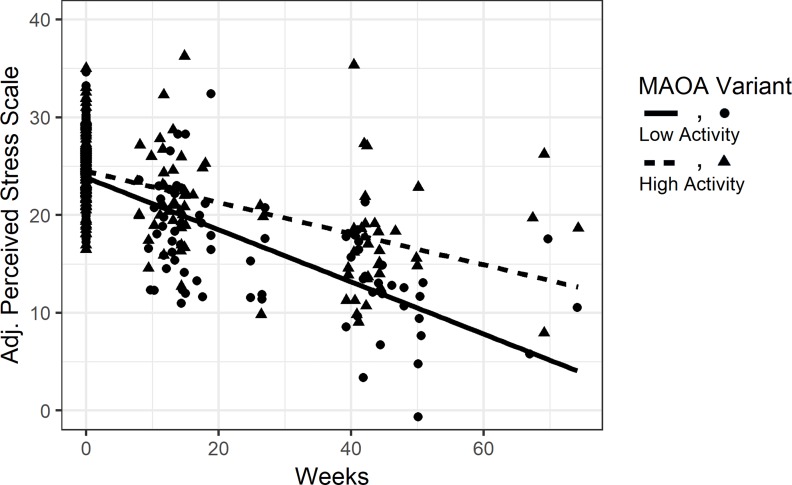
Fig 1
Fig 1. Partial effect plot of perceived psychosocial stress over time by MAOA variant in males.
MAOA-L males had sharper reductions in levels of perceived stress (PSS) over time relative to MAOA-H males. Perceived stress symptom scores were adjusted for the effects of all covariates in the model and plotted (Y axis) for each participant at all time points (X axis).
Fig 2
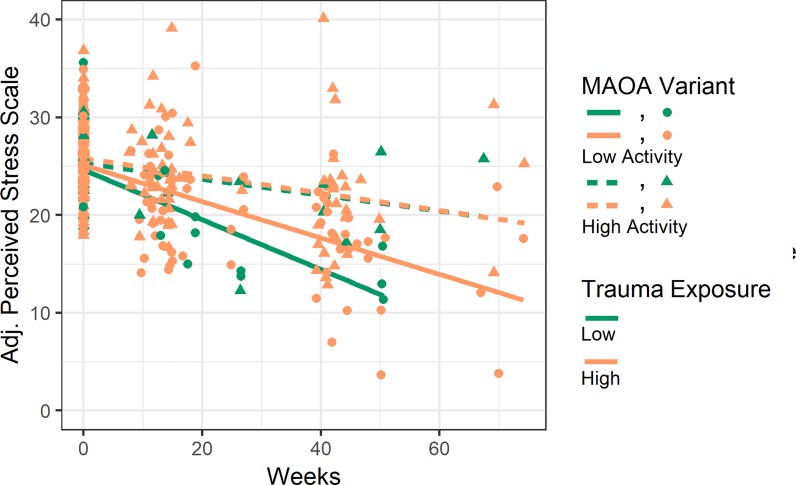
Fig 2. Partial effect plot of perceived psychosocial stress over time by MAOA variant and trauma exposure in males.
MAOA-L males had sharper reductions in levels of perceived stress (PSS) over time relative to MAOA-H males. Perceived stress symptom scores were adjusted for the effects of all covariates in the model and plotted (Y axis) for each participant at all time points (X axis). Partial effect plot lines were fitted for the four categories of MAOA variant (Low-activity/High-activity) and trauma exposure (Low/High). Trauma exposure was dichotomized around <4 vs ≥4 events in the figure for visualization purposes, but was treated as a continuous measure in multilevel models.
Fig 3
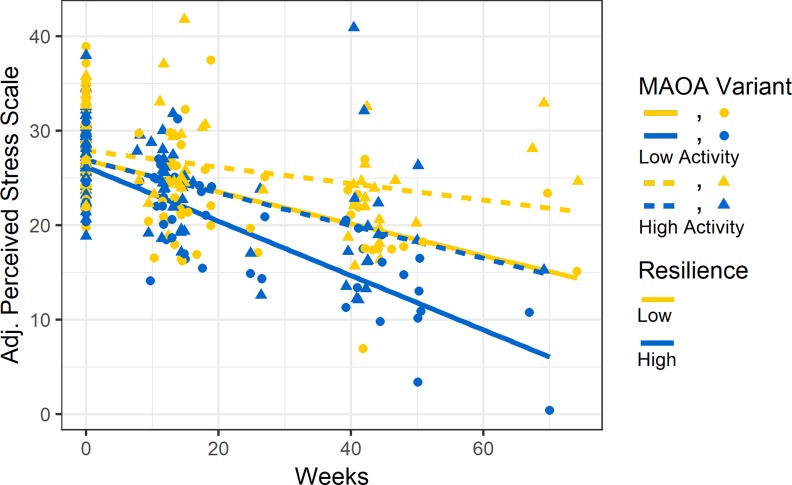
Fig 3. Partial effect plot of perceived psychosocial stress over time by MAOA variant and resilience levels in males.
MAOA-L males with high resilience had the sharpest reduction in levels of perceived stress (PSS) over time. Perceived stress symptom scores were adjusted for the effects of all covariates in the model and plotted (Y axis) for each participant at all time points (X axis). Partial effect plot lines were fitted for the four categories of MAOA variant (Low-activity/High-activity) and Resilience (Low/High). Resilience was dichotomized around the median (median = 51) in the figure purely for visualization purposes but was treated as a continuous measure in multilevel models.

References

    1. Edwards VJ, Holden GW, Felitti VJ, Anda RF. Relationship between multiple forms of childhood maltreatment and adult mental health in community respondents: Results from the adverse childhood experiences study. American Journal of Psychiatry. 2018;160(8):1453–60. - PubMed
    1. Keyes KM, Eaton NR, Krueger RF, McLaughlin KA, Wall MM, Grant BF, et al. Childhood maltreatment and the structure of common psychiatric disorders. British Journal of Psychiatry. 2012;200(2):107–15. Epub 2018/01/02. 10.1192/bjp.bp.111.093062 - DOI - PMC - PubMed
    1. Scott KM, McLaughlin KA, Smith DAR, Ellis PM. Childhood maltreatment and DSM-IV adult mental disorders: Comparison of prospective and retrospective findings. British Journal of Psychiatry. 2012;200(6):469–75. 10.1192/bjp.bp.111.103267 - DOI - PMC - PubMed
    1. Clemens V, Huber-Lang M, Plener PL, Brähler E, Brown RC, Fegert JM. Association of child maltreatment subtypes and long-term physical health in a German representative sample. European Journal of Psychotraumatology. 2018;9(1):1510278 10.1080/20008198.2018.1510278 PMC6136347. - DOI - PMC - PubMed
    1. Thompson MP, Kingree JB, Lamis D. Associations of adverse childhood experiences and suicidal behaviors in adulthood in a U.S. nationally representative sample. Child: Care, Health and Development. 2018;2018(0):1–8. 10.1111/cch.12617 - DOI - PubMed

Publication types

Substances