Review
. 2019 Jul 16;20(14):3494.
doi: 10.3390/ijms20143494.

Platelets Are Critical Key Players in Sepsis

Affiliations
Review

Platelets Are Critical Key Players in Sepsis

Fanny Vardon-Bounes et al. Int J Mol Sci. .

Abstract

Host defense against infection is based on two crucial mechanisms: the inflammatory response and the activation of coagulation. Platelets are involved in both hemostasis and immune response. These mechanisms work together in a complex and synchronous manner making the contribution of platelets of major importance in sepsis. This is a summary of the pathophysiology of sepsis-induced thrombocytopenia, microvascular consequences, platelet-endothelial cells and platelet-pathogens interactions. The critical role of platelets during sepsis and the therapeutic implications are also reviewed.

Keywords: endothelium; immunothrombosis; platelets; sepsis.


Conflict of interest statement

The authors declare no conflict of interest.

Figures
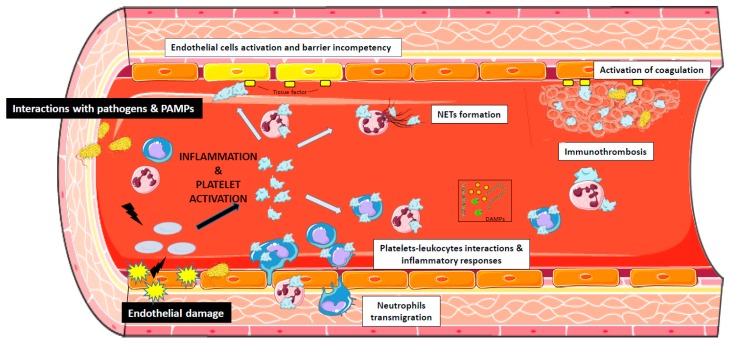
Figure 1
Figure 1
Selected examples of pro-inflammatory role of platelets during sepsis: endothelial damage and interactions with pathogens such as pathogens-associated molecular patterns (PAMPs) activate platelets that interact with endothelium, with monocytes and neutrophils, promoting neutrophils extra-cellular Trap (NET)osis, neutrophils transmigration, activation of coagulation through tissue factor release and immunothrombosis. DAMPs: damage associated molecular patterns (microvesicles, free DNA, protease).

References

    1. Singer M., Deutschman C.S., Seymour C.W., Shankar-Hari M., Annane D., Bauer M., Bellomo R., Bernard G.R., Chiche J.-D., Coopersmith C.M., et al. The Third International Consensus Definitions for Sepsis and Septic Shock (Sepsis-3) JAMA. 2016;315:801–810. doi: 10.1001/jama.2016.0287. - DOI - PMC - PubMed
    1. Iskander K.N., Osuchowski M.F., Stearns-Kurosawa D.J., Kurosawa S., Stepien D., Valentine C., Remick D.G. Sepsis: Multiple abnormalities, heterogeneous responses, and evolving understanding. Physiol. Rev. 2013;93:1247–1288. doi: 10.1152/physrev.00037.2012. - DOI - PMC - PubMed
    1. Pfeiler S., Massberg S., Engelmann B. Biological basis and pathological relevance of microvascular thrombosis. Thromb. Res. 2014;133:S35–S37. doi: 10.1016/j.thromres.2014.03.016. - DOI - PubMed
    1. Engelmann B., Massberg S. Thrombosis as an intravascular effector of innate immunity. Nat. Rev. Immunol. 2012;13:34–45. doi: 10.1038/nri3345. - DOI - PubMed
    1. Hui P., Cook DJ M.E., Lim W., Fraser G.A., Arnold D.M. The Frequency and Clinical Significance of Thrombocytopenia Complicating Critical Illness. Chest. 2011;139:271–278. doi: 10.1378/chest.10-2243. - DOI - PubMed

Substances
