


C9orf72 intermediate expansions of 24-30 repeats are associated with ALS
- PMID: 31315673
- PMCID: PMC6637621
- DOI: 10.1186/s40478-019-0724-4
C9orf72 intermediate expansions of 24-30 repeats are associated with ALS
Abstract
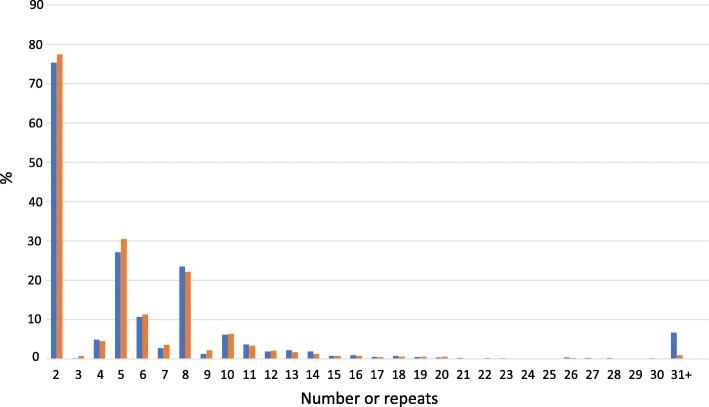
The expansion of a hexanucleotide repeat GGGGCC in C9orf72 is the most common known cause of ALS accounting for ~ 40% familial cases and ~ 7% sporadic cases in the European population. In most people, the repeat length is 2, but in people with ALS, hundreds to thousands of repeats may be observed. A small proportion of people have an intermediate expansion, of the order of 20 to 30 repeats in size, and it remains unknown whether intermediate expansions confer risk of ALS in the same way that massive expansions do. We investigated the association of this intermediate repeat with ALS by performing a meta-analysis of four previously published studies and a new British/Alzheimer's Disease Neuroimaging Initiative dataset of 1295 cases and 613 controls. The final dataset comprised 5071 cases and 3747 controls. Our meta-analysis showed association between ALS and intermediate C9orf72 repeats of 24 to 30 repeats in size (random-effects model OR = 4.2, 95% CI = 1.23-14.35, p-value = 0.02). Furthermore, we showed a different frequency of the repeat between the northern and southern European populations (Fisher's exact test p-value = 5 × 10- 3). Our findings provide evidence for the association between intermediate repeats and ALS (p-value = 2 × 10- 4) with direct relevance for research and clinical practice by showing that an expansion of 24 or more repeats should be considered pathogenic.
Keywords: ALS; C9orf72; Genetics; Next-generation sequencing; Repeat expansion; Whole-genome sequencing.
Conflict of interest statement
The authors declare that they have no competing interests.
Figures
References
-
- DeJesus-Hernandez M, Mackenzie IR, Boeve BF, Boxer AL, Baker M, Rutherford NJ, Nicholson AM, Finch NA, Flynn H, Adamson J. Expanded GGGGCC hexanucleotide repeat in noncoding region of C9ORF72 causes chromosome 9p-linked FTD and ALS. Neuron. 2011;72:245–256. doi: 10.1016/j.neuron.2011.09.011. - DOI - PMC - PubMed
Publication types
MeSH terms
Substances
Grants and funding
- MC_PC_17214/MRC_/Medical Research Council/United Kingdom
- MR/L501529/1/MRC_/Medical Research Council/United Kingdom
- SHAW/APR18/864-791/MNDA_/Motor Neurone Disease Association/United Kingdom
- U01 AG024904/AG/NIA NIH HHS/United States
- G0600974/MRC_/Medical Research Council/United Kingdom
- AL-CHALABI/APR15/844-791/MNDA_/Motor Neurone Disease Association/United Kingdom
- G0500289/MRC_/Medical Research Council/United Kingdom
- G0900688/MRC_/Medical Research Council/United Kingdom
- ES/L008238/1/Economic and Social Research Council/International
- MC_PC_17115/MRC_/Medical Research Council/United Kingdom
- SHAW/NOV14/985-797/MNDA_/Motor Neurone Disease Association/United Kingdom
- G0900635/MRC_/Medical Research Council/United Kingdom
- ALCHALABI-DOBSON/APR14/829-791/MNDA_/Motor Neurone Disease Association/United Kingdom
- MR/L021803/1/MRC_/Medical Research Council/United Kingdom
- G1100695/MRC_/Medical Research Council/United Kingdom
- WT_/Wellcome Trust/United Kingdom
- MR/R024804/1/MRC_/Medical Research Council/United Kingdom
- 633413/Horizon 2020 Framework Programme/International
LinkOut - more resources
Full Text Sources
Medical
Miscellaneous
