Review
. 2019 Jun 28:10:1464.
doi: 10.3389/fimmu.2019.01464. eCollection 2019.

Exosome-Induced Regulation in Inflammatory Bowel Disease

Affiliations
Review

Exosome-Induced Regulation in Inflammatory Bowel Disease

Huiting Zhang et al. Front Immunol. .

Abstract

An exosome (30-150 nm size) is a cell-derived vesicle. Exosome-induced regulation in inflammatory bowel disease (IBD) is becoming increasingly popular due to their potential functions of exosomal pathways. Exosomes, which are involved in the regulation of IBD, can be released from various cell types, or found in many physiological fluids, and plants. The specific functions of exosomes in IBD primarily depend on the internal functional components, including RNAs, proteins, and other substances. However, exosome-induced transport mechanisms involving cell-cell communications or cell-environment interactions are also very important. Recent studies have revealed that exosome crosstalk mechanisms may influence major IBD-related pathways, such as immune responses, barrier functions, and intestinal flora. This review highlights the advancements in the biology of exosome secretions and their regulation in IBD. The functional roles of exosomal components, including nucleic acids, proteins, and some other components, are the main focus of this review. More animal and clinical research is needed to study the functions of exosomes on IBD. Designing new drug dosage form using exosome-like-structure may provide new insights into IBD treatment. This review suggests a potential significance for exosomes in IBD diagnosis and treatment.

Keywords: exosome; immunology; inflammation; inflammatory bowel disease; intestine.


Figures
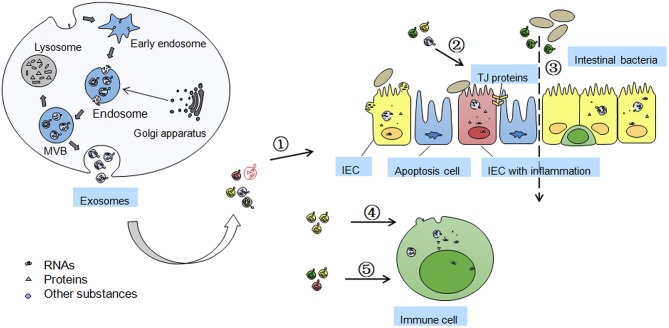
Figure 1
Figure 1
Formation of exosomes and functions/mechanisms of exosomes in IBD. Exosomes are formed by inward budding of cell membrane and are released through fusion of multi-vesicular body (MVB) with the membrane. MVB can be degraded by fusion with lysosome and losing the activity of components inside. Golgi apparatus in origin cells can accumulate some exosomal proteins before their secreting into the exosomes. The effects of secreted exosomes on IBD includes ➀ the exosomes isolated from serum and saliva may be novel biomarkers of IBD; ➁ Exosomes from colon cancer cells, IECs, and platelets, can maintain TJ barrier function; ➂ Exosomes from DCs may influence intestinal microbiota profile in heat shock proteins dependent manner; ➃ Intestinal epithelial cell (IEC)-derived exosomes can fuse with the membrane of dendritic cells (DCs) to induce immune tolerance; ➄ Exosomes from colitis serum or treated DCs regulates immune cell proliferation through MAPK, NF-κB, and other inflammation related signaling pathways.

References

    1. Annahazi A, Molnar T. Optimal endpoint of therapy in IBD: an update on factors determining a successful drug withdrawal. Gastroenterol Res Pract. (2015) 2015:832395. 10.1155/2015/832395 - DOI - PMC - PubMed
    1. Höie O, Wolters F, Riis L, Aamodt G, Solberg C, Bernklev T, et al. Ulcerative colitis: patient characteristics may predict 10-yr disease recurrence in a European-wide population-based cohort. Am J Gastroenterol. (2007) 102:1692–701. 10.1111/j.1572-0241.2007.01265.x - DOI - PubMed
    1. Bernstein CN, Burchill C, Targownik LE, Singh H, Roos LL. Events within the first year of life, but not the neonatal period, affect risk for later development of inflammatory bowel diseases. Gastroenterology. (2019) 156:2190–7. 10.1053/j.gastro.2019.02.004 - DOI - PMC - PubMed
    1. Kaplan GG. The global burden of IBD: from 2015 to 2025. Nat Rev Gastroenterol Hepatol. (2015) 12:720–7. 10.1038/nrgastro.2015.150 - DOI - PubMed
    1. Ponder A, Long MD. A clinical review of recent findings in the epidemiology of inflammatory bowel disease. Clin Epidemiol. (2013) 5:237–47. 10.2147/clep.s33961 - DOI - PMC - PubMed

Publication types

LinkOut - more resources
