. 2019 Jun 27:6:38.
doi: 10.3389/fsurg.2019.00038. eCollection 2019.

Augmented Reality in Orthopedics: Current State and Future Directions

Affiliations

Augmented Reality in Orthopedics: Current State and Future Directions

Dimitrios Chytas et al. Front Surg. .

Abstract

Augmented reality (AR) comprises special hardware and software, which is used in order to offer computer-processed imaging data to the surgeon in real time, so that real-life objects are combined with computer-generated images. AR technology has recently gained increasing interest in the surgical practice. Preclinical research has provided substantial evidence that AR might be a useful tool for intra-operative guidance and decision-making. AR has been applied to a wide spectrum of orthopedic procedures, such as tumor resection, fracture fixation, arthroscopy, and component's alignment in total joint arthroplasty. The present study aimed to summarize the current state of the application of AR in orthopedics, in preclinical and clinical level, providing future directions and perspectives concerning potential further benefits from this technology.

Keywords: augmented reality; current status; future; orthopedics; perspective.


Figures
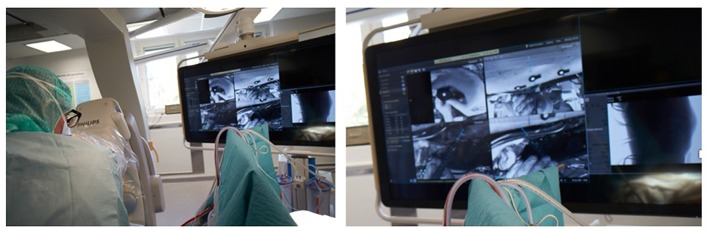
Figure 1
Figure 1
(Left) Picture showing a surgeon from Karolinska hospital in Stockholm using a hybrid operating room with an augmented reality system integrated with the robotic C-arm. (Right) The surgeon is seeing at the screen the video streaming of his surgery with a blue line indicating the direction of his instruments that he is navigating into the pedicle (Photo courtesy of Dr. Rami Nachabe).
Figure 2
Figure 2
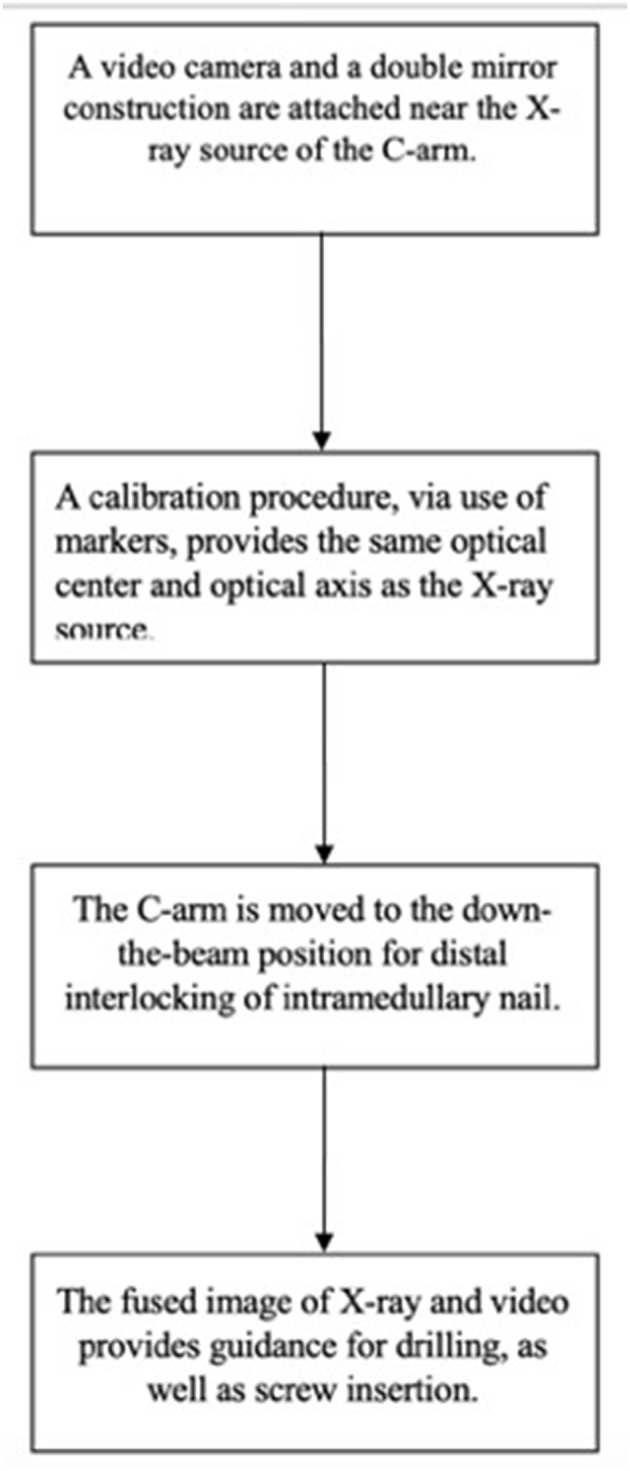
A diagram which depicts the use of a camera-augmented C-arm for distal interlocking of an intramedullary nail.
Figure 3
Figure 3
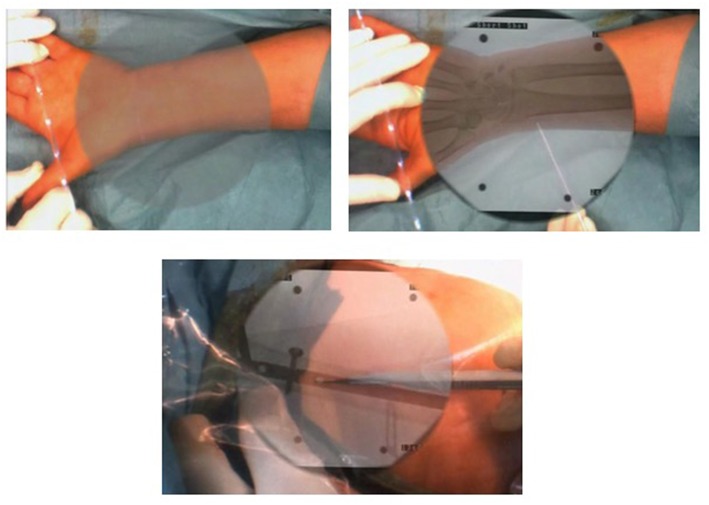
Examples of intraoperative image in wrist surgery and distal locking intramedullary nailing (Photos courtesy of Prof. Pascal Fallavolitta, Ottava, Canada).

References

    1. Ewurum CH, Guo Y, Pagnha S, Feng Z, Luo X. Surgical navigation in orthopedics: workflow and system review. Adv Exp Med Biol. (2018) 1093:47–63. 10.1007/978-981-13-1396-7_4 - DOI - PubMed
    1. Hernandez D, Garimella R, Eltorai AEM, Daniels AH. Computer-assisted orthopaedic surgery. Orthop Surg. (2017) 9:152–8. 10.1111/os.12323 - DOI - PMC - PubMed
    1. Wang G, Li L, Xing S, Ding H. Intelligent HMI in orthopedic navigation. Adv Exp Med Biol. (2018) 1093:207–24. 10.1007/978-981-13-1396-7_17 - DOI - PubMed
    1. Azuma RT. A survey of augmented reality. Presence. (1997) 6:355–85. 10.1162/pres.1997.6.4.355 - DOI
    1. Vávra P, Roman J, Zonča P, Ihnát P, Němec M, Kumar J, et al. Recent development of augmented reality in surgery: a review. J Healthc Eng. (2017) 2017:4574172. 10.1155/2017/4574172 - DOI - PMC - PubMed