


Patient factors affecting decision regret in the medical treatment process of gynecological diseases
- PMID: 31317289
- PMCID: PMC6637166
- DOI: 10.1186/s41687-019-0137-y
Patient factors affecting decision regret in the medical treatment process of gynecological diseases
Abstract
Background: To ensure that patients continue treatment, it is essential that the patient is satisfied with the decision-making process of the treatment. One way to address this is to assess the healthcare quality using the concept of regret, which can measure "Being convinced in decision-making." This study aimed to elucidate patient factors affecting regret using the Japanese version of the Decision Regret Scale (DRS).
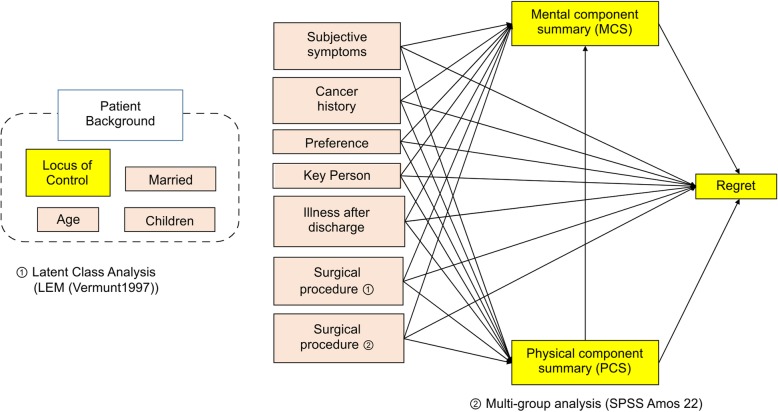
Methods: A questionnaire survey was conducted with 197 patients with uterine myoma, ovarian tumors, and endometriosis. We then examined the relationship between the Japanese DRS, the Japanese SF-8 as a health-related quality of life (QOL), and patient factors using latent class analysis and path analysis through a multi-group comparison.
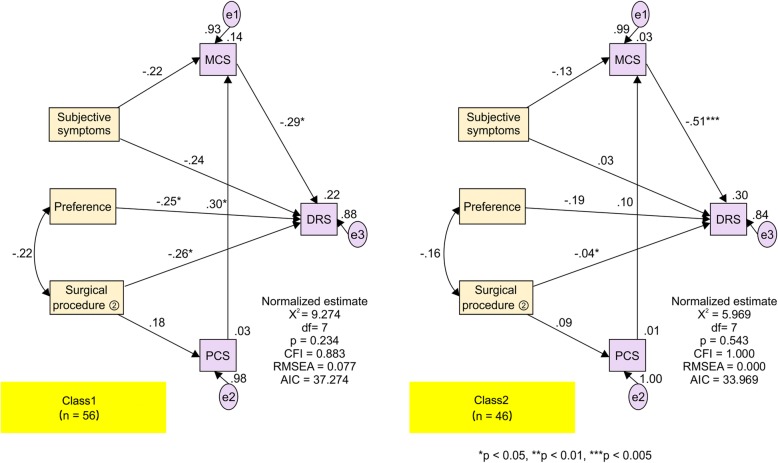
Results: The final sample comprised 102 patients. Patients were classified into the following two groups based on the latent class analysis of patient characteristics: many patients who were married and had children and a few patients who were unmarried and had no children (class 1), and many patients who were unmarried and had no children and a few patients who were married and had children (class 2). The path analysis through the group comparison of the two classes revealed that subjective symptoms, preferences, and surgical procedure (laparotomy or laparoscopic surgery) had a direct impact on regret. The magnitude of the influence factors for Class 1 and Class 2 Regret was different. The indirect effect on regret was through mental component summary.
Conclusion: Our results suggest that it is necessary to present treatment methods with consideration to patients' backgrounds and to obtain informed consent from patients.
Keywords: Decision-making; Japanese version of the decision regret scale; Latent class analysis; Multi-group analysis; Patient factors; Patient preference.
Conflict of interest statement
The authors declare that they have no competing interests.
Figures

References
-
- Bell DE. Regret in decision making under uncertainty. Operations Research. 1982;30(5):961–981. doi: 10.1287/opre.30.5.961. - DOI
-
- Kahneman D, Miller DT. Norm theory: Comparing reality to its alternatives. Psychological Review. 1986;93(2):136–153. doi: 10.1037/0033-295X.93.2.136. - DOI
-
- Zeelenberg M, Beattie J, van der Pligt J, de Vries NK. Consequences of regret aversion: Effects of expected feedback on risky decision making. Organizational Behavior and Human Decision Processes. 1996;65(2):148–158. doi: 10.1006/obhd.1996.0013. - DOI
-
- Zeelenberg M, van Dijk WW, van der Pligt J, Manstead ASR, van Empelen P, Reinderman D. Emotional reactions to the outcomes of decisions: The role of counterfactual thought in the experience of regret and disappointment. Organizational Behavior and Human Decision Processes. 1998;75(2):117–141. doi: 10.1006/obhd.1998.2784. - DOI - PubMed
LinkOut - more resources
Full Text Sources
