


Self-management of stress urinary incontinence: effectiveness of two treatment programmes focused on pelvic floor muscle training, one booklet and one Internet-based
- PMID: 31317808
- PMCID: PMC6713123
- DOI: 10.1080/02813432.2019.1640921
Self-management of stress urinary incontinence: effectiveness of two treatment programmes focused on pelvic floor muscle training, one booklet and one Internet-based
Abstract
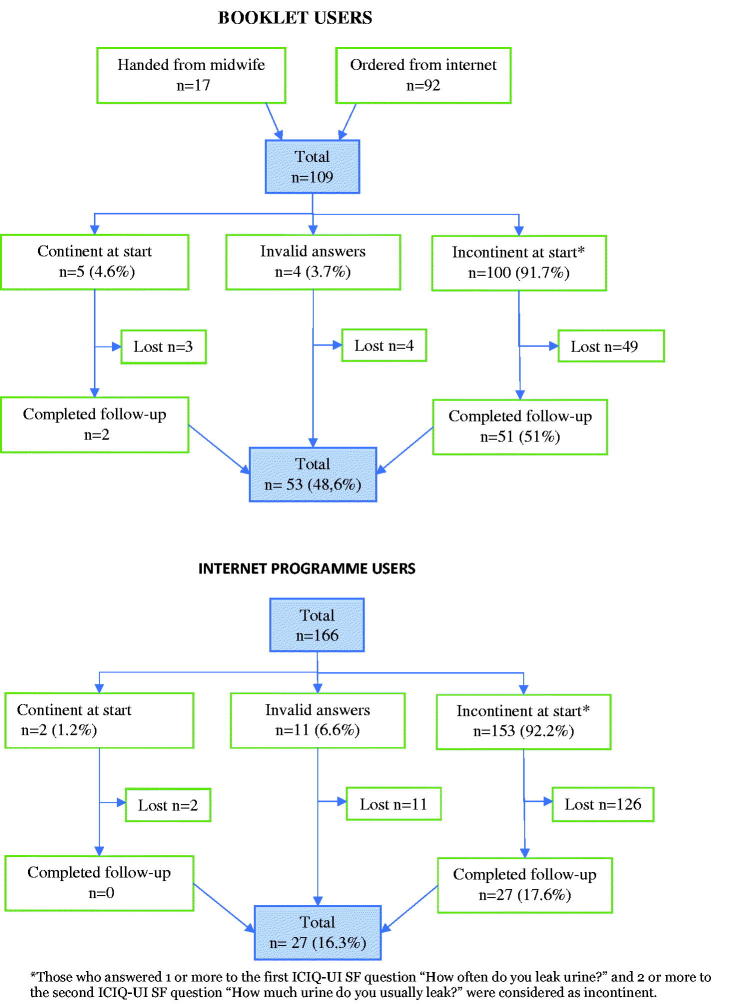
Objectives: In a previous study, self-management of stress urinary incontinence (SUI), via an Internet-based programme or a booklet improved symptoms and quality of life. We wanted to evaluate the effectiveness of these programmes when implemented for free use, as well as to characterize the users. Design: Pragmatic prospective cohort study. Setting and subjects: Information about the Internet programme and the booklet was provided at www.tät.nu and by nurse midwives. Both programmes included a three-month pelvic floor muscle training (PFMT) programme. Questionnaires were used at the start and after three months. Main outcome measures: Characteristics of the participants regarding age and education. Reductions in symptom severity was measured using the validated ICIQ-UI SF. Results: 109 women using the booklet, and 166 women using the Internet-based programme responded to the pre-treatment questionnaire. Of these, 53 (48.6%) in the booklet group and 27 (16.3%) in the Internet group responded to the follow-up. The mean age of booklet users was higher, 59.4 years vs. 54.5 years (p = .005). The proportion of women with post-secondary education was high, 59% in the booklet group and 67% in the Internet group. The mean reduction in the symptom score was 2.6 points (SD 3.4) in the booklet group, and 3.4 (SD 2.9) in the Internet group. These reductions were significant within both groups, with no difference between the groups, and in the same order of magnitude as in the previous randomised controlled study. Conclusion: Two self-management programmes for SUI, one provided as a booklet and one as an Internet-based programme, also rendered clinically relevant improvements when made freely available. KEY POINTS Female stress urinary incontinence can be treated using self-management programmes focused on pelvic floor muscle training. This study evaluates the effect of two different programmes, one provided as a booklet and one Internet-based, when made freely available to the public. •Both programmes rendered clinically relevant improvements, in the same order of magnitude as in the previous randomised controlled study. •Self-management of stress urinary incontinence should be recommended to women that request treatment.
Keywords: Stress; e-health; self-management; urinary incontinence.
Figures
References
-
- Milsom I, Altman D, Cartwright R, et al. . Epidemiology of Urinary Incontinence (UI) and other Lower Urinary Tract Symptoms (LUTS), Pelvic Organ Prolapse (POP) and Anal Incontinence (AI). In: Abrams P, Cardozo L, Wagg A, Wein A, editors. Incontinence, 6th edition. Bristol UK: ICI-ICS. International Continence Society; 2017. p. 17–35. ISBN: 978–0956960733
-
- Haylen BT, de Ridder D, Freeman RM, et al. . An International Urogynecological Association (IUGA)/International Continence Society (ICS) joint report on the terminology for female pelvic floor dysfunction. Neurourol Urodyn. 2010;29:4–20. - PubMed
-
- Rortveit G, Daltveit AK, Hannestad YS, et al. . Urinary incontinence after vaginal delivery or cesarean section. N Engl J Med. 2003;348:900–907. - PubMed
-
- Siddiqui NY, Levin PJ, Phadtare A, et al. . Perceptions about female urinary incontinence: a systematic review. Int Urogynecol J. 2014;25:863–871. - PubMed
-
- Hannestad Y, Rortveit G, Hunskaar S. Help-seeking and associated factors in female urinary incontinence. The Norwegian EPINCONT study. Scand J Primary Health Care. 2002;20:102–107. - PubMed
MeSH terms
LinkOut - more resources
Full Text Sources
Medical
Research Materials
