


Refractory depression - mechanisms and efficacy of radically open dialectical behaviour therapy (RefraMED): findings of a randomised trial on benefits and harms
- PMID: 31317843
- PMCID: PMC7282863
- DOI: 10.1192/bjp.2019.53
Refractory depression - mechanisms and efficacy of radically open dialectical behaviour therapy (RefraMED): findings of a randomised trial on benefits and harms
Abstract
Background: Individuals with depression often do not respond to medication or psychotherapy. Radically open dialectical behaviour therapy (RO DBT) is a new treatment targeting overcontrolled personality, common in refractory depression.
Aims: To compare RO DBT plus treatment as usual (TAU) for refractory depression with TAU alone (trial registration: ISRCTN 85784627).
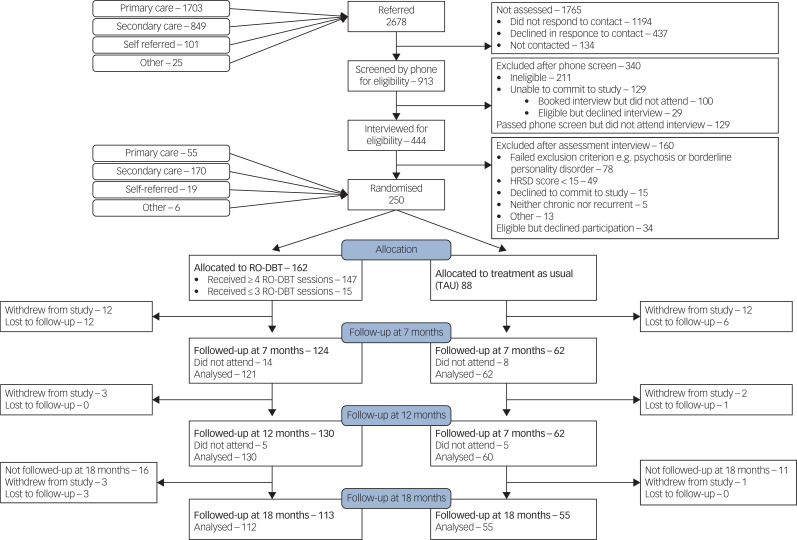
Method: RO DBT comprised 29 therapy sessions and 27 skills classes over 6 months. Our completed randomised trial evaluated RO DBT for refractory depression over 18 months in three British secondary care centres. Of 250 adult participants, we randomised 162 (65%) to RO DBT. The primary outcome was the Hamilton Rating Scale for Depression (HRSD), assessed masked and analysed by treatment allocated.
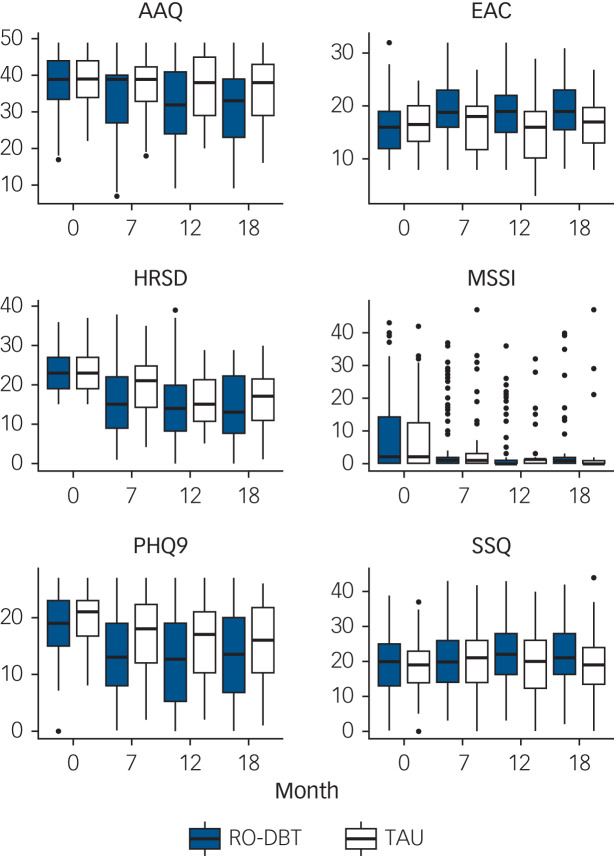
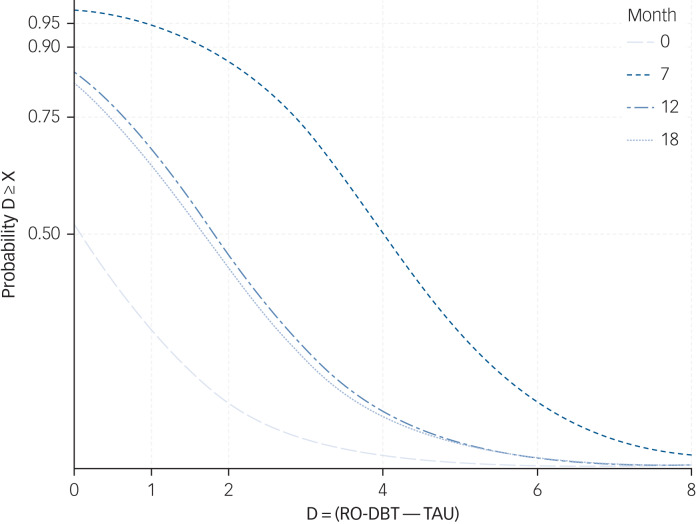
Results: After 7 months, immediately following therapy, RO DBT had significantly reduced depressive symptoms by 5.40 points on the HRSD relative to TAU (95% CI 0.94-9.85). After 12 months (primary end-point), the difference of 2.15 points on the HRSD in favour of RO DBT was not significant (95% CI -2.28 to 6.59); nor was that of 1.69 points on the HRSD at 18 months (95% CI -2.84 to 6.22). Throughout RO DBT participants reported significantly better psychological flexibility and emotional coping than controls. However, they reported eight possible serious adverse reactions compared with none in the control group.
Conclusions: The RO DBT group reported significantly lower HRSD scores than the control group after 7 months, but not thereafter. The imbalance in serious adverse reactions was probably because of the controls' limited opportunities to report these.
Keywords: Treatment-resistant depression; chronic depression; personality disorder; radically open dialectical behaviour therapy (RO DBT); randomised controlled trial.
Conflict of interest statement
Figures
References
-
- Crown WH, Finkelstein S, Berndt ER, Ling D, Poret AW, Rush AJ, et al. The impact of treatment-resistant depression on health care utilization and costs. J Clin Psychiatry 2002; 63: 963–71. - PubMed
-
- Berlim MT, Turecki G. What is the meaning of treatment resistant/refractory major depression (TRD)? A systematic review of current randomized trials. Eur Neuropsychopharmacol 2007; 17: 696–707. - PubMed
-
- Fava M, Farabaugh AH, Sickinger AH, Wright E, Alpert JE, Sonawalla S, et al. Personality disorders and depression. Psychol Med 2002; 32: 1049–57. - PubMed
-
- Riso LP, du Toit PL, Blandino JA, Penna S, Dacey S, Dui JS, et al. Cognitive aspects of chronic depression. J Abnorm Psychol 2003; 112: 72–80. - PubMed
Publication types
MeSH terms
Grants and funding
LinkOut - more resources
Full Text Sources
Research Materials
