. 2019 Jul 18;14(7):e0218034.
doi: 10.1371/journal.pone.0218034. eCollection 2019.

Infection free "resisters" among household contacts of adult pulmonary tuberculosis

Affiliations

Infection free "resisters" among household contacts of adult pulmonary tuberculosis

Vidya Mave et al. PLoS One. .

Abstract

Despite substantial exposure to infectious pulmonary tuberculosis (TB) cases, some household contacts (HHC) never acquire latent TB infection (LTBI). Characterizing these "resisters" can inform who to study immunologically for the development of TB vaccines. We enrolled HHCs of culture-confirmed adult pulmonary TB in India who underwent LTBI testing using tuberculin skin test (TST) and QuantiFERON TB Gold Test-in-tube (QFT-GIT) at baseline and, if negative by both (<5mm TST and <0.35IU/mL QFT-GIT), underwent follow-up testing at 4-6 and/or 12 months. We defined persons with persistently negative LTBI tests at both baseline and followup as pLTBI- and resisters as those who had a high exposure to TB using a published score and remained pLTBI-. We calculated the proportion of resisters overall and resisters with complete absence of response to LTBI tests (0mm TST and/or QFT-GIT <0.01 IU/ml). Using random effects Poisson regression, we assessed factors associated with pLTBI-. Of 799 HHCs in 355 households, 67 (8%) were pLTBI- at 12 months; 52 (6.5%) pLTBI- in 39 households were resisters. Complete absence of response to LTBI tests was found in 27 (53%) resisters. No epidemiological characteristics were associated with the pLTBI- phenotype. LTBI free resisters among HHC exist but are uncommon and are without distinguishing epidemiologic characteristics. Assessing the genetic and immunologic features of such resister individuals is likely to elucidate mechanisms of protective immunity to TB.


Conflict of interest statement

All authors declare that they have no competing interests to declare.

Figures
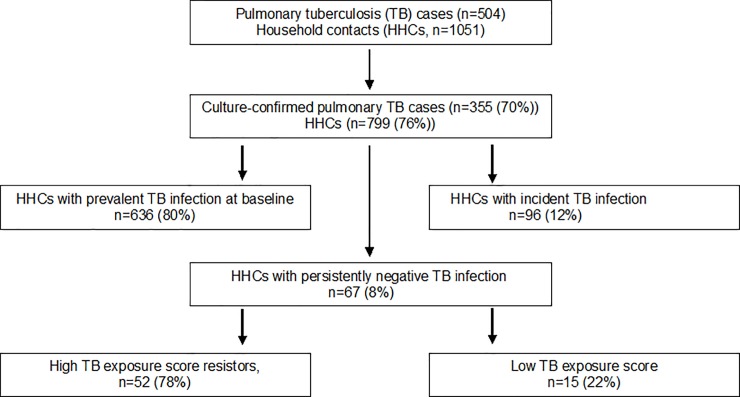
Fig 1
Fig 1. Household contacts with persistently negative latent Mycobacterial tuberculosis infection at 12 months (pLTBI-) despite exposure to adults with culture-confirmed pulmonary tuberculosis).
Consort diagram showing the number of household contacts with persistently negative latent Mycobacterial tuberculosis infection in 12 months (pLTBI-) despite exposure to adults with culture-confirmed pulmonary tuberculosis.
Fig 2
Fig 2
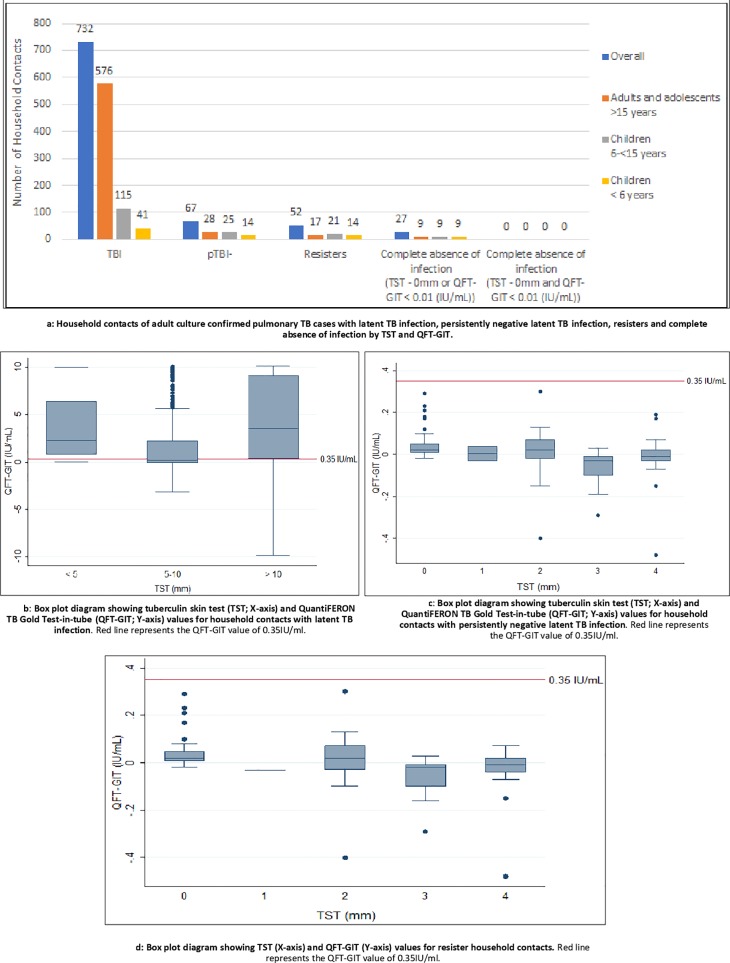
Figa: Household contacts of adult culture confirmed pulmonary TB cases with latent TB infection, persistently negative latent TB infection, resisters and complete absence of infection by TST and QFT-GIT. Fig 2B: Box plot diagram showing tuberculin skin test (TST; X-axis) and QuantiFERON TB Gold Test-in-tube (QFT-GIT; Y-axis) values for household contacts with latent TB infection. Fig 2C: Box plot diagram showing tuberculin skin test (TST; X-axis) and QuantiFERON TB Gold Test-in-tube (QFT-GIT; Y-axis) values for household contacts with persistently negative latent TB infection. Fig 2D: Box plot diagram showing TST (X-axis) and QFT-GIT (Y-axis) values for resister household contacts. Red line in Fig 2B, Fig 2C and Fig 2D represents the QFT-GIT value of 0.35IU/ml.
Fig 3
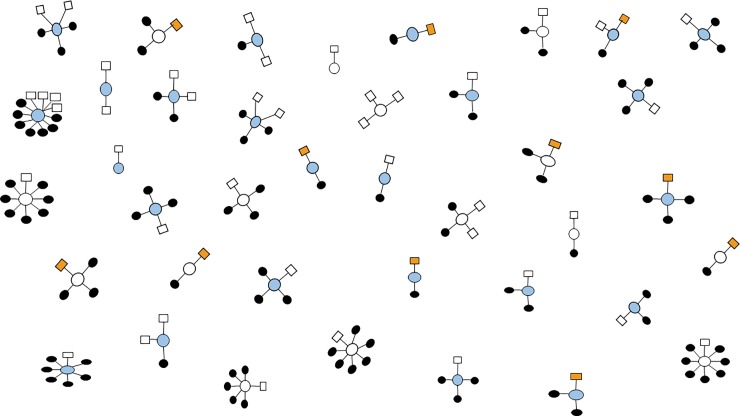
Fig 3. Clustering of household contacts with persistently negative latent Mycobacterial tuberculosis infection (pLTBI-) in 39 households stratified by high and low tuberculosis (TB) case exposure is the Fig 3 title.
Square represents pLTBI- household contacts with high exposure, referred to as resisters. Orange shaded squares represents household members who share the bed with culture-confirmed pulmonary TB case. Shaded circles represent the household contacts with positive LTBI and blue are smear positive TB cases.

References

    1. World Health Organization. World Health Organization. Global tuberculosis report 2016 [Internet]. Available: http://www.who.int/tb/publications/global_report/en/
    1. Houben RMGJ Dodd PJ. The Global Burden of Latent Tuberculosis Infection: A Re-estimation Using Mathematical Modelling. PLoS Med. 2016;13: e1002152 10.1371/journal.pmed.1002152 - DOI - PMC - PubMed
    1. Lienhardt C, Glaziou P, Uplekar M, Lönnroth K, Getahun H, Raviglione M. Global tuberculosis control: lessons learnt and future prospects. Nat Rev Microbiol. 2012;10: 407–16. 10.1038/nrmicro2797 - DOI - PubMed
    1. Hermans S, Horsburgh CR, Wood R. A Century of Tuberculosis Epidemiology in the Northern and Southern Hemisphere: The Differential Impact of Control Interventions. PLoS One. 2015;10: e0135179 10.1371/journal.pone.0135179 - DOI - PMC - PubMed
    1. Fox GJ, Barry SE, Britton WJ, Marks GB. Contact investigation for tuberculosis: a systematic review and meta-analysis. Eur Respir J. 2013;41: 140–156. 10.1183/09031936.00070812 - DOI - PMC - PubMed

Publication types