


A Metallomic Approach to Assess Associations of Serum Metal Levels With Gallstones and Gallbladder Cancer
- PMID: 31318976
- PMCID: PMC6980252
- DOI: 10.1002/hep.30861
A Metallomic Approach to Assess Associations of Serum Metal Levels With Gallstones and Gallbladder Cancer
Abstract
Background and aims: Exposure to metals may promote the risk for cancers. We evaluated the associations of a broad spectrum of metals with gallbladder cancer (GBC) and gallstones.
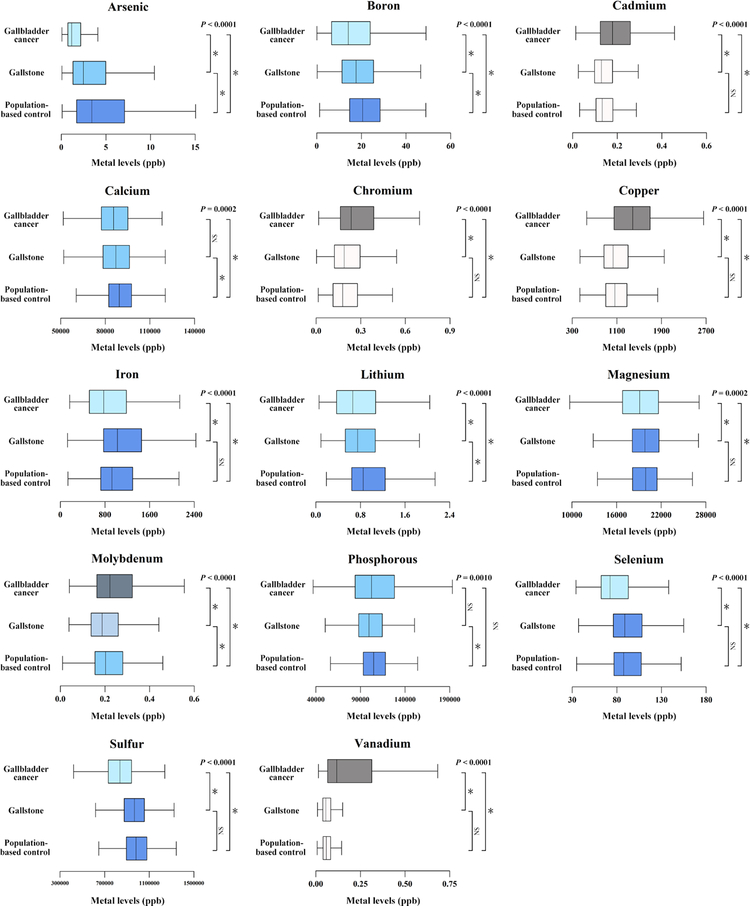
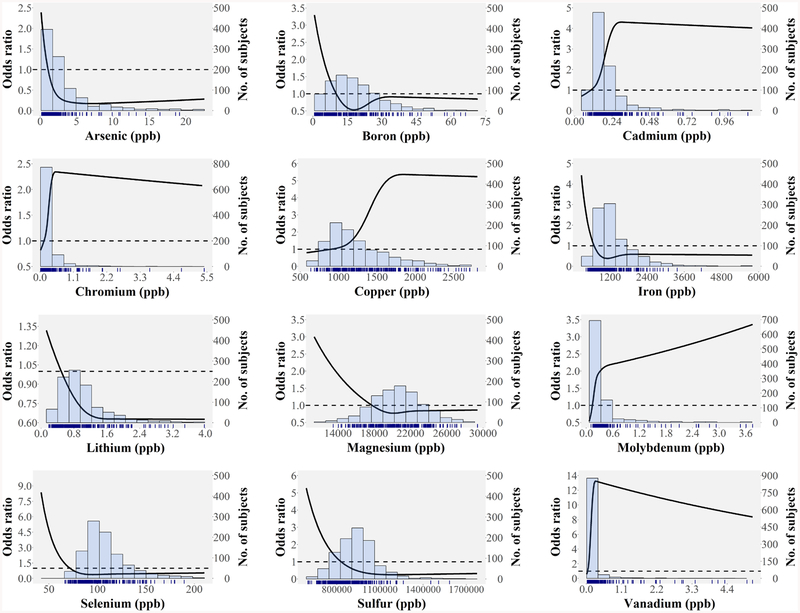
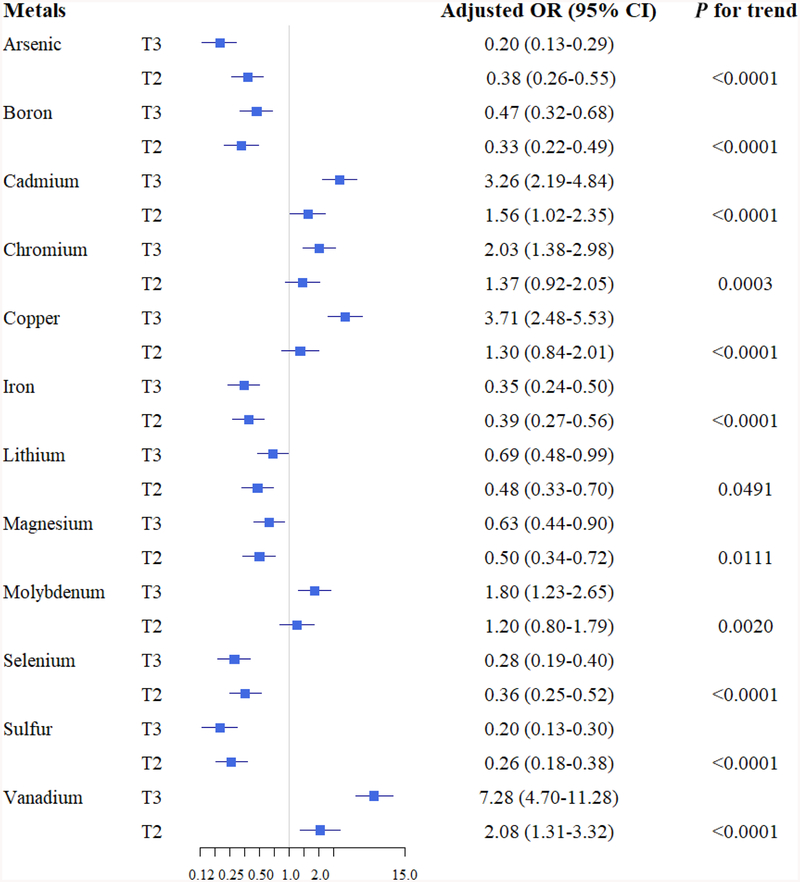
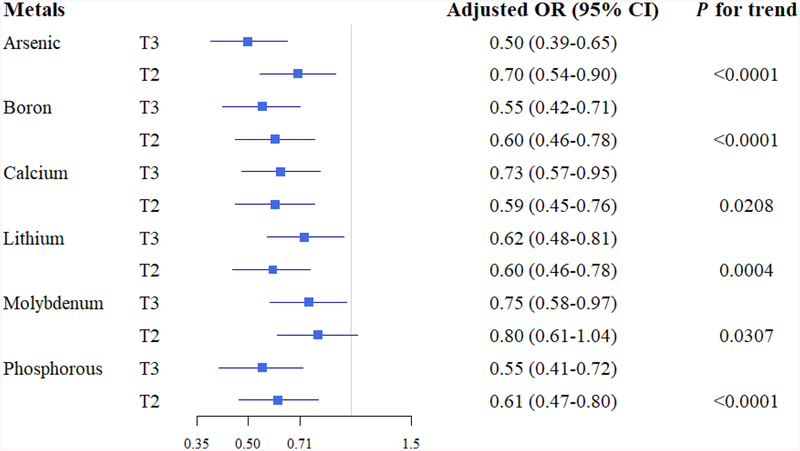
Approach and results: A total of 259 patients with GBC, 701 patients with gallstones, and 851 population-based controls were enrolled in Shanghai, China. A metallome panel was used to simultaneously detect 18 metals in serum through inductively coupled plasma-mass spectrometry. Logistic regression models were used to estimate crude or adjusted odds ratios (ORadj ) with 95% confidence intervals (CIs) for the association between metal levels and gallbladder disease. Among the 18 metals tested, 12 were significantly associated with GBC and six with gallstones (Pcorrected < 0.002). Boron, lithium, molybdenum, and arsenic levels were associated with GBC compared to gallstones as well as with gallstones compared to population-based controls. Elevated levels of cadmium, chromium, copper, molybdenum, and vanadium were positively associated with GBC versus gallstones; and the ORadj for the highest tertile (T3) compared to the lowest tertile (T1) ranged from 1.80 to 7.28, with evidence of dose-response trends (P < 0.05). Arsenic, boron, iron, lithium, magnesium, selenium, and sulfur were inversely associated with GBC, with the T3 versus T1 ORadj ranging from 0.20 to 0.69. Arsenic, boron, calcium, lithium, molybdenum, and phosphorus were negatively associated with gallstones, with the T3 versus T1 ORadj ranging from 0.50 to 0.75 (P < 0.05).
Conclusions: Metals were associated with both GBC and gallstones, providing cross-sectional evidence of association across the natural history of disease. Longitudinal studies are needed to evaluate the temporality of metal exposure and gallbladder diseases and to investigate the mechanisms of disease pathogenesis.
© 2019 by the American Association for the Study of Liver Diseases.
Conflict of interest statement
Figures
Comment in
-
Arsenic and gallbladder cancer risk: Mendelian randomization analysis of European prospective data.Int J Cancer. 2020 May 1;146(9):2648-2650. doi: 10.1002/ijc.32837. Epub 2019 Dec 31. Int J Cancer. 2020. PMID: 31846055 No abstract available.
References
-
- Koshiol J, Ferreccio C, Devesa S, et al. Biliary tract cancers In: Thun M, Linet M, Cerhan J, Haiman C, Schottenfeld, eds. Cancer Epidemiology and Prevention. New York: Oxford University Press, 2017.
-
- Wistuba II, Gazdar AF. Gallbladder cancer: lessons from a rare tumour. Nat Rev Cancer 2004;4:695–706. - PubMed
Publication types
MeSH terms
Substances
Grants and funding
LinkOut - more resources
Full Text Sources
Medical
