Review
. 2019 Jul 17;20(14):3506.
doi: 10.3390/ijms20143506.

Endoplasmic Reticulum Export of GPI-Anchored Proteins

Affiliations
Review

Endoplasmic Reticulum Export of GPI-Anchored Proteins

Sergio Lopez et al. Int J Mol Sci. .

Abstract

Protein export from the endoplasmic reticulum (ER) is an essential process in all eukaryotes driven by the cytosolic coat complex COPII, which forms vesicles at ER exit sites for transport of correctly assembled secretory cargo to the Golgi apparatus. The COPII machinery must adapt to the existing wide variety of different types of cargo proteins and to different cellular needs for cargo secretion. The study of the ER export of glycosylphosphatidylinositol (GPI)-anchored proteins (GPI-APs), a special glycolipid-linked class of cell surface proteins, is contributing to address these key issues. Due to their special biophysical properties, GPI-APs use a specialized COPII machinery to be exported from the ER and their processing and maturation has been recently shown to actively regulate COPII function. In this review, we discuss the regulatory mechanisms by which GPI-APs are assembled and selectively exported from the ER.

Keywords: COPII coat; GPI-anchored protein; endoplasmic reticulum; p24 complex.


Conflict of interest statement

The authors declare no conflict of interest.

Figures
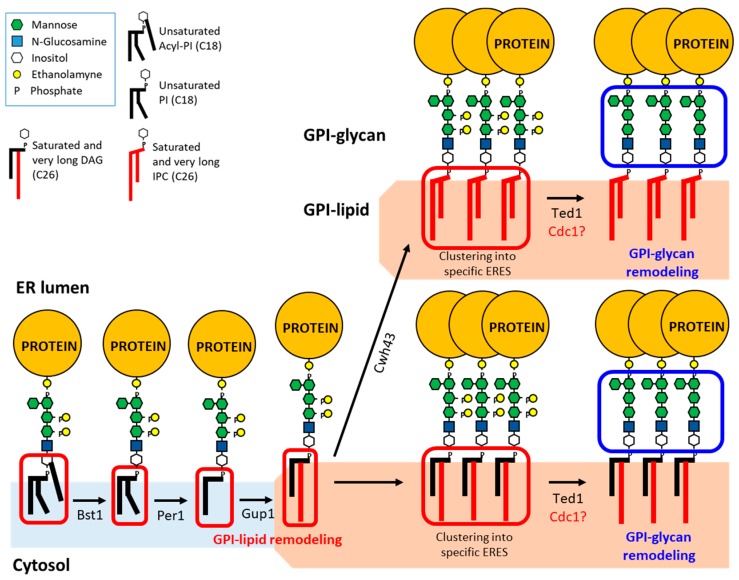
Figure 1
Figure 1
GPI anchor remodeling in yeast. The GPI anchor is synthesized in the ER and transferred to proteins by the GPI–transamidase complex. After protein attachment, the GPI-lipid undergoes a structural remodeling that in yeast occurs almost entirely at the ER. First, the inositol is deacylated by Bst1. Next, the fatty acid is remodeled by Per1 and Gup1, which remove the unsaturated fatty acid at the sn2 position and replace it with a very long-chain and highly saturated fatty acid (C26:0), respectively. In most cases, the C26:0 diacylglycerol (DAG) generated is swapped with a very long-chain saturated (C26:0) ceramide yielding (C26:0) inositolphosphoceramide (IPC). In both C26:0 DAG and C26:0 IPC-based GPI-APs, the side-chain EtNP on Man2 is removed by Ted1. This reaction is critical for subsequent recruitment of the ER export machinery. The side-chain EtNP on Man1 is also removed from some fractions of GPI anchors by Cdc1 [14] but it remains unclear which GPI-APs undergo this process. After GPI-APs are transported to the Golgi, additional Man is transferred to the Man4 (not shown). Once arrived at the cell surface, GPI-APs with C26:0 DAG as GPI-lipid are cleaved and cross-linked to α1,6-glucans on the cell wall, whereas GPI-APs with C26:0 IPC remain at the plasma membrane (not shown).
Figure 2
Figure 2
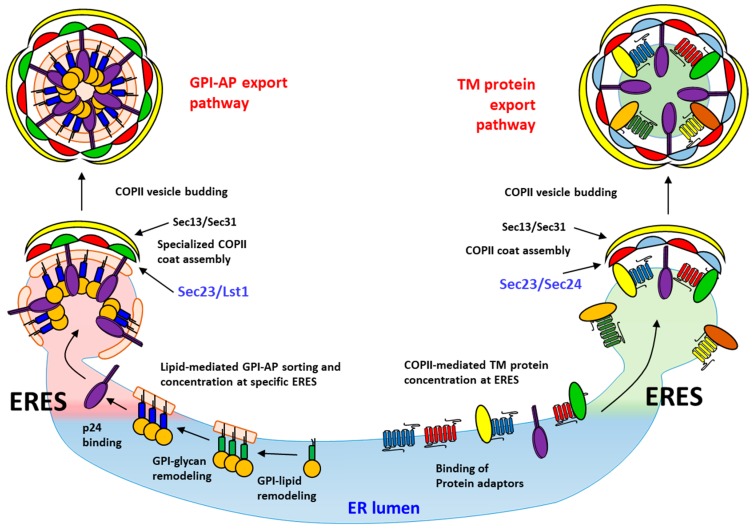
GPI-AP sorting upon ER exit in yeast. A schematic model for the sorting mechanism of GPI-APs at the ER in yeast cells is shown. Upon GPI-lipid remodeling with very long and saturated fatty acid chains in the ER, GPI-APs are segregated from transmembrane secretory proteins and concentrated into specific ERES. Next, the GPI-glycan remodeling allows the subsequent recruitment of the p24 complex, which functions as a specific lectin by recognizing the remodeled GPI-glycan moiety of GPI-APs, to these ERES. This binding stimulates p24 receptor to recruit a specialized COPII coat that leads to the formation of COPII vesicles enriched in GPI-APs. By contrast, transmembrane secretory cargo proteins are concentrated into distinct ERES than GPI-APs by a COPII-dependent mechanism that involves their capture by the COPII coat directly or indirectly through cargo receptors. The p24 complex has been also shown to follow the non-GPI-AP pathway to the Golgi. Part of images from Motifolio drawing toolkits (http://www.motifolio.com/) were utilized in the figure preparation.
Figure 3
Figure 3
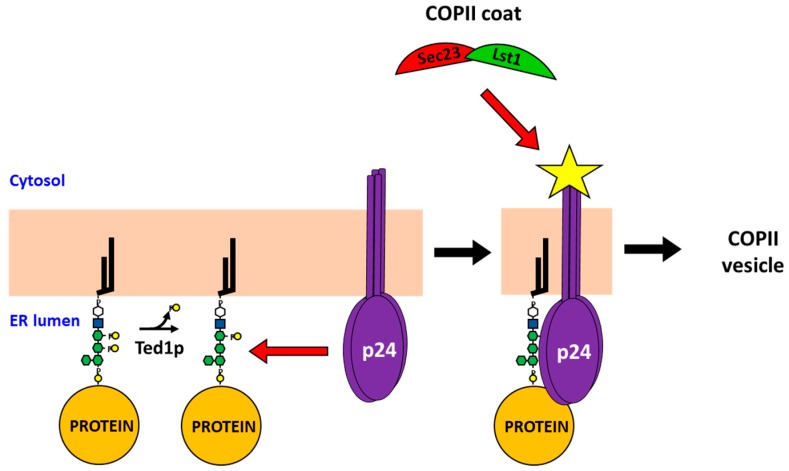
GPI-anchor remodeling actively regulates the recruitment of a specialized COPII coat in yeast. The removal of the EtNP on the second mannose of the GPI-glycan by Ted1 triggers the interaction of the GPI-AP cargo with the p24 receptor. This binding modifies the conformation of the p24 receptor (represented by the yellow star) which prompts the selective recruitment of the of the specific inner COPII coat Lst1/Sec23 and subsequent COPII vesicle budding. This mechanism implies that formation of these specialized COPII vesicles is fine-tuned by the amount of GPI-APs that are ready to be exported from the ER.
Figure 4
Figure 4
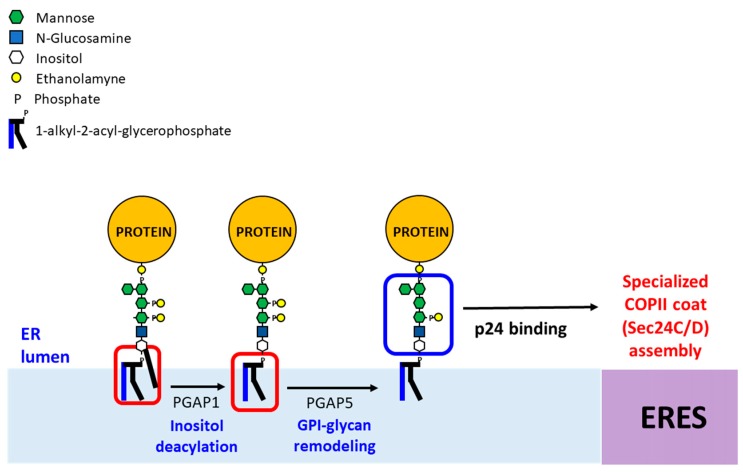
GPI anchor remodeling in mammalian cells at the ER. Newly synthesized GPI-APs undergo two remodeling reactions, inositol-deacylation by PGAP1 and removal of the EtNP side chain from Man2 by PGAP5 in the ER. Next, the p24 complex recognizes the remodeled GPI-APs and connect them with the COPII coat for ER export in COPII vesicles. In the Golgi, GPI-APs undergo fatty acid remodeling by PGAP3 and PGAP2, generating mature GPI-APs (not shown).

References

    1. Bonifacino J.S., Glick B.S. The mechanisms of vesicle budding and fusion. Cell. 2004;116:153–166. doi: 10.1016/S0092-8674(03)01079-1. - DOI - PubMed
    1. Peotter J., Kasberg W., Pustova I., Audhya A. COPII-mediated trafficking at the ER/ERGIC interface. Traffic. 2019;20:491–503. doi: 10.1111/tra.12654. - DOI - PMC - PubMed
    1. Gomez-Navarro N., Miller E. Protein sorting at the ER-Golgi interface. J. Cell Biol. 2016;215:769–778. doi: 10.1083/jcb.201610031. - DOI - PMC - PubMed
    1. Maeda M., Kurokawa K., Katada T., Nakano A., Saito K. COPII proteins exhibit distinct subdomains within each ER exit site for executing their functions. Sci. Rep. 2019;9:7346. doi: 10.1038/s41598-019-43813-3. - DOI - PMC - PubMed
    1. D’Arcangelo J.G., Stahmer K.R., Miller E.A. Vesicle-mediated export from the ER: COPII coat function and regulation. Biochim. Biophys. Acta. 2013;1833:2464–2472. doi: 10.1016/j.bbamcr.2013.02.003. - DOI - PMC - PubMed

Substances