Bicortical Screw Purchase at Upper Instrumented Vertebra (UIV) Can Cause UIV Fracture After Adult Spinal Deformity Surgery: A Finite Element Analysis Study
- PMID: 31319661
- PMCID: PMC7338956
- DOI: 10.14245/ns.1938100.050
Bicortical Screw Purchase at Upper Instrumented Vertebra (UIV) Can Cause UIV Fracture After Adult Spinal Deformity Surgery: A Finite Element Analysis Study
Abstract
Objective: To examine the biomechanical stress distribution at the upper instrumented vertebra (UIV) according to unicortical- and bicortical purchase model by finite element analysis (FEA).
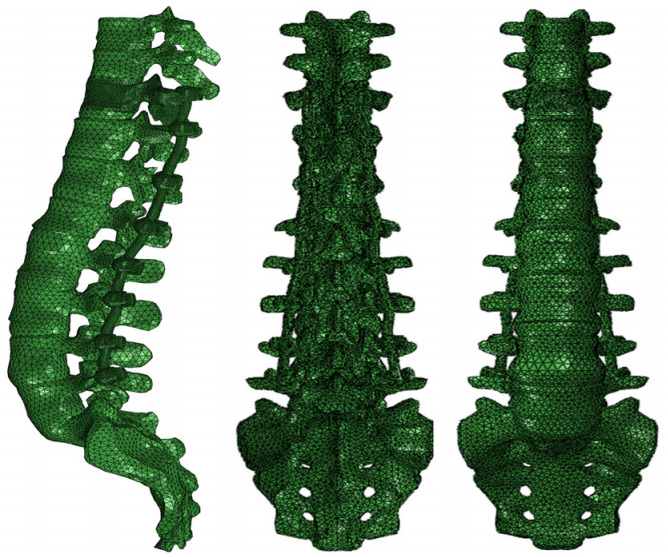
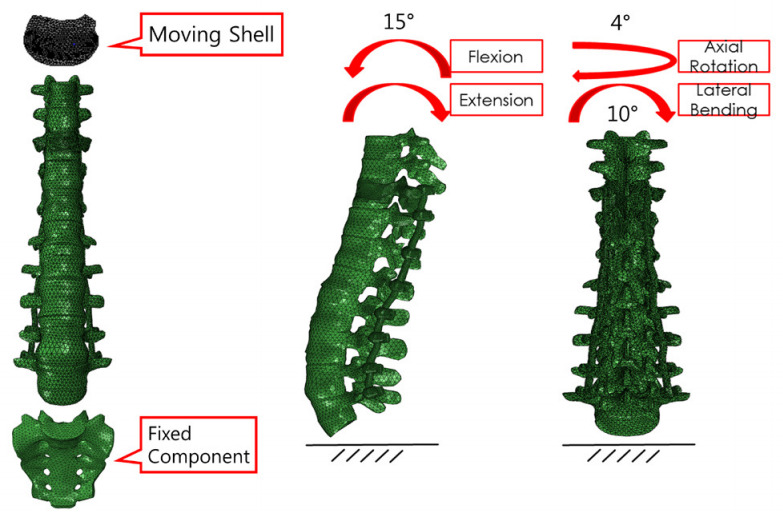
Methods: A T8 to Sacrum with implant finite element model was developed and validated. The pedicle screws were unicortically or bicortically inserted from T10 to L5, and each model was compared and the von Mises (VM) yield stress of T10 was calculated. According to the motion (flexion, extension, lateral bending, and axial rotation) of spine, boundary condition values were set as 15°, 15°, 10°, 4°.
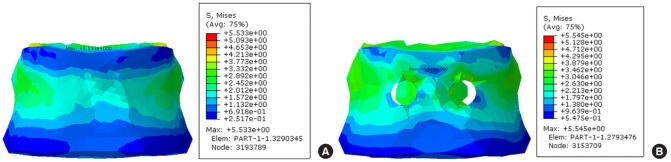
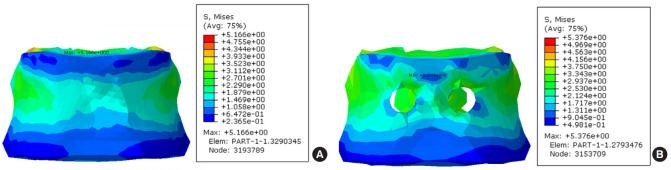
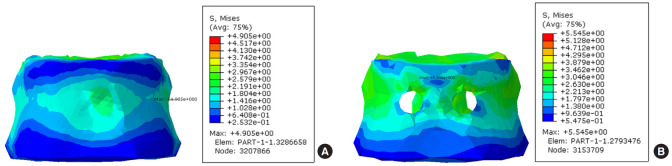
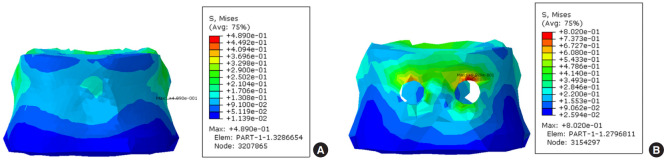
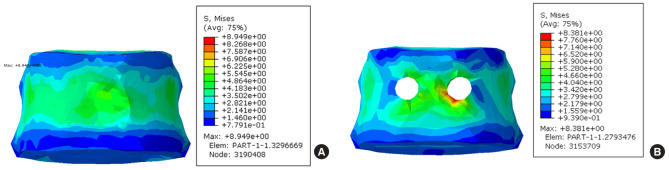
Results: Although the 2 stress values did not show a significant difference between the unicortical- and bicortical purchase models in the flexion and extension, bicortical purchase model showed a larger stress distribution. However, the asymmetric behavior was significantly greater in the case of lateral bending (0.802 MPa vs. 0.489 MPa) and the rotation (5.545 MPa vs. 4.905 MPa). The greater stress was observed on the spinal body surface abutting the implanted screw. Although the maximum stress was observed around the implanted screw in the bicortical purchase model under axial loading, the VM stress of both models was not significantly different.
Conclusion: Bicortical purchase model showed a larger stress distribution than the unicortical model, especially in the case of lateral bending and the rotation behavior. Our biomechanical simulation by FEA indicates that bicortical fixation at UIV can be a risk factor for early UIV compression fracture after adult spinal deformity surgery.
Keywords: Adult spinal deformity; Finite element analysis; Pedicle screws; Spinal fusion.
Conflict of interest statement
The authors have nothing to disclose.
Figures

References
-
- O’Leary PT, Bridwell KH, Lenke LG, et al. Risk factors and outcomes for catastrophic failures at the top of long pedicle screw constructs: a matched cohort analysis performed at a single center. Spine (Phila Pa 1976) 2009;34:2134–9. - PubMed
-
- Watanabe K, Lenke LG, Bridwell KH, et al. Proximal junctional vertebral fracture in adults after spinal deformity surgery using pedicle screw constructs: analysis of morphological features. Spine (Phila Pa 1976) 2010;35:138–45. - PubMed
-
- Park YS, Hyun SJ, Choi HY, et al. Association between bicortical screw fixation at upper instrumented vertebra and risk for upper instrumented vertebra fracture. J Neurosurg Spine. 2017;26:638–44. - PubMed
LinkOut - more resources
Full Text Sources
Research Materials