


Current approaches to identify sections within clinical narratives from electronic health records: a systematic review
- PMID: 31319802
- PMCID: PMC6637496
- DOI: 10.1186/s12874-019-0792-y
Current approaches to identify sections within clinical narratives from electronic health records: a systematic review
Abstract
Background: The identification of sections in narrative content of Electronic Health Records (EHR) has demonstrated to improve the performance of clinical extraction tasks; however, there is not yet a shared understanding of the concept and its existing methods. The objective is to report the results of a systematic review concerning approaches aimed at identifying sections in narrative content of EHR, using both automatic or semi-automatic methods.
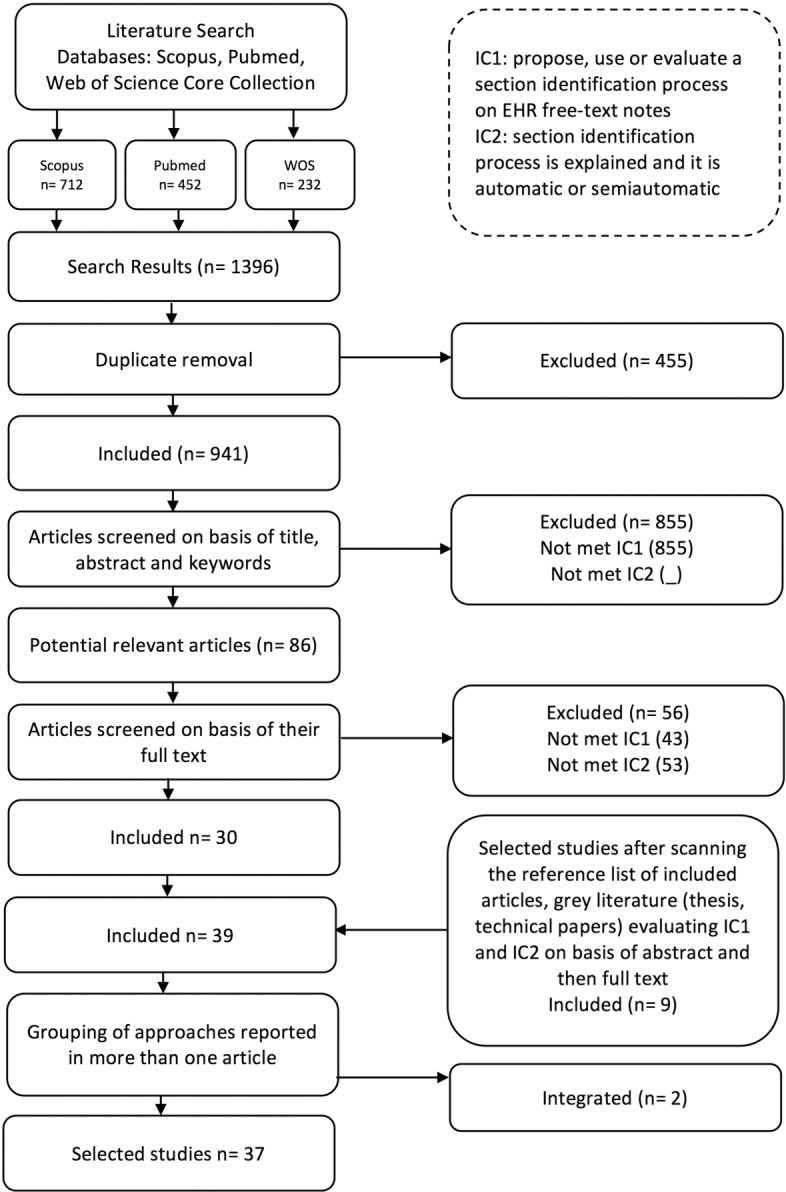
Methods: This review includes articles from the databases: SCOPUS, Web of Science and PubMed (from January 1994 to September 2018). The selection of studies was done using predefined eligibility criteria and applying the PRISMA recommendations. Search criteria were elaborated by using an iterative and collaborative keyword enrichment.
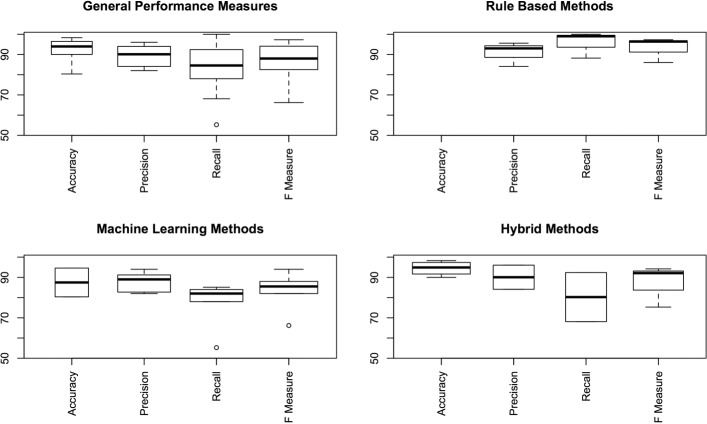
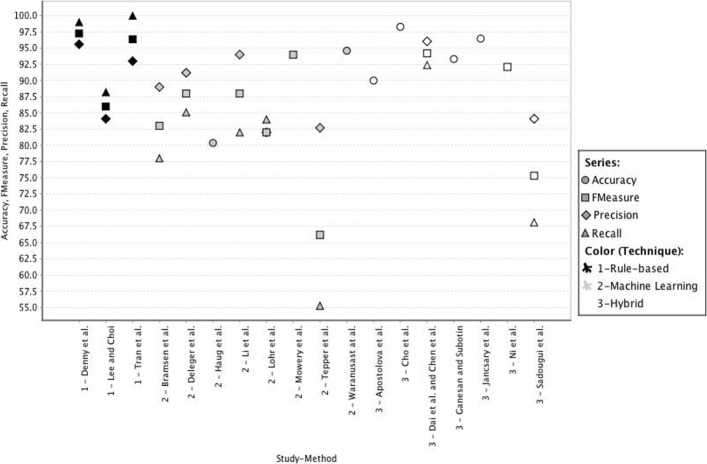
Results: Following the eligibility criteria, 39 studies were selected for analysis. The section identification approaches proposed by these studies vary greatly depending on the kind of narrative, the type of section, and the application. We observed that 57% of them proposed formal methods for identifying sections and 43% adapted a previously created method. Seventy-eight percent were intended for English texts and 41% for discharge summaries. Studies that are able to identify explicit (with headings) and implicit sections correspond to 46%. Regarding the level of granularity, 54% of the studies are able to identify sections, but not subsections. From the technical point of view, the methods can be classified into rule-based methods (59%), machine learning methods (22%) and a combination of both (19%). Hybrid methods showed better results than those relying on pure machine learning approaches, but lower than rule-based methods; however, their scope was more ambitious than the latter ones. Despite all the promising performance results, very few studies reported tests under a formal setup. Almost all the studies relied on custom dictionaries; however, they used them in conjunction with a controlled terminology, most commonly the UMLSⓇ metathesaurus.
Conclusions: Identification of sections in EHR narratives is gaining popularity for improving clinical extraction projects. This study enabled the community working on clinical NLP to gain a formal analysis of this task, including the most successful ways to perform it.
Keywords: Clinical narrative; Electronic health record; Free text; Machine learning; Natural language processing; Section identification.
Conflict of interest statement
The authors declare that they have no competing interests.
Figures
References
-
- Apostolova E, Channin DS, Demner-Fushman D, Furst J, Lytinen S, Raicu D. Conf Proc IEEE Eng Med Biol Soc.: 5905-8. New York: IEEE; 2009. Automatic segmentation of clinical texts. - PubMed
-
- Chapman WW, Savova GK, Zheng J, Tharp M, Crowley R. Anaphoric reference in clinical reports: characteristics of an annotated corpus. J Biomed Inform. 2012;45(3):507–21. - PubMed
-
- Chen C, Chang N, Chang Y, Dai H. Section heading recognition in electronic health records using conditional random fields. In: TAAI, volume 8916 of LNCS. Springer: 2014. p. 47–55.
Publication types
MeSH terms
LinkOut - more resources
Full Text Sources
Other Literature Sources
