Validation of Minnesota acute graft- versus-host disease Risk Score
- PMID: 31320554
- PMCID: PMC7012472
- DOI: 10.3324/haematol.2019.220970
Validation of Minnesota acute graft- versus-host disease Risk Score
Abstract
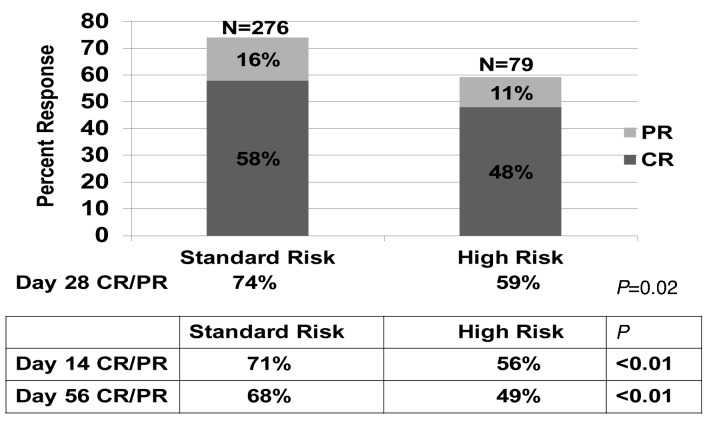
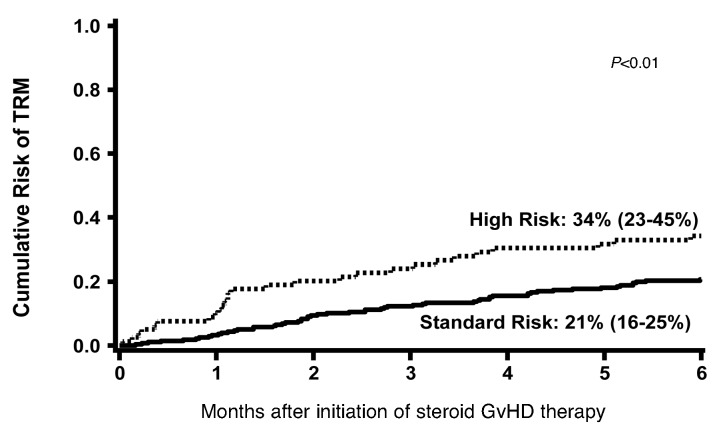
Using multicenter data, we developed a novel acute graft-versus-host disease Risk Score which more accurately predicts response to steroid treatment, survival and transplant related mortality than other published risk scores based upon clinical grading criteria.1 To validate this Risk Score in a contemporary cohort, we examined 355 recent University of Minnesota patients (2007-2016) diagnosed with acute graft-versus-host disease and treated with prednisone 60 mg/m2/day for 14 days, followed by an 8-week taper. Overall response [complete response + partial response] was higher in the 276 standard risk versus 79 high risk graft-versus-host disease patients at day 14 (71% versus 56%, P<0.01), day 28 (74% versus 59%, P=0.02) and day 56 (68% versus 49%, P<0.01) after steroid initiation. Day 28 response did not differ by the initial graft-versus-host disease grade. In multiple regression analysis, patients with high risk graft-versus-host disease were less likely to respond at day 28 (odds ratio 0.5, 95% CI 0.3-0.9, P<0.01) and had higher risks of 2 year transplant related mortality (Hazard Ratio 1.8, 95% CI, 1.0-2.1, P=0.03) and overall mortality (Hazard Ratio 1.7, 95% CI, 1.2-2.4, P<0.01) than patients with a standard risk graft-versus-host disease. This analysis confirms the Minnesota graft-versus-host disease Risk Score as a valuable bedside tool to define risk in patients with acute graft-versus-host disease. A tailored approach to upfront acute graft-versus-host disease therapy based upon the Minnesota Risk Score may improve outcomes and facilitate testing of novel treatments in these patients.
Copyright© 2020 Ferrata Storti Foundation.
Figures
References
-
- Rowlings PA, Przepiorka D, Klein JP, et al. IBMTR Severity Index for grading acute graft-versus-host disease: retrospective comparison with Glucksberg grade. Br J Haematol. 1997;97(4):855–864. - PubMed
-
- Przepiorka D, Weisdorf D, Martin P, et al. 1994. Consensus Conference on acute GvHD grading. Bone Marrow Transplant. 1995;15(6):825–828. - PubMed
-
- Weisdorf DJ, Snover DC, Haake R, et al. Acute upper gastrointestinal graft-versus-host disease: clinical significance and response to immunosuppressive therapy. Blood. 1990;76(3):624–629. - PubMed
Publication types
MeSH terms
Substances
Grants and funding
LinkOut - more resources
Full Text Sources
Other Literature Sources