Review
. 2019 Jul 18;8(7):737.
doi: 10.3390/cells8070737.

MicroRNAs in Cardiac Diseases

Affiliations
Review

MicroRNAs in Cardiac Diseases

Robin M W Colpaert et al. Cells. .

Abstract

Since their discovery 20 years ago, microRNAs have been related to posttranscriptional regulation of gene expression in major cardiac physiological and pathological processes. We know now that cardiac muscle phenotypes are tightly regulated by multiple noncoding RNA species to maintain cardiac homeostasis. Upon stress or various pathological conditions, this class of non-coding RNAs has been found to modulate different cardiac pathological conditions, such as contractility, arrhythmia, myocardial infarction, hypertrophy, and inherited cardiomyopathies. This review summarizes and updates microRNAs playing a role in the different processes underlying the pathogenic phenotypes of cardiac muscle and highlights their potential role as disease biomarkers and therapeutic targets.

Keywords: cardiac diseases; heart; inherited cardiomyopathies; miRNA.


Conflict of interest statement

The authors declare no conflicts of interest.

Figures
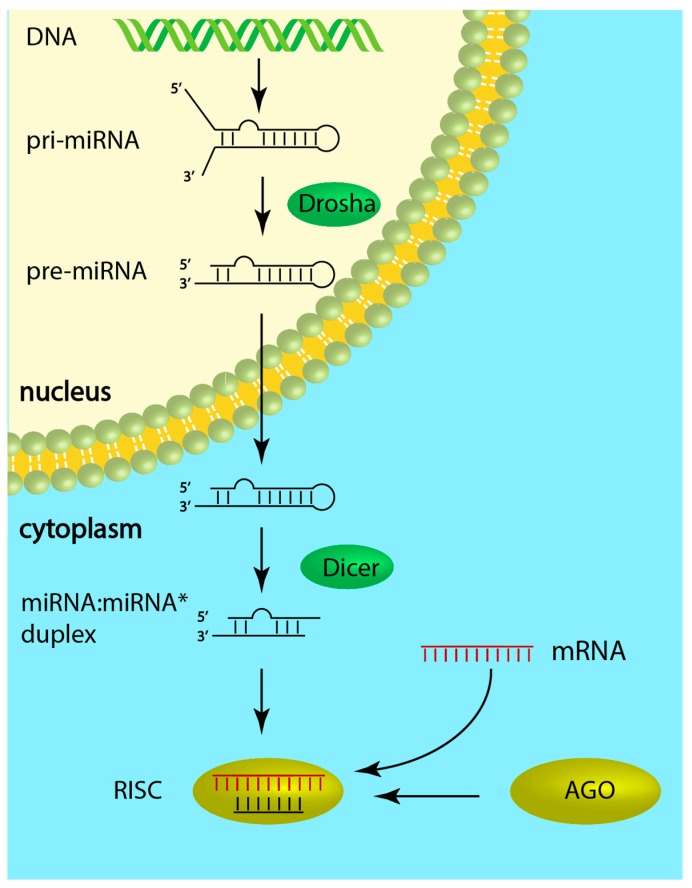
Figure 1
Figure 1
MicroRNA biogenesis. First the microRNA (miRNA) gene is transcribed to create the pri-miRNA, a single-stranded RNA hairpin with imperfect base pairing. Then, Drosha will cleave the pri-miRNA into a 70-nucleotide hairpin with a 2-nucleotide-3′ overhang, the pre-miRNA. After export to the cytoplasm, Dicer will further process the molecule and form a double-stranded miRNA:miRNA* duplex 22 nucleotides long. One strand of this duplex, called the guide strand, combines with the Argonaute (AGO) protein and the target messenger RNA into the RNA-induced silencing complex (RISC). The other strand, the passenger strand, is degraded.
Figure 2
Figure 2
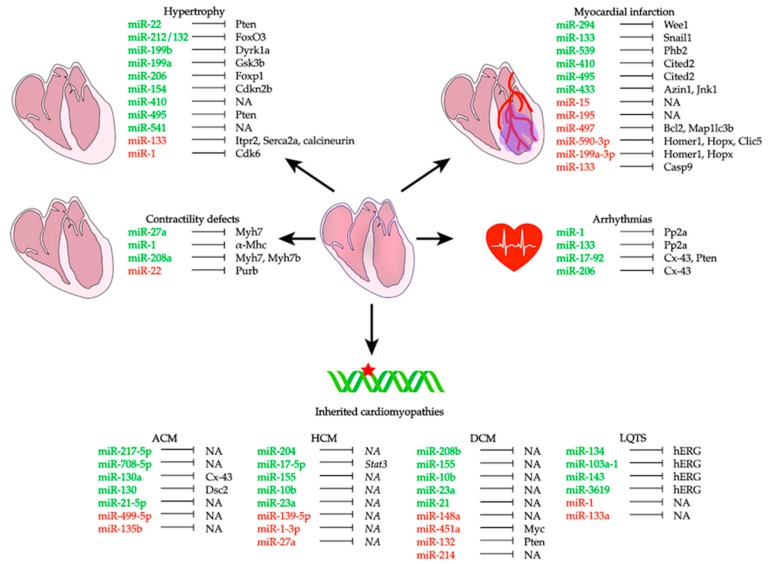
MiRNAs and the relative targets associated with cardiac diseases. Green miRNAs are upregulated, while red miRNAs are downregulated in the different diseases. NA, not available.
Figure 3
Figure 3
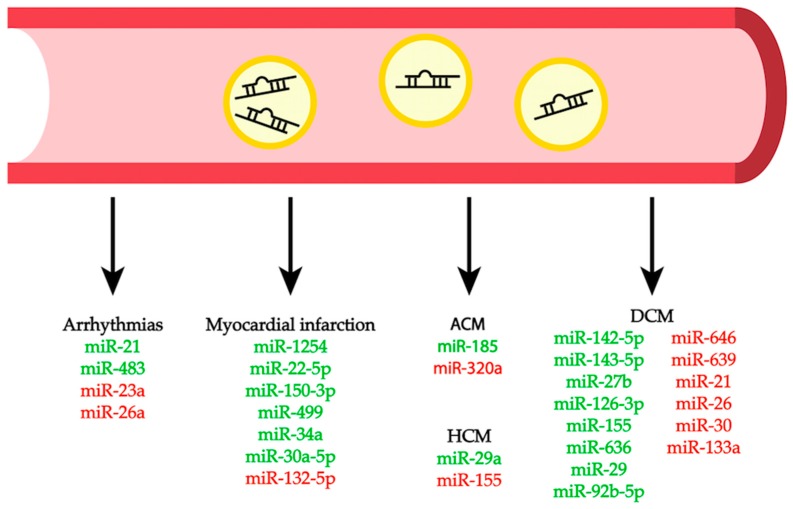
Circulating miRNAs are associated with different cardiac diseases. Green miRNAs are upregulated, while red miRNAs are downregulated in the different diseases.

References

    1. Benjamin E.J., Virani S.S., Callaway C.W., Chamberlain A.M., Chang A.R., Cheng S., Chiuve S.E., Cushman M., Delling F.N., Deo R., et al. Heart disease and stroke statistics - 2018 update: A report from the American Heart Association. Circulation. 2018;137:e467–e492. doi: 10.1161/CIR.0000000000000558. - DOI - PubMed
    1. Bui A.L., Horwich T.B., Fonarow G.C. Epidemiology and risk profile of heart failure. Nat. Rev. Cardiol. 2011;8:30–41. doi: 10.1038/nrcardio.2010.165. - DOI - PMC - PubMed
    1. Clerk A., Cullingford T.E., Fuller S.J., Giraldo A., Markou T., Pikkarainen S., Sugden P.H. Signaling pathways mediating cardiac myocyte gene expression in physiological and stress responses. J. Cell. Physiol. 2007;212:311–322. doi: 10.1002/jcp.21094. - DOI - PubMed
    1. Wojciechowska A., Osiak A., Kozar-Kamińska K. MicroRNA in cardiovascular biology and disease. Adv. Clin. Exp. Med. 2017;26:865–874. doi: 10.17219/acem/62915. - DOI - PubMed
    1. Martinez S.R., Gay M.S., Zhang L. Epigenetic mechanisms in heart development and disease. Drug Discov. Today. 2015;20:799–811. doi: 10.1016/j.drudis.2014.12.018. - DOI - PMC - PubMed

Publication types