Review
. 2019 Jul 9;8(7):997.
doi: 10.3390/jcm8070997.

High-Risk Multiple Myeloma: Integrated Clinical and Omics Approach Dissects the Neoplastic Clone and the Tumor Microenvironment

Affiliations
Review

High-Risk Multiple Myeloma: Integrated Clinical and Omics Approach Dissects the Neoplastic Clone and the Tumor Microenvironment

Antonio Giovanni Solimando et al. J Clin Med. .

Abstract

Multiple myeloma (MM) is a genetically heterogeneous disease that includes a subgroup of 10-15% of patients facing dismal survival despite the most intensive treatment. Despite improvements in biological knowledge, MM is still an incurable neoplasia, and therapeutic options able to overcome the relapsing/refractory behavior represent an unmet clinical need. The aim of this review is to provide an integrated clinical and biological overview of high-risk MM, discussing novel therapeutic perspectives, targeting the neoplastic clone and its microenvironment. The dissection of the molecular determinants of the aggressive phenotypes and drug-resistance can foster a better tailored clinical management of the high-risk profile and therapy-refractoriness. Among the current clinical difficulties in MM, patients' management by manipulating the tumor niche represents a major challenge. The angiogenesis and the stromal infiltrate constitute pivotal mechanisms of a mutual collaboration between MM and the non-tumoral counterpart. Immuno-modulatory and anti-angiogenic therapy hold great efficacy, but variable and unpredictable responses in high-risk MM. The comprehensive understanding of the genetic heterogeneity and MM high-risk ecosystem enforce a systematic bench-to-bedside approach. Here, we provide a broad outlook of novel druggable targets. We also summarize the existing multi-omics-based risk profiling tools, in order to better select candidates for dual immune/vasculogenesis targeting.

Keywords: angiogenesis; bone marrow microenvironment; drug resistance; extramedullary disease; multiple myeloma.


Conflict of interest statement

The authors declare no conflict of interest.

Figures
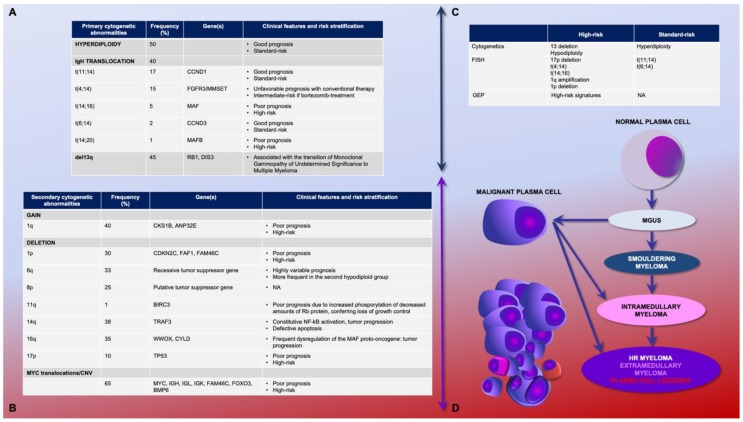
Figure 1
Figure 1
Relationship between peculiar cytogenetic abnormalities and multiple myeloma evolution. (A) Primary genetic events occur in the early premalignant phase during the transition from a normal plasma cell to a clonal plasma cell; (B) secondary genetic events occurring during the disease progression [6]; (C) genetic risk stratification, modified from [5]; (D) multiple myeloma disease evolution. GEP: gene expression profile. MGUS: monoclonal gammopathy of undetermined significance.
Figure 2
Figure 2
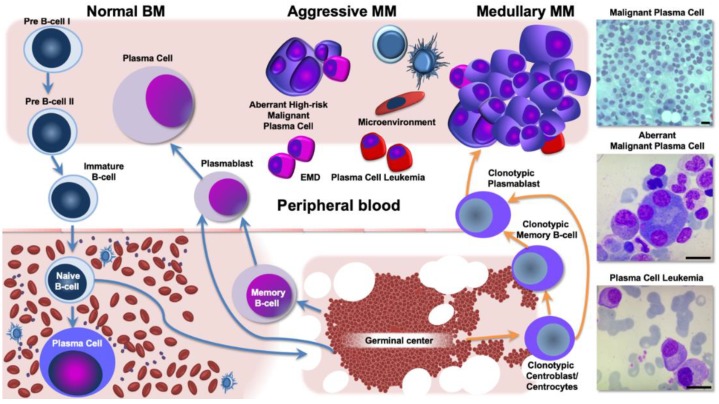
B-cell differentiation, multiple myeloma (MM) development, and aggressive disease phenotypes. Left panel: pre-B cells migrate from the bone marrow (BM) into the peripheral blood and the germinal center. Memory B-cell differentiation drives the production and localization of plasma cells (PCs) into the BM. Right panel: The earliest clonotypic cell, putatively the MM precursor, can turn into mature premalignant PCs, namely MGUS. Subsequent genetic events lead to overt disease in multiple BM sites. Ultimately, clonal evolution driven by disease biology and BM microenvironment interaction continues to select MM PCs that finally give rise to extramedullary and aberrantly growing sub-clones. EMD: extramedullary disease.
Figure 3
Figure 3
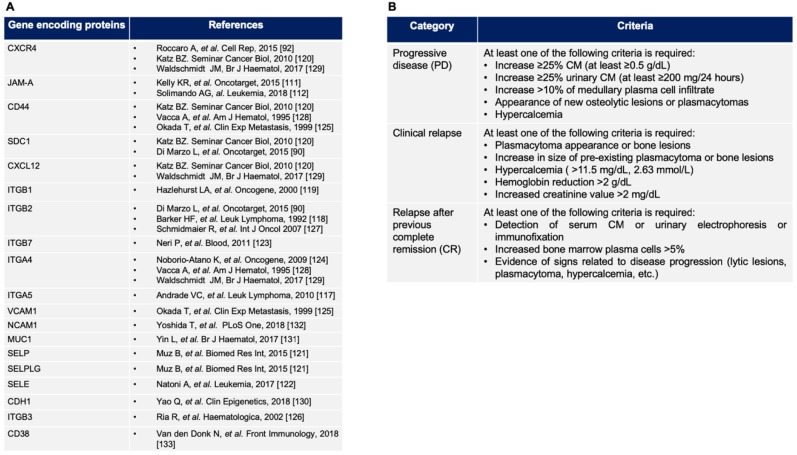
(A) Gene encoding protein list: adhesion molecule implicated in drug resistance described in MM (see the text and [117,118,119,120,121,122,123,124,125,126,127,128,129,130,131,132,133] for details); (B) definition of the disease relapse according to the International Myeloma Working Group (see the text for details). M protein: monoclonal protein.
Figure 4
Figure 4
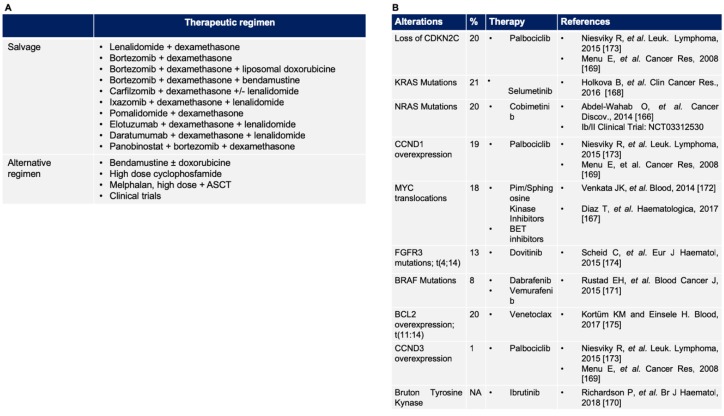
(A) Therapeutic regimens for relapse/refractory MM; (B) common druggable molecular alterations in MM (see the text and [166,167,168,169,170,171,172,173,174,175] for details). ASCT, autologous stem cell transplantation.
Figure 5
Figure 5
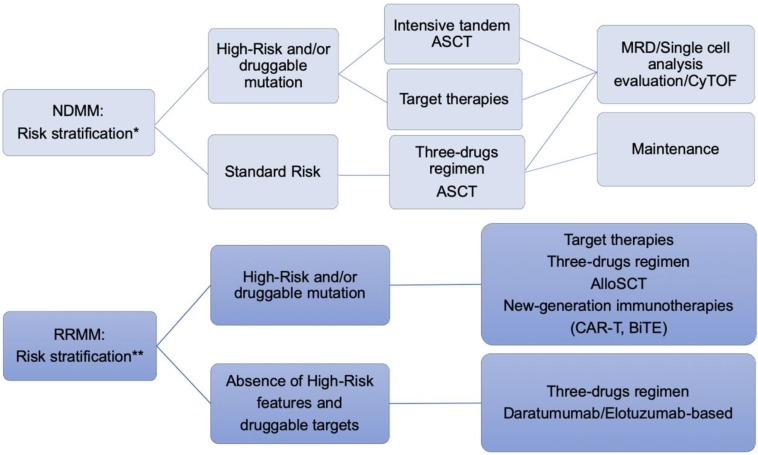
Clinical trial design proposal for a risk-driven personalized approach. NDMM: newly-diagnosed MM. RRMM: relapsed-refractory MM. ASCT: autologous stem cell transplantation. Allo-SCT: allogeneic stem cell transplantation. MRD: minimal residual disease. * FISH, NGS (genomic panels including known actionable mutation and TP53 mutation), and GEP. ** FISH, NGS (genomic panels including known actionable mutation and TP53 mutation and drug resistance-related genomic alterations), and GEP. CAR-T: Chimeric Antigen Receptor T cell; BiTE: Bispecific T cell engager antibody; tandem ASCT: double autologous stem cell transplantation. Tandem ASCT is already being investigated in experimental studies.
Figure 6
Figure 6
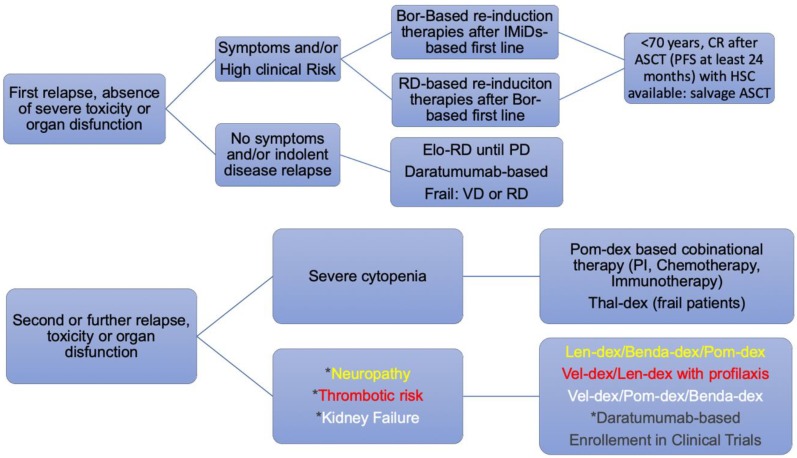
Pragmatic Integrated approach to MM patients according to the clinical risk profile. Bor: bortezomib; RD: REVLIMID® (lenalidomide)-dexamethasone; Elo-RD: elotuzumab®-REVLIMID® (lenalidomide)-dexamethasone; VD: VELCADE® (bortezomib)-dexamethasone; PI: proteasome inhibitor; Thal-dex: thalidomide-dexamethasone; Len-dex: lenalidomide-dexamethasone; Benda-dex: bendamustine-dexamethasone; Pom-dex: pomalidomide-dexamethasone; Vel-dex: VELCADE® (bortezomib)-dexamethasone. PI: proteasome inhibitor. PD: progressive disease; CR: complete response. PFS: progression-free survival. HSC: hematopoietic stem cells ASCT: autologous stem cell transplantation.

References

    1. Kumar S.K., Dispenzieri A., Lacy M.Q., Gertz M.A., Buadi F.K., Pandey S., Kapoor P., Dingli D., Hayman S.R., Leung N., et al. Continued improvement in survival in multiple myeloma: Changes in early mortality and outcomes in older patients. Leukemia. 2014;28:1122–1128. doi: 10.1038/leu.2013.313. - DOI - PMC - PubMed
    1. Durie B.G., Salmon S.E. A clinical staging system for multiple myeloma. Correlation of measured myeloma cell mass with presenting clinical features, response to treatment, and survival. Cancer. 1975;36:842–854. doi: 10.1002/1097-0142(197509)36:3<842::AID-CNCR2820360303>3.0.CO;2-U. - DOI - PubMed
    1. Kuehl W.M., Bergsagel P.L. Multiple myeloma: Evolving genetic events and host interactions. Nat. Rev. Cancer. 2002;2:175–187. doi: 10.1038/nrc746. - DOI - PubMed
    1. Greipp P.R., San Miguel J., Durie B.G., Crowley J.J., Barlogie B., Blade J., Boccadoro M., Child J.A., Avet-Loiseau H., Kyle R.A., et al. International staging system for multiple myeloma. J. Clin. Oncol. 2005;23:3412–3420. doi: 10.1200/JCO.2005.04.242. - DOI - PubMed
    1. Sonneveld P., Avet-Loiseau H., Lonial S., Usmani S., Siegel D., Anderson K.C., Chng W.J., Moreau P., Attal M., Kyle R.A., et al. Treatment of multiple myeloma with high-risk cytogenetics: A consensus of the International Myeloma Working Group. Blood. 2016;127:2955–2962. doi: 10.1182/blood-2016-01-631200. - DOI - PMC - PubMed