


Longevity: Lesson from Model Organisms
- PMID: 31324014
- PMCID: PMC6678192
- DOI: 10.3390/genes10070518
Longevity: Lesson from Model Organisms
Abstract
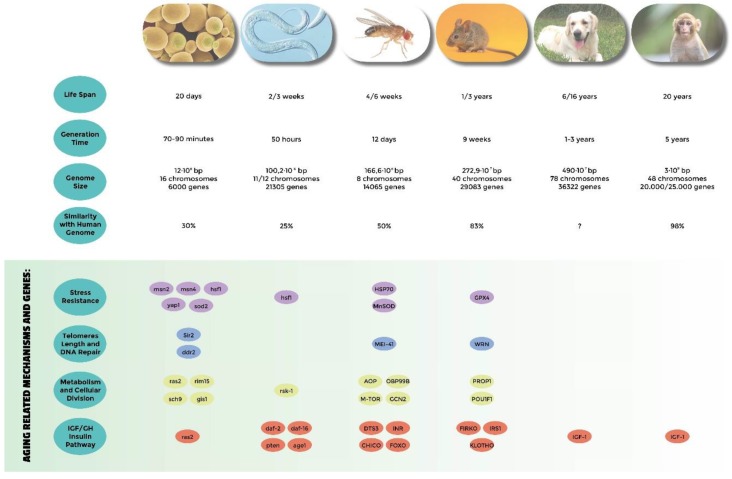
Research on longevity and healthy aging promises to increase our lifespan and decrease the burden of degenerative diseases with important social and economic effects. Many aging theories have been proposed, and important aging pathways have been discovered. Model organisms have had a crucial role in this process because of their short lifespan, cheap maintenance, and manipulation possibilities. Yeasts, worms, fruit flies, or mammalian models such as mice, monkeys, and recently, dogs, have helped shed light on aging processes. Genes and molecular mechanisms that were found to be critical in simple eukaryotic cells and species have been confirmed in humans mainly by the functional analysis of mammalian orthologues. Here, we review conserved aging mechanisms discovered in different model systems that are implicated in human longevity as well and that could be the target of anti-aging interventions in human.
Keywords: aging; model systems; molecular senescence; signal transduction.
Conflict of interest statement
The authors declare no conflict of interest. The funders had no role in the design of the study; in the collection, analyses, or interpretation of data; in the writing of the manuscript, and in the decision to publish the results.
Figures
References
-
- Williams G.C. Pleiotropy, natural selection, and the evolution of senescence. Evolution. 1957;11:398. doi: 10.1111/j.1558-5646.1957.tb02911.x. - DOI
Publication types
MeSH terms
Substances
LinkOut - more resources
Full Text Sources
Molecular Biology Databases
