


A Provegetarian Food Pattern Emphasizing Preference for Healthy Plant-Derived Foods Reduces the Risk of Overweight/Obesity in the SUN Cohort
- PMID: 31324022
- PMCID: PMC6683267
- DOI: 10.3390/nu11071553
A Provegetarian Food Pattern Emphasizing Preference for Healthy Plant-Derived Foods Reduces the Risk of Overweight/Obesity in the SUN Cohort
Abstract
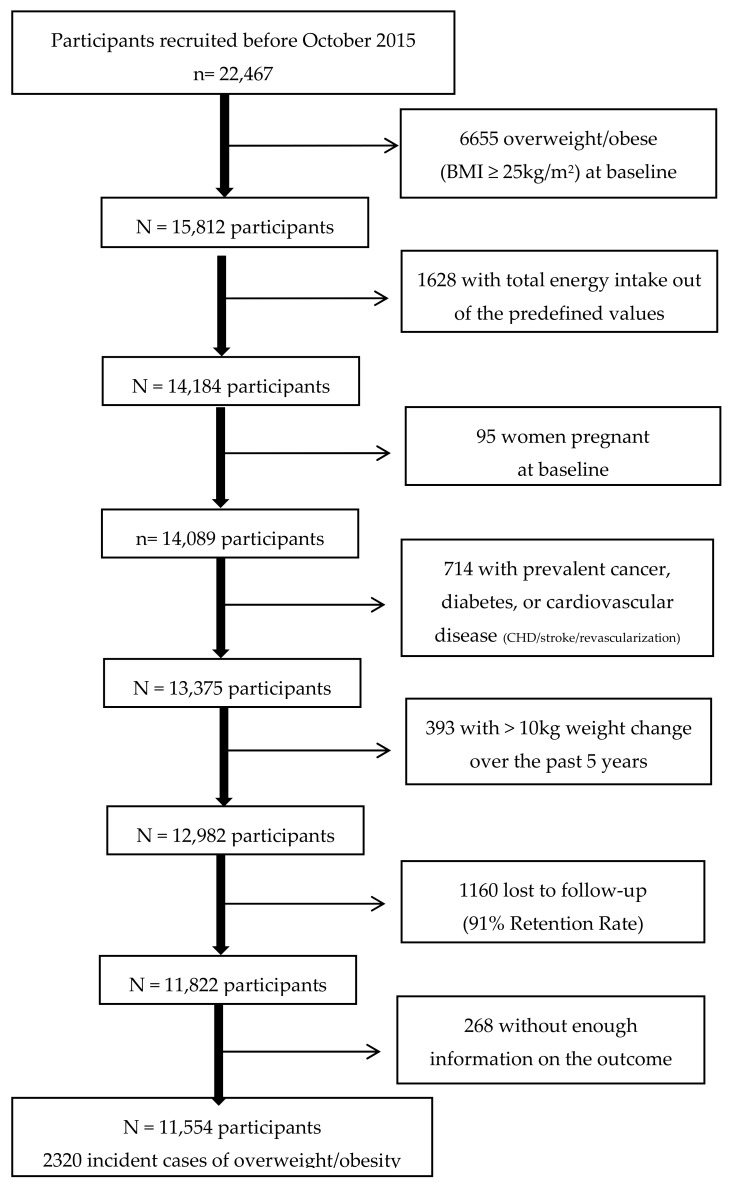
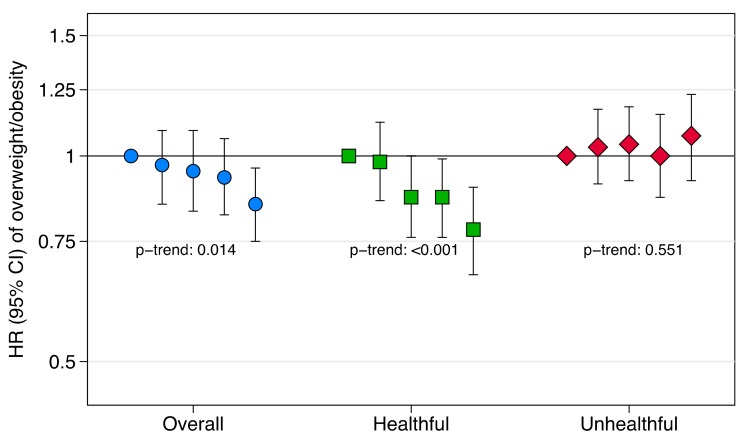
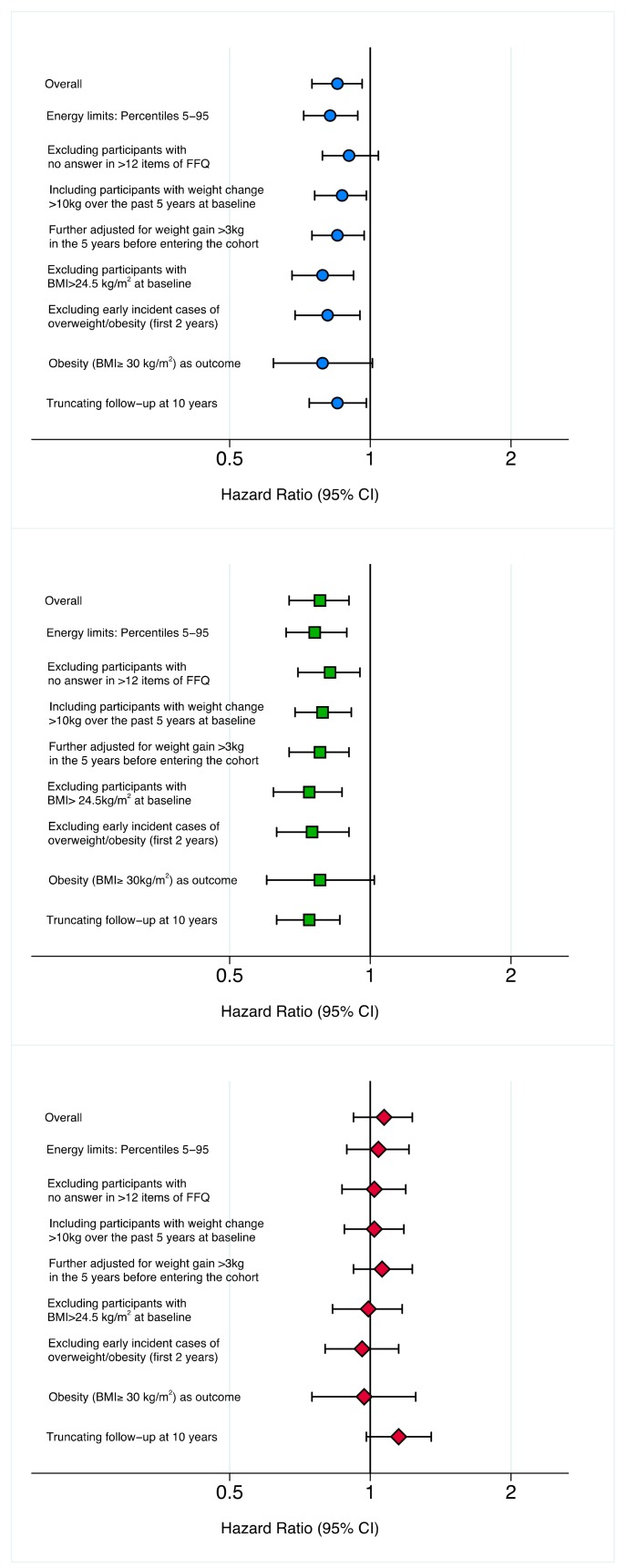
Provegetarian diets (i.e., preference for plant-derived foods but not exclusion of animal foods) have been associated with a reduced risk of long-term weight gain and could be more easily embraced than strict vegetarian diets. However, not all plant-derived foods are equally healthy. In the "Seguimiento Universidad de Navarra" (SUN) cohort, we prospectively evaluated the association between different provegetarian food patterns and the incidence of overweight/obesity in 11,554 participants with initial body mass index <25 kg/m2. A provegetarian food pattern (FP) was built by assigning positive scores to plant foods and reverse scores to animal foods. A healthful and an unhealthful provegetarian FP, which distinguished between healthy (fruits/vegetables/whole grains/nuts/legumes/olive oil/coffee) and less-healthy plant foods (fruit juices/potatoes/refined grains/pastries/sugary beverages), were also built. A total of 2320 new cases of overweight or obesity were identified after a median follow-up of 10.3 years. Higher baseline conformity with the overall provegetarian FP was inversely associated with overweight/obesity (HR comparing extreme quintiles: 0.85; 95% CI: 0.75 to 0.96; p-trend: 0.014). This association was stronger for the healthful FP (HR: 0.78; 95% CI: 0.67 to 0.90; p-trend: <0.001) and was not apparent for the unhealthful FP (HR: 1.07; 95% CI: 0.92 to 1.23; p-trend: 0.551). In a large prospective cohort of relatively young adults, better conformity with a healthy provegetarian diet was associated with a reduced long-term risk of overweight/obesity, whereas no consistent trend was found for a FP that emphasized less-healthy plant foods.
Keywords: dietary patterns; epidemiology; nutrition; obesity; overweight; prospective cohort study; provegetarian; vegetarian.
Conflict of interest statement
The authors declare no conflicts of interest.
Figures
References
-
- Willett W., Rockström J., Loken B., Springmann M., Lang T., Vermeulen S., Garnett T., Tilman D., Declerck F., Wood A., et al. Food in the Anthropocene: The EAT–Lancet Commission on healthy diets from sustainable food systems. Lancet. 2019;393:447–492. doi: 10.1016/S0140-6736(18)31788-4. - DOI - PubMed
-
- Key T., Fraser G., Thorogood M., Appleby P., Beral V., Reeves G., Burr M., Chang-Claude J., Frentzel-Beyme R., Kuzma J., et al. Mortality in Vegetarians and Nonvegetarians: Detailed Findings from A Collaborative Analysis Of 5 Prospective Studies. Am. J. Clin. Nutr. 1999;70:516s–524s. doi: 10.1093/ajcn/70.3.516s. - DOI - PubMed
MeSH terms
Grants and funding
LinkOut - more resources
Full Text Sources
Medical
