


Comparative Epidemiology and Resistance Trends of Common Urinary Pathogens in a Tertiary-Care Hospital: A 10-Year Surveillance Study
- PMID: 31324035
- PMCID: PMC6681214
- DOI: 10.3390/medicina55070356
Comparative Epidemiology and Resistance Trends of Common Urinary Pathogens in a Tertiary-Care Hospital: A 10-Year Surveillance Study
Abstract
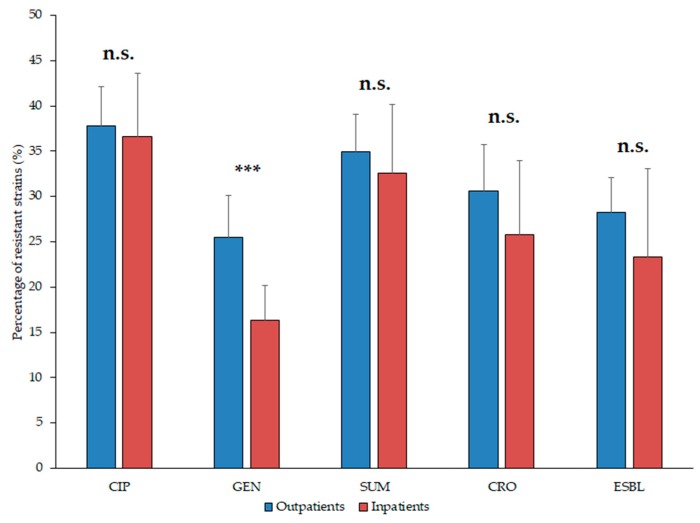
Background and Objective: Urinary tract infections (UTIs) are common in human medicine, affecting large patient populations worldwide. The principal cause of UTIs is uropathogenic Escherichia coli (UPEC) and Klebsiella, both in community and nosocomial settings. The assessment of local data on prevalence and resistance is essential to evaluate trends over time and to reflect on the national situation, compared to international data, using the methods of analytical epidemiology. Materials and Methods: The aim of this study was to assess resistance trends and epidemiology of UTIs caused by E. coli and Klebsiella species in inpatients and outpatients at a tertiary-care hospital in Hungary, using microbiological data. To evaluate resistance trends, several antibiotics were chosen as indicator drugs, based on local utilization data. Results: E. coli was the most prevalent isolate, representing 56.75 ± 4.86% for outpatients and 42.29 ± 2.94% for inpatients. For E. coli, the ratio of resistant strains for several antibiotics was significantly higher in the inpatient group, while in Klebsiella, similar trends were only observed for gentamicin. Extended-spectrum β-lactamase (ESBL)-producing isolates were detected in 4.33-9.15% and 23.22-34.22% from outpatient, 8.85-38.97% and 10.89-36.06% from inpatient samples for E. coli and Klebsiella, respectively. Conclusions: Resistance developments in common UTI pathogens (especially to fosfomycin, sulfamethoxazole-trimethoprim, fluoroquinolones, and 3rd generation cephalosporins), seriously curb therapeutic options, especially in outpatient settings.
Keywords: ESBL; Escherichia coli; Klebsiella; antibiotic; epidemiology; fosfomycin; indicator; infectious disease; resistance; urinary tract infection.
Conflict of interest statement
The authors declare no conflicts of interest, monetary or otherwise.
Figures
References
-
- Sobel J.D., Kaye D. 74—Urinary Tract Infections. In: Bennett J.E., Dolin R., Blaser M.J., editors. Mandell, Douglas, and Bennett’s Principles and Practice of Infectious Diseases. 8th ed. Elsevier; Philadelphia, PA, USA: 2015. pp. 886–913.e3.
-
- Gupta K., Hooton T.M., Naber K.G., Wullt B., Colgan R., Miller L.G., Moran G.J., Nicolle L.E., Raz R., Schaeffer A.J., et al. International clinical practice guidelines for the treatment of acute uncomplicated cystitis and pyelonephritis in women: A 2010 update by the Infectious Diseases Society of America and the European Society for Microbiology and Infectious Diseases. Clin. Infect. Dis. 2011;52:e103–e120. doi: 10.1093/cid/ciq257. - DOI - PubMed
-
- Hooton T.M., Bradley S.F., Cardenas D.D., Colgan R., Geerlings S.E., Rice J.C., Saint S., Schaeffer A.J., Tambayh P.A., Tenke P., et al. Diagnosis, Prevention, and Treatment of Catheter-Associated Urinary Tract Infection in Adults: 2009 International Clinical Practice Guidelines from the Infectious Diseases Society of America. Clin. Infect. Dis. 2010;50:625–663. doi: 10.1086/650482. - DOI - PubMed
MeSH terms
Substances
LinkOut - more resources
Full Text Sources
Medical
Molecular Biology Databases
