


Under nutrition, maternal anemia and household food insecurity are risk factors of anemia among preschool aged children in Menz Gera Midir district, Eastern Amhara, Ethiopia: a community based cross-sectional study
- PMID: 31324244
- PMCID: PMC6642588
- DOI: 10.1186/s12889-019-7293-0
Under nutrition, maternal anemia and household food insecurity are risk factors of anemia among preschool aged children in Menz Gera Midir district, Eastern Amhara, Ethiopia: a community based cross-sectional study
Abstract
Background: In Ethiopian, the prevalence of anemia among preschool aged children widely varied across regions. Since anemia adversely affects the cognitive and physical development of the children, it is important to determine its burden for implementing appropriate measurements. Therefore, this study was aimed at determining the anemia prevalence and associated factors among preschool aged children.
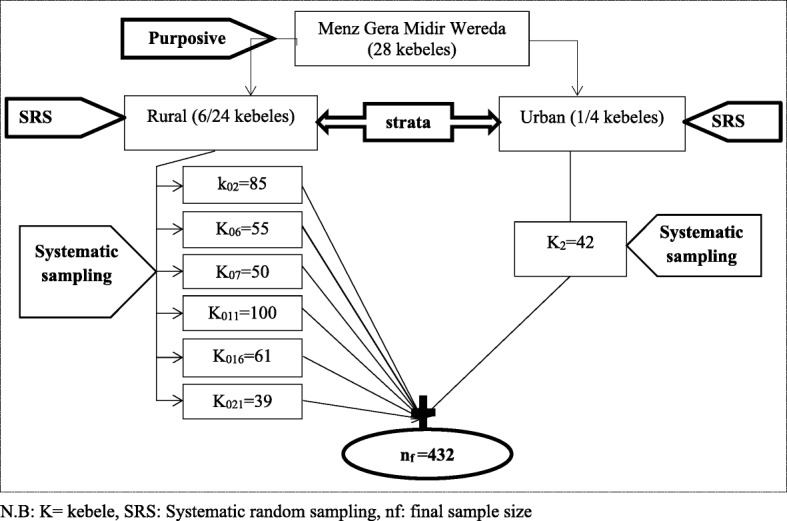
Method: A community based cross-sectional study was conducted on a total of 432 preschool children in Menz Gera Midir district from January to May, 2017. A multi stage sampling procedure was applied to select the target groups. Hemocue analyzer for Haemoglobin determination; anthropometric measurements for assessment nutritional status, structured questionnaires for socio-demographic and economic variables were used for data collection. The morphological appearance of red blood cell was assessed microscopically to determine type of anemia. Descriptive statistics were employed to summarize the data and binary logistic regression was used for inferential statistics. A p value less than 0.05 was considered as statistically significant.
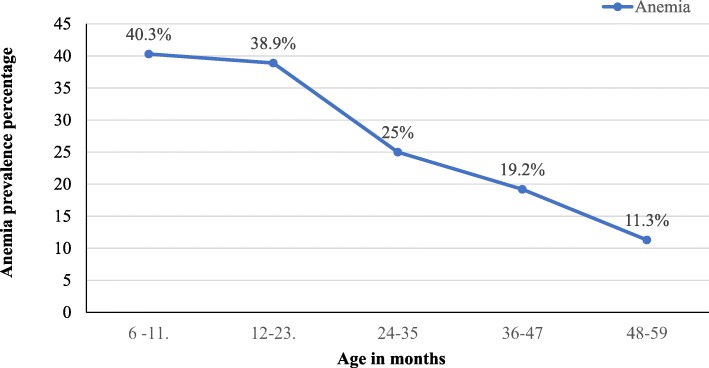
Result: The overall prevalence of anemia was 123 (28.5%); of which 38 (30.9%) and 85 (69.1%) were moderate and mild, respectively. Morphologically about 50.4, 37.4 and 12.2% were microcytic hypochromic, normocytic normochromic and macrocytic anemias, respectively. Child age 6-11 months (COR: 5.67, 95% CI: 2.2, 14.86), child age 12-23 months (COR: 5.8, 95% CI: 2.3, 14.7), wasting (COR: 3.5, 95% CI: 1.2, 9.8), stunting (COR: 3.8, 95% CI: 1.92, 7.77), underweight (COR: 2.12, 95% CI: 1.07, 4.38), MUAC measurement below 13 cm (COR: 5.6, 95% CI: 2.83, 11.15), household headed by female (COR: 3.24, 95% CI: 1.1, 9.63), maternal anemia (COR: 4, 95% CI: 2.2, 7.23) and household food insecurity (COR: 2.12, 95% CI: 1.09, 4.12) were significantly associated with anemia.
Conclusion: The prevalence of anemia among the children was found to be high and associated with child age group, child nutritional status, house hold headed by female, maternal anemia and household food insecurity. Further studies on nutritional anemia, community based nutritional education, iron supplementation to children at risk should be promoted.
Keywords: Anemia; Ethiopia; Menz Gera Midir; Pre-school aged children.
Conflict of interest statement
The authors declare that they have no competing interests.
Figures
References
-
- WHO. The global prevalence of anaemia in 2011. Geneva: World Health Organization; 2015. Available at: http://apps.who.int/iris/bitstream/10665/177094/1/9789241564960_eng.pdf. Accessed Nov 2016.
-
- Sanou D, Ngnie-Teta I. Risk factors for anemia in preschool children in sub-Saharan Africa: INTECH Open Access Publisher; 2012. Available at: https://www.researchgate.net/publication/272830110_Risk_factors_for_anem....
MeSH terms
LinkOut - more resources
Full Text Sources
Medical
