. 2019 Jul 19;12(1):357.
doi: 10.1186/s13071-019-3617-2.

Too "sexy" for the field? Paired measures of laboratory and semi-field performance highlight variability in the apparent mating fitness of Aedes aegypti transgenic strains

Affiliations

Too "sexy" for the field? Paired measures of laboratory and semi-field performance highlight variability in the apparent mating fitness of Aedes aegypti transgenic strains

Andrew Aldersley et al. Parasit Vectors. .

Abstract

Background: Evaluating and improving mating success and competitive ability of laboratory-reared transgenic mosquito strains will enhance the effectiveness of proposed disease-control strategies that involve deployment of transgenic strains. Two components of the mosquito rearing process, larval diet quantity and aquatic environment - which are linked to physiological and behavioural differences in adults - are both relatively easy to manipulate. In mosquitoes, as for many other arthropod species, the quality of the juvenile habitat is strongly associated with adult fitness characteristics, such as longevity and fecundity. However, the influence of larval conditioning on mating performance is poorly understood. Here, we investigated the combined effects of larval diet amount and environmental water source on adult male mating success in a genetically modified strain of Aedes aegypti mosquitoes in competition with wild-type conspecifics. Importantly, this research was conducted in a field setting using low generation laboratory and wild-type lines.

Results: By controlling larval diet (high and low) and rearing water source (field-collected and laboratory water), we generated four treatment lines of a genetically modified strain of Ae. aegypti tagged with fluorescent sperm. Laboratory reared mosquitoes were then competed against a low generation wild-type colony in a series of laboratory and semi-field mating experiments. While neither food quantity nor larval aquatic environment were found to affect male mating fitness, the transgenic lines consistently outperformed wild-types in laboratory competition assays, an advantage that was not conferred to semi-field tests.

Conclusions: Using a model transgenic system, our results indicate that differences in the experimental conditions of laboratory- and field-based measures of mating success can lead to variation in the perceived performance ability of modified strains if they are only tested in certain environments. While there are many potential sources of variation between laboratory and field lines, laboratory adaptation - which may occur over relatively few generations in this species - may directly impact mating ability depending on the context in which it is measured. We suggest that colony-hybridization with field material can potentially be used to mitigate these effects in a field setting. Release programs utilising mass-produced modified laboratory strains should incorporate comparative assessments of quality in candidate lines.

Keywords: Aedes aegypti; Body size; Larval conditioning; Mating success; Vector control.


Conflict of interest statement

The authors declare that they have no competing interests.

Figures
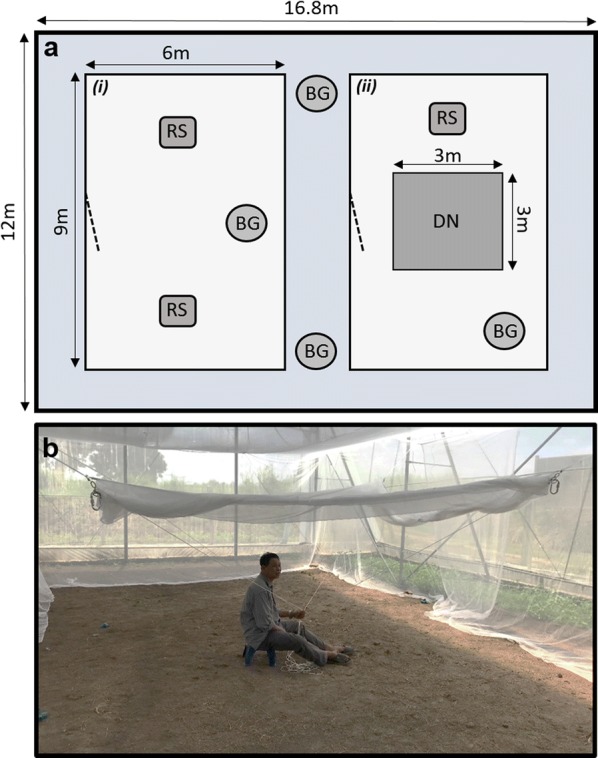
Fig. 1
Fig. 1
Layout of individual semi-field cages. a Two sub-enclosures constructed from bednet material were erected inside each semi-field cage structure. These had entrance points on the left-side (dashed line). The leftmost sub-enclosure (i) was used for mating competition assays, while the right (ii) was used for swarm site attendance experiments. In (ii), a drop-net (DN) was hung and used to capture males attracted to the host. BG-Sentinel traps (BG) were left inside the sub-enclosures and in the main semi-field cage area for mosquito recapture. Resting sites (RS), partially filled with water, were also placed inside each experimental arena. Access to the semi-field cages was controlled by a double sliding door. b Drop-net procedure for measuring swarm site attendance inside a semi-field cage sub-enclosure. Host is positioned under the raised drop-net, which is released after 10 min. Male mosquitoes in close proximity to the host are trapped and recaptured using a vacuum aspirator
Fig. 2
Fig. 2
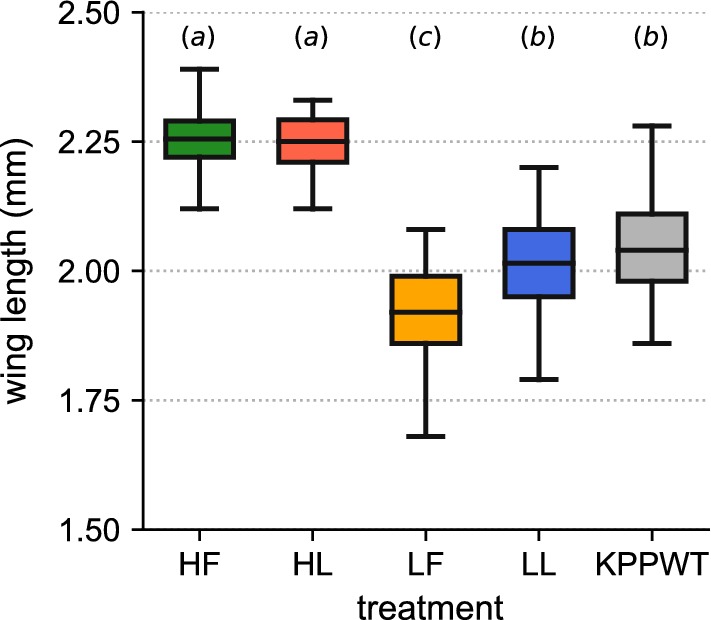
The distribution of adult male wing lengths for samples taken from DsRedKPP and KPPWT strains, separated by larval treatment. Data are aggregated across all experimental blocks. Treatments with the same letter-label (a, b, c) were not significantly different from one another. Different letters indicate significant differences between respective treatments. Sample sizes for each group: HF (n = 76); HL (n = 68); LF (n = 77); LL (n = 72); KPPWT (n = 294)
Fig. 3
Fig. 3
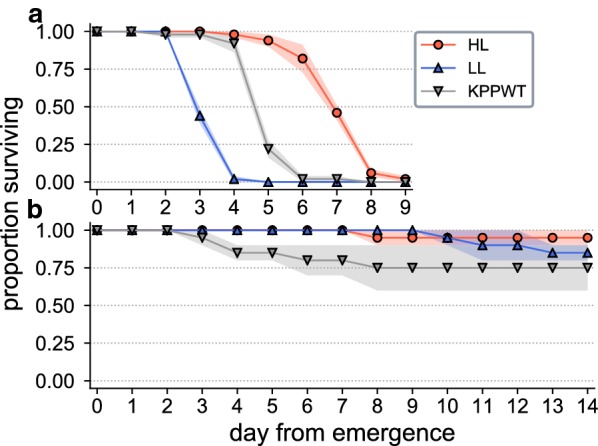
Adult male survival of individuals from different larval treatments offered a diet of either water (a) or 10% sugar solution (b). Data plotted show the mean across all replicates (n = 5 per treatment for water; n = 2 per treatment for sugar), with shaded regions indicating the standard error
Fig. 4
Fig. 4
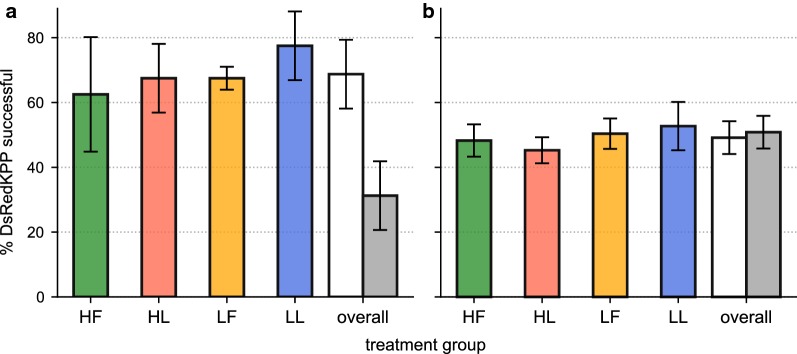
Results from the small cage and semi-field mating experiments. a The mean (± standard deviation) proportion of trials in which a DsRedKPP male was the first to copulate with a KPPWT female in small cage mating competition assays. b The mean (± standard deviation) proportion of mated recaptured females that were found to be inseminated by DsRed-tagged sperm in semi-field mating assays. Data are averaged across each replicate and separated by larval treatment. For each graph, the “overall” treatment group shows the DsRedKPP success rate averaged across all treatments (white bars) versus the corresponding average KPPWT success rate (grey bars)
Fig. 5
Fig. 5
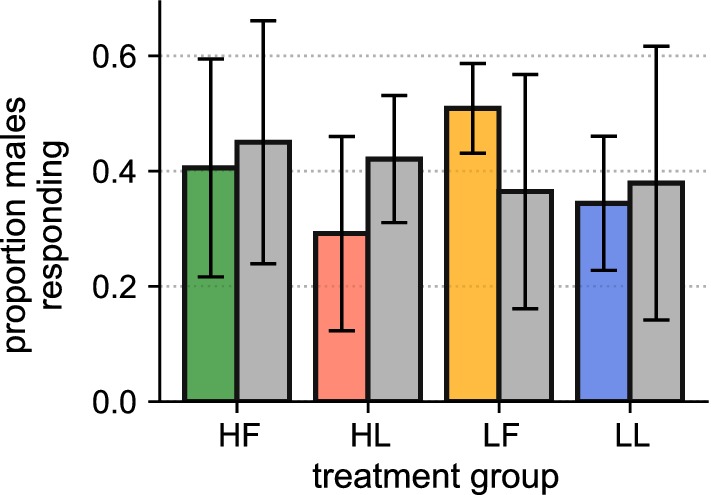
Swarm site attendance in semi-field cage sub-enclosures for DsRedKPP (coloured bars) and KPPWT (grey bars) strains. Bars show the mean (± standard deviation) proportion of all recaptured males that were collected inside the drop-net, separated by larval condition. All data shown are averaged over 6 trials per treatment

References

    1. Fredericks AC, Fernandez-Sesma A. The burden of dengue and chikungunya worldwide: implications for the southern United States and California. Ann Glob Health. 2015;80:466. doi: 10.1016/j.aogh.2015.02.006. - DOI - PMC - PubMed
    1. Benelli G, Mehlhorn H. Declining malaria, rising of dengue and Zika virus: insights for mosquito vector control. Parasitol Res. 2016;115:1747–1754. doi: 10.1007/s00436-016-4971-z. - DOI - PubMed
    1. Alphey L, McKemey A, Nimmo D, Neira Oviedo M, Lacroix R, Matzen K, et al. Genetic control of Aedes mosquitoes. Pathog Glob Health. 2013;107:170–179. doi: 10.1179/2047773213Y.0000000095. - DOI - PMC - PubMed
    1. McGraw EA, O’Neill SL. Beyond insecticides: new thinking on an ancient problem. Nat Rev Microbiol. 2013;11:181–193. doi: 10.1038/nrmicro2968. - DOI - PubMed
    1. Carvalho DO, McKemey AR, Garziera L, Lacroix R, Donnelly CA, Alphey L, et al. Suppression of a field population of Aedes aegypti in Brazil by sustained release of transgenic male mosquitoes. PLoS Negl Trop Dis. 2015;9:1–15. doi: 10.1371/journal.pntd.0003864. - DOI - PMC - PubMed