Meta-Analysis
. 2019 Aug 14;26(2):265-272.e4.
doi: 10.1016/j.chom.2019.06.013. Epub 2019 Jul 16.

Meta-Analysis Reveals Reproducible Gut Microbiome Alterations in Response to a High-Fat Diet

Affiliations
Meta-Analysis

Meta-Analysis Reveals Reproducible Gut Microbiome Alterations in Response to a High-Fat Diet

Jordan E Bisanz et al. Cell Host Microbe. .

Abstract

Multiple research groups have shown that diet impacts the gut microbiome; however, variability in experimental design and quantitative assessment have made it challenging to assess the degree to which similar diets have reproducible effects across studies. Through an unbiased subject-level meta-analysis framework, we re-analyzed 27 dietary studies including 1,101 samples from rodents and humans. We demonstrate that a high-fat diet (HFD) reproducibly changes gut microbial community structure. Finer taxonomic analysis revealed that the most reproducible signals of a HFD are Lactococcus species, which we experimentally demonstrate to be common dietary contaminants. Additionally, a machine-learning approach defined a signature that predicts the dietary intake of mice and demonstrated that phylogenetic and gene-centric transformations of this model can be translated to humans. Together, these results demonstrate the utility of microbiome meta-analyses in identifying robust and reproducible features for mechanistic studies in preclinical models.

Keywords: Lactococcus; high-fat diet; machine learning; meta-analysis; microbiome; murine.


Conflict of interest statement

Declaration of Interests

Dr. Turnbaugh is on the scientific advisory boards for Kaleido, Seres, SNIPRbiome, uBiome, and WholeBiome; there is no direct overlap between the current study and these consulting duties. All other authors have no relevant declarations.

Figures
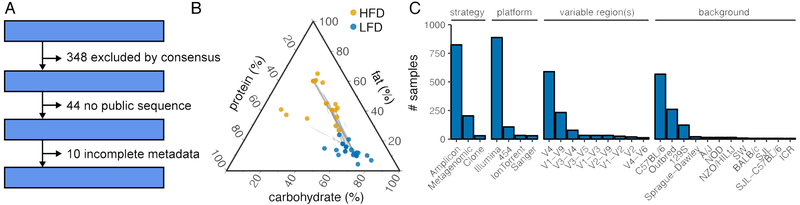
Figure 1.
Figure 1.. Study characteristics.
(A) A total of 427 studies were identified for potential inclusion of which 25 murine studies were ultimately selected. (B) Macronutrient composition (by % kCal) of studied HFD and LFD diets demonstrates diets are generally isocaloric in protein content while there is great variability in what fat content is considered high (linked diets represent those used in the same study). (C) Sample breakdown by sequencing strategy, platform, variable region and host strain demonstrate that Illumina sequencing of the V4 hypervariable region of the 16S rRNA gene in C57BL/6 hosts are most common
Figure 2.
Figure 2.. Forest plot of commonly described community metrics in murine studies.
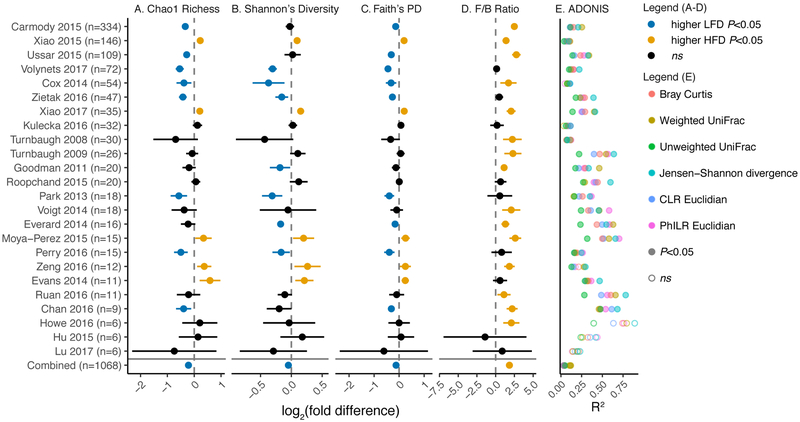
Measures of alpha diversity including (A) Chao1 richness, (B) Shannon's diversity, and (C) Faith's phylogenetic diversity demonstrate inconsistent effects of diet between studies. (D) The ratio of the Firmicutes phylum to the Bacteroidetes phylum is a consistent feature of the HFD. Points represent mean and 95% confidence interval (panels A-D, individual studies computed by Welch's t-test and combined by linear mixed effects model with study as random effect). Anhe 2015 was excluded from plotting due to n=2/group. (E) ADONIS tests of various distance metrics demonstrates consistent within-study effects on community composition as measured by the % variation explained (R2) by diet classification (Combined with study as stratum).
Figure 3.
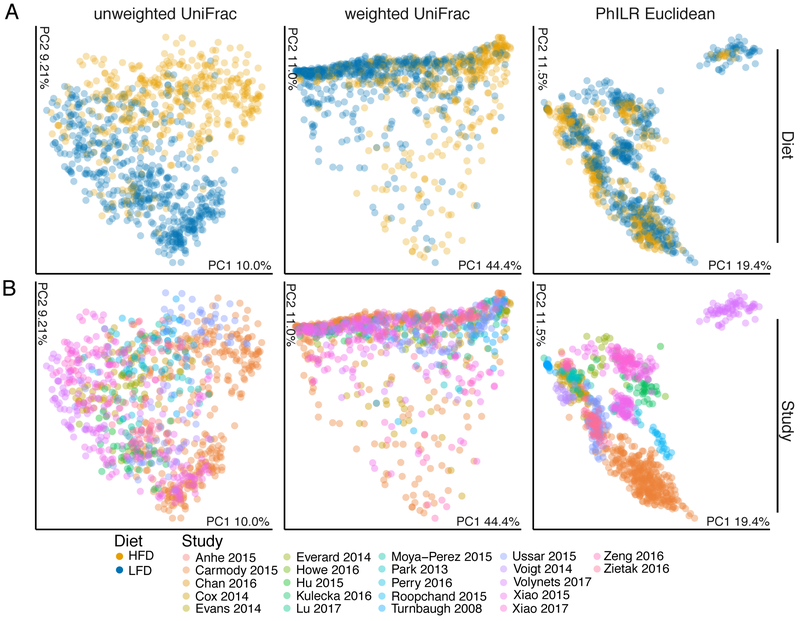
Figure 3.. Principal coordinate analysis of conventional murine samples by diet (A) and study (B).
Ordination, where compositionally related samples are co-localized, provides clear visual evidence for a significant effect of study as well as an effect of diet composition (n=978 samples, P<0.001 ADONIS; Table S2).
Figure 4.
Figure 4.. A reproducible signature of the HFD-associated gut microbiome.
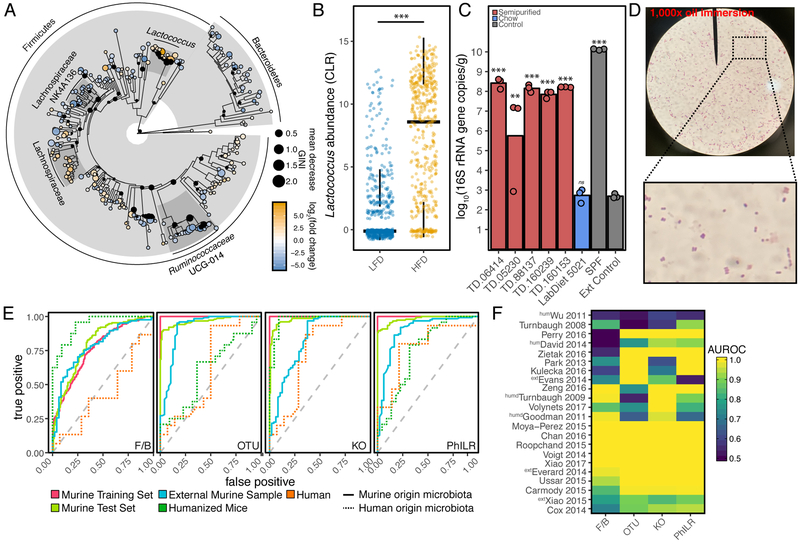
(A) Phylogenetic tree of informative OTUs (n=229) demonstrates highly informative clades of Lactococcus, Ruminococcaceae UCG-014 and Lachnospiraceae. Size of circle correlates with mean decrease GINI coefficient and data are colored by log2(fold change). (B) Lactococcus genus abundance across LFD and HFD groups reveals a significant increase in HFD diets (***P<0.001 linear mixed effect model with study as random effect). (C) Fecal bacterial DNA content (expressed as 16S rRNA gene copies/gram wet weight) in culture-negative germ-free mice on various diets (n=1 mouse per diet analyzed in triplicate; **P<0.01, ***P<0.001 ANOVA with TukeyHSD). (D) Microscopy reveals Gram-positive cocci within stool sample of culture-negative germ-free mice fed a high-fat diet 0. (E) Receiver operator curves for Lactococcus depleted OTUs, phylogenetic node balances (PhILR), KEGG orthologies (KO), and F/B ratio. Area under the receiver operator curve (AUROC) are provided in Table S5. (F) Area under the receiver operator curve (AUROC) by study excluding training samples demonstrates that PhILR and KO models are generalizable to most studies (abbreviations: ext - external murine sample, hum - human sample, humd-humanized murine sample). A subset of small studies with insufficient samples in the test set were removed from plotting. Rows are ordered by UPGMA clustering

Comment in

References

    1. Amir A, McDonald D, Navas-Molina JA, Kopylova E, Morton JT, Zech Xu Z, Kightley EP, Thompson LR, Hyde ER, Gonzalez A, Knight R. Deblur rapidly resolves single-nucleotide community sequence patterns. mSystems 2017;2(2):759. - PMC - PubMed
    1. Baker M 1,500 scientists lift the lid on reproducibility. Nature 2016;533(7604):452–4. - PubMed
    1. Ballal SA, Veiga P, Fenn K, Michaud M, Kim JH, Gallini CA, Glickman JN, Quéré G, Garault P, Béal C, Derrien M, Courtin P, Kulakauskas S, Chapot-Chartier MP, van Hylckama Vlieg J, Garrett WS. Host lysozyme-mediated lysis of Lactococcus lactis facilitates delivery of colitis-attenuating superoxide dismutase to inflamed colons. Proc Natl Acad Sci U S A 2015;112(25):7803–8. - PMC - PubMed
    1. Breiman L Random forests. Machine Learning 2001;45(1):5–32.
    1. Callahan BJ, McMurdie P, Holmes S. Exact sequence variants should replace operational taxonomic units in marker-gene data analysis. ISME J 2017;11(12):2639. - PMC - PubMed

Publication types