Review
. 2019 Sep 17;85(19):e01095-19.
doi: 10.1128/AEM.01095-19. Print 2019 Oct 1.

Plastics: Environmental and Biotechnological Perspectives on Microbial Degradation

Affiliations
Review

Plastics: Environmental and Biotechnological Perspectives on Microbial Degradation

Dominik Danso et al. Appl Environ Microbiol. .

Abstract

Plastics are widely used in the global economy, and each year, at least 350 to 400 million tons are being produced. Due to poor recycling and low circular use, millions of tons accumulate annually in terrestrial or marine environments. Today it has become clear that plastic causes adverse effects in all ecosystems and that microplastics are of particular concern to our health. Therefore, recent microbial research has addressed the question of if and to what extent microorganisms can degrade plastics in the environment. This review summarizes current knowledge on microbial plastic degradation. Enzymes available act mainly on the high-molecular-weight polymers of polyethylene terephthalate (PET) and ester-based polyurethane (PUR). Unfortunately, the best PUR- and PET-active enzymes and microorganisms known still have moderate turnover rates. While many reports describing microbial communities degrading chemical additives have been published, no enzymes acting on the high-molecular-weight polymers polystyrene, polyamide, polyvinylchloride, polypropylene, ether-based polyurethane, and polyethylene are known. Together, these polymers comprise more than 80% of annual plastic production. Thus, further research is needed to significantly increase the diversity of enzymes and microorganisms acting on these polymers. This can be achieved by tapping into the global metagenomes of noncultivated microorganisms and dark matter proteins. Only then can novel biocatalysts and organisms be delivered that allow rapid degradation, recycling, or value-added use of the vast majority of most human-made polymers.

Keywords: PET; cutinase; microbial plastic degradation; polyamides; polyethylene; polyethylene terephthalate; polypropylene; polystyrene; polyurethane; polyvinylchloride.


Figures

FIG 1
FIG 1
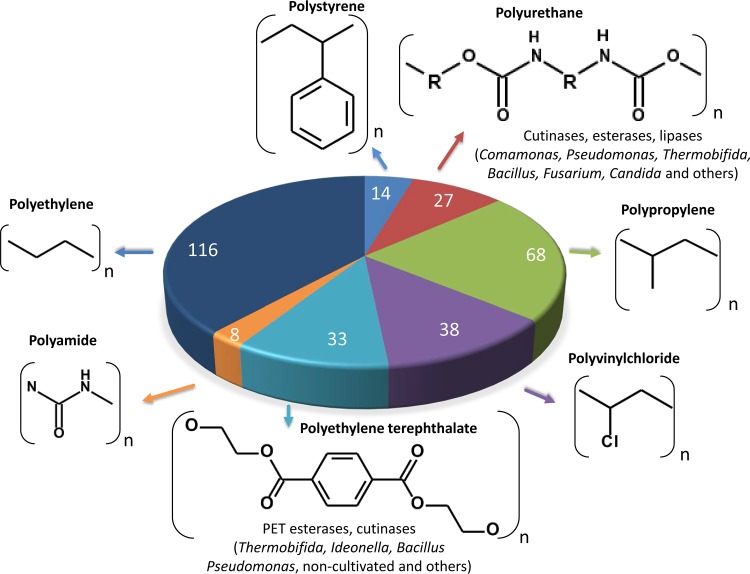
Main synthetic polymers globally produced in 2016. Numbers in the chart indicate the global annual production (millions of tons) of the specified synthetic polymer. Global annual plastic production was extracted from references , and https://www.plasticsinsight.com/global-pet-resin-production-capacity, https://www.plasticsinsight.com/resin-intelligence/resin-prices/polyamide/, and https://www.plasticsinsight.com/world-plastics-production/. Monomers are depicted above the chart. Indicated are the names of bacterial genera producing verified enzymes with available protein sequences that are known to be involved in the breakdown of the high-molecular-weight polymers (not the additives, plasticizers, etc.). For detailed references on the individual enzymes, refer to the main text. For PA, PE, PS, PVC, and PP, no defined enzymes that act on the polymer have been identified at the level of amino acid or DNA sequences. For enzymes acting on dimers or oligomers and feeding them into the different metabolic pathways, see the main text. For additional structural information on the polymers we refer to ChEBI (https://www.ebi.ac.uk/chebi/init.do).
FIG 2
FIG 2
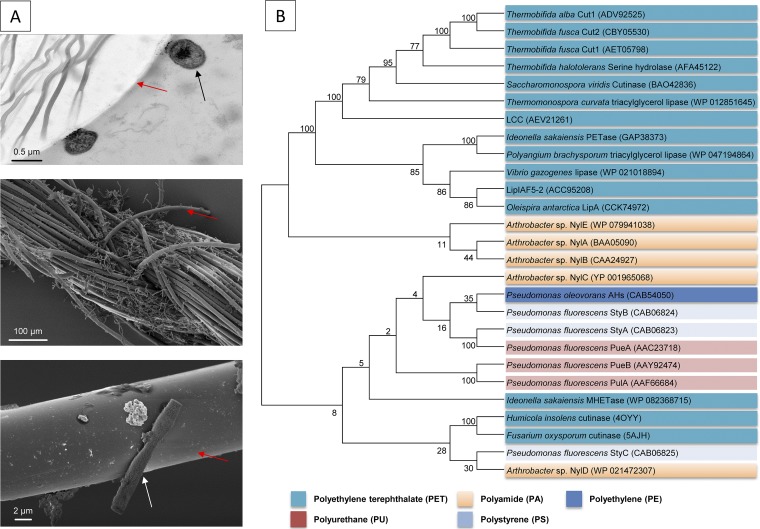
(A) Electron microscopic images of Comamonas sp. strain DDHH 01 attached and hydrolyzing PET fibers. Comamonas sp. DDHH 01 was isolated from a sewage enrichment culture. Red arrows indicate PET fibers. Black and white arrows indicate bacterial cells. (Top) Transmission electron microscopy image of a PET fiber with attached Comamonas sp. cells. (Middle) Scanning electron microscope image of PET yarn with microcolonies. (Bottom) Closeup of a single cell on the surface of a single PET fiber. (B) Topology of a neighbor-joining tree containing representative sequences of most of the currently known synthetic polymer- or oligomer/monomer-degrading enzymes. The tree is based on amino acid sequence homologies. Overall, 27 known functional and verified enzymes were included in this alignment. This represents the majority of the currently known and biochemically characterized enzymes. PET hydrolases represent the largest fraction of known and studied enzymes. The alignment was calculated using T-Coffee in accurate mode (124). The tree was calculated with Molecular Evolutionary Genetics Analysis version 6 (MEGA6) (125) and is not rooted. A similarity and identity matrix for all included sequences, together with their accession numbers, is provided in the supplemental material (Table S1).

References

    1. Geyer R, Jambeck JR, Law KL. 2017. Production, use, and fate of all plastics ever made. Sci Adv 3:e1700782. doi: 10.1126/sciadv.1700782. - DOI - PMC - PubMed
    1. PlasticsEurope. 2018. PlasticsEurope, plastics—the facts 2018: an analysis of European plastics production, demand and waste data. PlasticsEurope, Brussels, Belgium.
    1. Ellen MacArthur Foundation. 2017. The new plastics economy: rethinking the future of plastics and catalysing action. Ellen MacArthur Foundation, Cowes, United Kingdom.
    1. Jambeck JR, Geyer R, Wilcox C, Siegler TR, Perryman M, Andrady A, Narayan R, Law KL. 2015. Marine pollution. Plastic waste inputs from land into the ocean. Science 347:768–771. doi: 10.1126/science.1260352. - DOI - PubMed
    1. Derraik J. 2002. The pollution of the marine environment by plastic debris: a review. Mar Pollut Bull 44:842–852. doi: 10.1016/S0025-326X(02)00220-5. - DOI - PubMed

Publication types

LinkOut - more resources