. 2019 Aug 1;105(2):364-372.
doi: 10.1016/j.ajhg.2019.06.013. Epub 2019 Jul 18.

Family Clustering of Autoimmune Vitiligo Results Principally from Polygenic Inheritance of Common Risk Alleles

Affiliations

Family Clustering of Autoimmune Vitiligo Results Principally from Polygenic Inheritance of Common Risk Alleles

Genevieve H L Roberts et al. Am J Hum Genet. .

Abstract

Vitiligo is an autoimmune disease that results in patches of depigmented skin and hair. Previous genome-wide association studies (GWASs) of vitiligo have identified 50 susceptibility loci. Variants at the associated loci are generally common and have individually small effects on risk. Most vitiligo cases are "simplex," where there is no family history of vitiligo, though occasional family clustering of vitiligo occurs, and some "multiplex" families report numerous close affected relatives. Here, we investigate whether simplex and multiplex vitiligo comprise different disease subtypes with different underlying genetic etiologies. We developed and compared the performance of several different vitiligo polygenic risk scores derived from GWAS data. By using the best-performing risk score, we find increased polygenic burden of risk alleles identified by GWAS in multiplex vitiligo cases relative to simplex cases. We additionally find evidence of polygenic transmission of common, low-effect-size risk alleles within multiplex-vitiligo-affected families. Our findings strongly suggest that family clustering of vitiligo involves a high burden of the same common, low-effect-size variants that are relevant in simplex cases. We furthermore find that a variant within the major histocompatibility complex (MHC) class II region contributes disproportionately more to risk in multiplex vitiligo cases than in simplex cases, supporting a special role for adaptive immune triggering in the etiology of multiplex cases. We suggest that genetic risk scores can be a useful tool in analyzing the genetic architecture of clinical disease subtypes and identifying subjects with unusual etiologies for further investigation.

Keywords: autoimmunity; family clustering; genetic architecture; genetic risk score; polygenic inheritance; vitiligo.


Conflict of interest statement

The authors declare no competing interests.

Figures
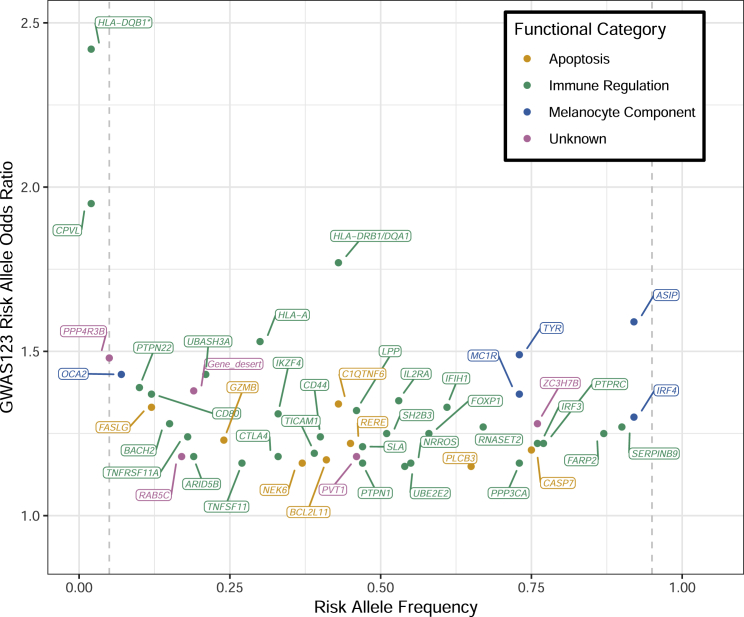
Figure 1
Figure 1
Distribution of Risk Allele Frequency and Estimated Odds Ratio for 48 Autosomal Variants Previously Identified in Vitiligo GWAS123 Each dot represents the most-associated variant for a vitiligo susceptibility locus, and each locus is labeled with a gene in close proximity to the most-associated variant in the locus. Dot and label colors represent the likely functional category of the locus, designated by manual review of each locus: orange = apoptosis, green = immune regulation, blue = functional component of the melanocyte, and pink = unknown function. denotes an HLA-DQB1 locus specifically associated in early-onset vitiligo cases; the effect size used for the HLA-DQB1 variant here was derived from all vitiligo cases, regardless of the age of onset.
Figure 2
Figure 2
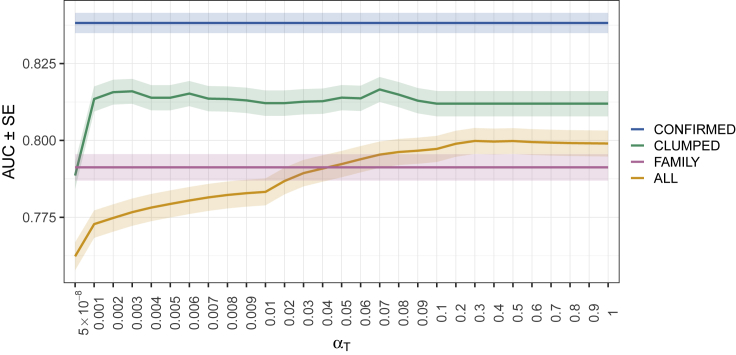
Comparison of AUC for Four Different Approaches for Vitiligo Risk Score Calculation at Multiple P Value Thresholds (∝T) Four different approaches are shown: ALL (orange), CLUMPED (green), CONFIRMED (blue), and FAMILY (pink). The solid line represents the mean AUC across the 10-fold cross-validation sets, and the shaded region represents the standard error of the mean AUC.
Figure 3
Figure 3
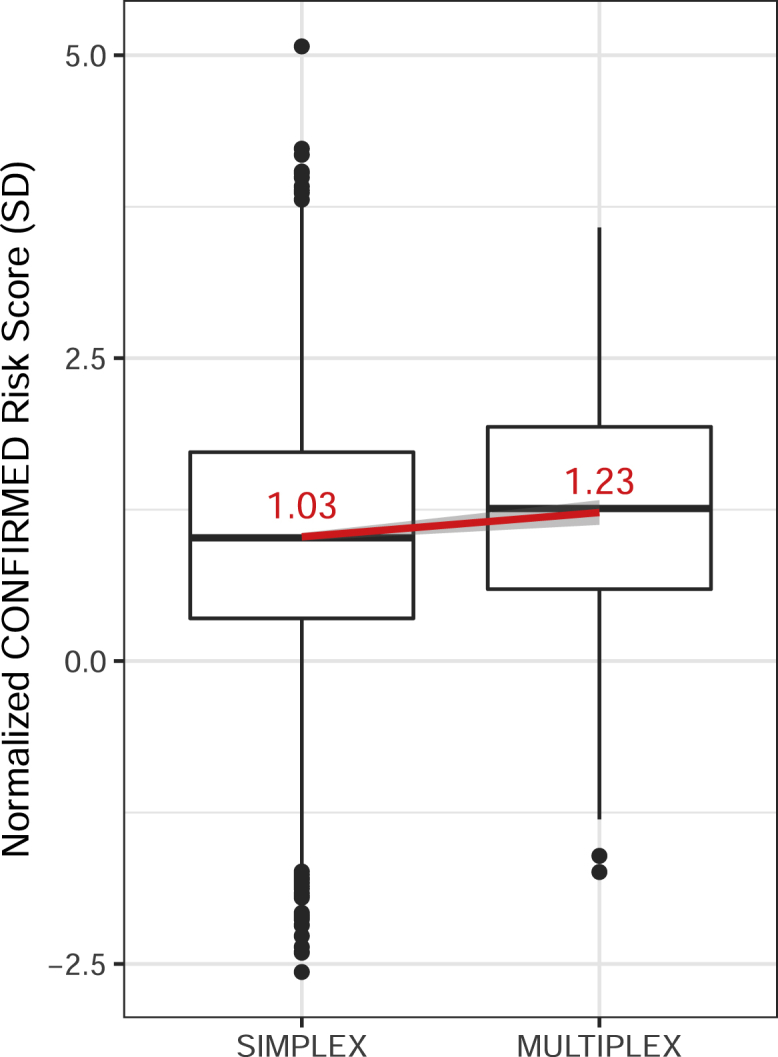
Comparison of CONFIRMED Risk Score in Simplex-Affected Subjects and Multiplex-Vitiligo-Affected Probands in GWAS123 + Replication Data The y axis represents the normalized CONFIRMED risk score; units represent standard deviations (SDs) difference from the mean risk score in controls. Center horizontal lines denote the medians, and the value of the mean is shown in red text. The red line shows the fit linear regression line, and the corresponding 95% CI surrounds the line in gray. Boxes denote first through third quartiles. Each vertical bar extends from the box to the largest or smallest value, no farther than 1.5 times the inter-quartile range. Data beyond the vertical bars are considered outliers and are plotted individually.
Figure 4
Figure 4
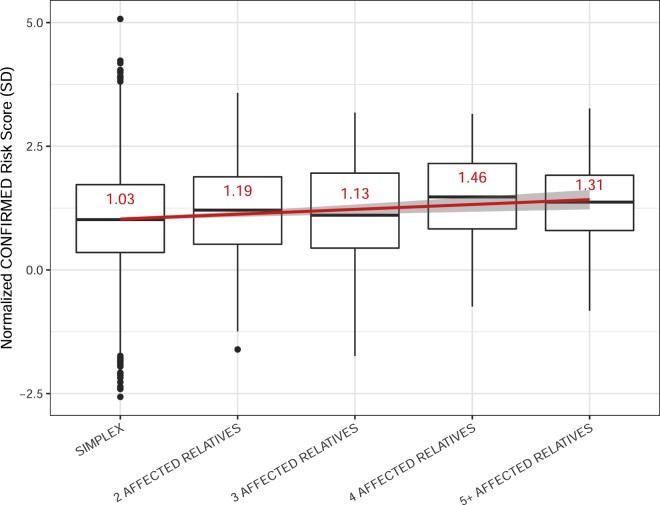
Comparison of CONFIRMED Risk Score in Vitiligo Cases Categorized by the Number of Affected Relatives Reported by the Proband The y axis represents the normalized CONFIRMED risk score; units represent standard deviations (SDs) difference from the mean risk score in controls. Horizontal lines denote the median, and the value of the mean is shown in red text. The red line shows the fit linear regression line, and the corresponding 95% CI surrounds the line in gray. Boxes denote first through third quartiles. Each vertical bar extends from the box to the largest or smallest value, no farther than 1.5 times the inter-quartile range. Data beyond the vertical bars are considered outliers and are plotted individually.
Figure 5
Figure 5
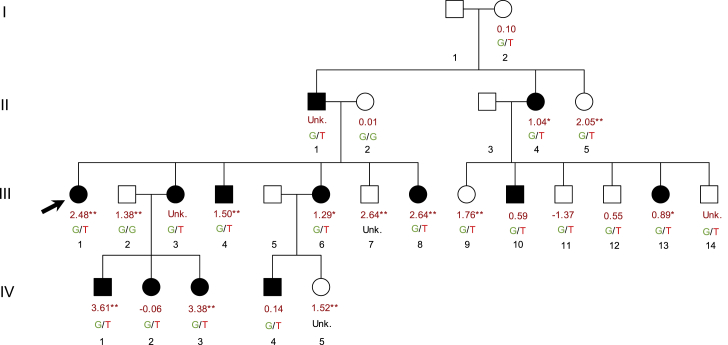
Annotated Pedigree for the Multiplex-Vitiligo-Affected Family with the Largest Number of Affected Relatives in Our Collection In the largest multiplex-vitiligo-affected family in our collection, 13 individuals were affected. Symbols filled with black indicate individuals affected with vitiligo. The black arrow indicates the proband, who was genotyped genome-wide in GWAS123. Each individual is annotated with available genotype information; the top number represents the normalized FAMILY risk score (the units of the risk score are standard deviations from the mean in GWAS123 controls). denotes individuals whose risk scores fall in the top 20th percentile and ∗∗ denotes individuals whose risk scores fall in the top 10th percentile, as defined in Table 1. The second annotation is the individual’s genotype for the FOXD3 promotor variant dbSNP: rs41285370; the rare risk allele of dbSNP: rs41285370 (T) is shown in red. Most dbSNP: rs41285370 genotypes were inferred based on linkage data. Unk. = unknown, where genotype or risk score could not be inferred or calculated based on available data.

References

    1. Hafez M., Sharaf L., Abd el-Nabi S.M. The genetics of vitiligo. Acta Derm. Venereol. 1983;63:249–251. - PubMed
    1. Das S., Majumder P.P., Majumdar T., Haldar B., Rao D.J.G.e. Studies on vitiligo. II. Familial aggregation and genetics. Genet. Epidemiol. 1985;2:255–262. - PubMed
    1. Alkhateeb A., Fain P.R., Thody A., Bennett D.C., Spritz R.A. Epidemiology of vitiligo and associated autoimmune diseases in Caucasian probands and their families. Pigment Cell Res. 2003;16:208–214. - PubMed
    1. Jin Y., Birlea S.A., Fain P.R., Gowan K., Riccardi S.L., Holland P.J., Mailloux C.M., Sufit A.J., Hutton S.M., Amadi-Myers A. Variant of TYR and autoimmunity susceptibility loci in generalized vitiligo. N. Engl. J. Med. 2010;362:1686–1697. - PMC - PubMed
    1. Jin Y., Birlea S.A., Fain P.R., Ferrara T.M., Ben S., Riccardi S.L., Cole J.B., Gowan K., Holland P.J., Bennett D.C. Genome-wide association analyses identify 13 new susceptibility loci for generalized vitiligo. Nat. Genet. 2012;44:676–680. - PMC - PubMed

Publication types