


UK phenomics platform for developing and validating electronic health record phenotypes: CALIBER
- PMID: 31329239
- PMCID: PMC6857510
- DOI: 10.1093/jamia/ocz105
UK phenomics platform for developing and validating electronic health record phenotypes: CALIBER
Abstract
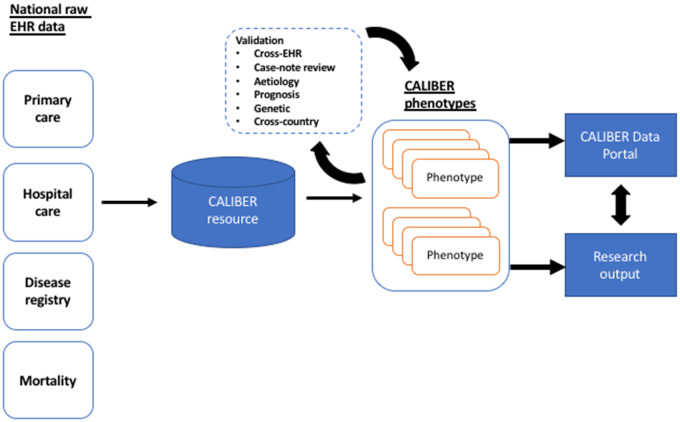
Objective: Electronic health records (EHRs) are a rich source of information on human diseases, but the information is variably structured, fragmented, curated using different coding systems, and collected for purposes other than medical research. We describe an approach for developing, validating, and sharing reproducible phenotypes from national structured EHR in the United Kingdom with applications for translational research.
Materials and methods: We implemented a rule-based phenotyping framework, with up to 6 approaches of validation. We applied our framework to a sample of 15 million individuals in a national EHR data source (population-based primary care, all ages) linked to hospitalization and death records in England. Data comprised continuous measurements (for example, blood pressure; medication information; coded diagnoses, symptoms, procedures, and referrals), recorded using 5 controlled clinical terminologies: (1) read (primary care, subset of SNOMED-CT [Systematized Nomenclature of Medicine Clinical Terms]), (2) International Classification of Diseases-Ninth Revision and Tenth Revision (secondary care diagnoses and cause of mortality), (3) Office of Population Censuses and Surveys Classification of Surgical Operations and Procedures, Fourth Revision (hospital surgical procedures), and (4) DM+D prescription codes.
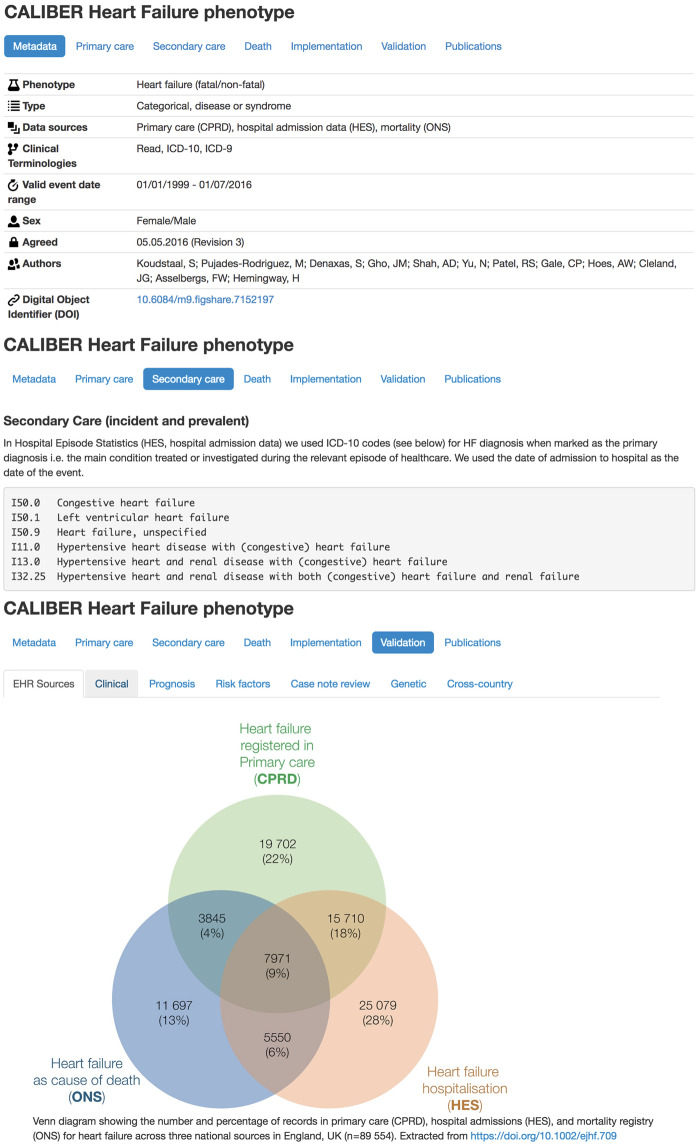
Results: Using the CALIBER phenotyping framework, we created algorithms for 51 diseases, syndromes, biomarkers, and lifestyle risk factors and provide up to 6 validation approaches. The EHR phenotypes are curated in the open-access CALIBER Portal (https://www.caliberresearch.org/portal) and have been used by 40 national and international research groups in 60 peer-reviewed publications.
Conclusions: We describe a UK EHR phenomics approach within the CALIBER EHR data platform with initial evidence of validity and use, as an important step toward international use of UK EHR data for health research.
Keywords: electronic health records; medical informatics; personalized medicine; phenotyping.
© The Author(s) 2019. Published by Oxford University Press on behalf of the American Medical Informatics Association.
Figures
References
-
- Ludwick DA, Doucette J.. Adopting electronic medical records in primary care: lessons learned from health information systems implementation experience in seven countries. Int J Med Inform 2009; 781: 22–31. - PubMed
-
- Turnbull C, Scott RH, Thomas E, Jones L, Murugaesu N, Pretty FB.. The 100 000 genomes project: bringing whole genome sequencing to the NHS. BMJ 2018; 361: k1687. - PubMed
-
- Denaxas SC, Fatemifar G, Patel R, Hemingway H.. Deriving research-quality phenotypes from national electronic health records to advance precision medicine: a UK Biobank case-study In: Proceedings of the BHI-2017 International Conference on Biomedical and Health Informatics. Orlando, FL: IEEE Engineering in Medicine and Biology Society (EMBS; ); 2017.
-
- Schnier C, Denaxas S, Eggo R, et al. Identification and validation of myocardial infarction and stroke outcomes at scale in UK Biobank. Int J Pop Data Sci 2017; 11: 337. doi: 10.23889/ijpds.v1i1.358.
