Secular Trends in Pubertal Growth Acceleration in Swedish Boys Born From 1947 to 1996
- PMID: 31329245
- PMCID: PMC6647355
- DOI: 10.1001/jamapediatrics.2019.2315
Secular Trends in Pubertal Growth Acceleration in Swedish Boys Born From 1947 to 1996
Abstract
Importance: A secular trend for earlier menarcheal age has been established in girls but there are few studies of pubertal timing for boys.
Objective: To determine if there is a secular trend for earlier pubertal timing among boys.
Design, setting, and participants: For this population-based retrospective cohort study conducted in Gothenburg, Sweden, we collected heights and weights from school health records for boys born consecutively from January 1 and onwards in 1947 and every 5 years from 1951 to 1996 (n = 375 for each birth cohort from 1947-1991, n = 340 for the birth cohort in 1996, and n = 4090 for the total cohort). We estimated age at the peak height velocity (PHV), the maximum growth velocity during puberty, and childhood body mass index (BMI) at age 8 years for all study participants. The data were analyzed during 2018 and 2019. Boys were eligible if they had a complete personal identity number and data to calculate their age at PHV and childhood BMI. Approximately 2.4% of the original study population was excluded because they lacked a personal identity number, and in the remaining study population, 4090 (69%) had sufficient data to calculate childhood BMI and age at PHV.
Exposures: The exposure was birth year and a potential confounding factor was childhood BMI.
Main outcomes and measures: The outcome was age at PHV.
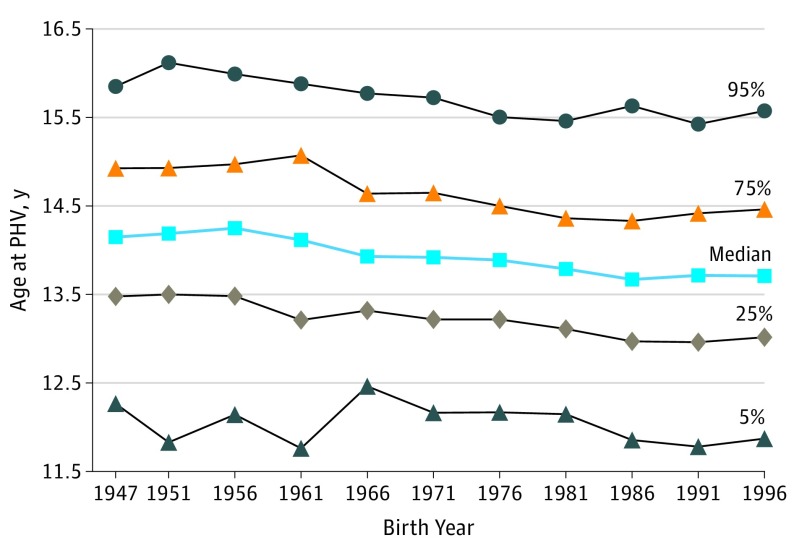
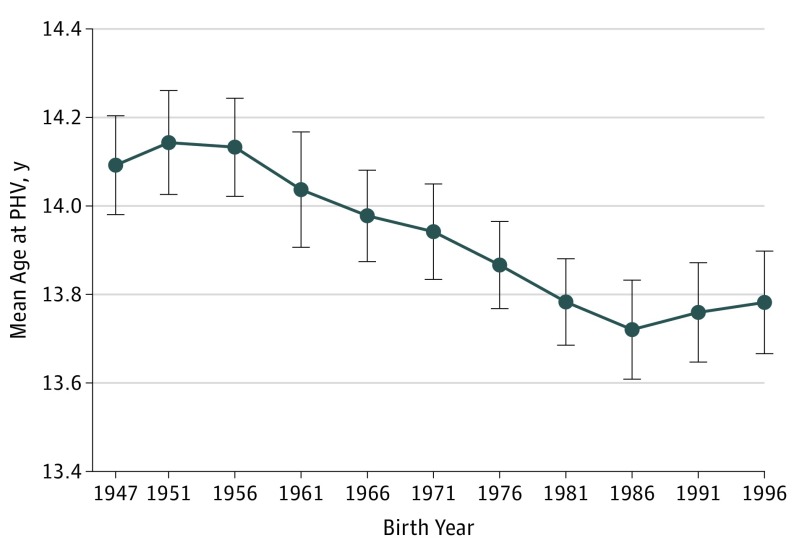
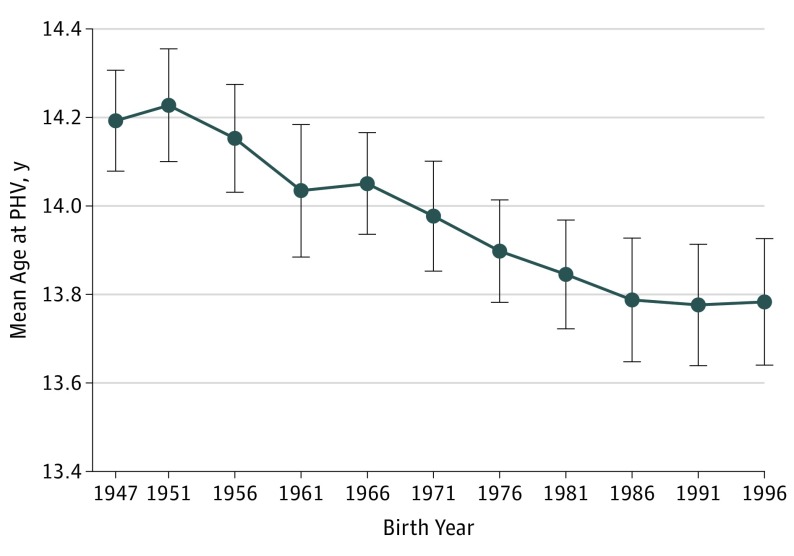
Results: Of the 4090 participants, most were white and the mean (SD) age at PHV was 13.9 (1.1) years. A linear regression model revealed a significant association between year of birth and age at PHV. Age at PHV was 1.5 months earlier for every decade increase in birth year (95% CI, -1.72 to -1.19; P < .001). After adjusting for childhood BMI, age at PHV was 1.2 months earlier per decade increase in birth year (95% CI, -1.41 to -0.89). All analyses were repeated in the subgroup of boys born in Sweden and with parents born in Sweden with similar results, indicating that the secular trend was not explained by demographic changes in the population between 1947 and 1996.
Conclusions and relevance: We provide evidence of a secular trend for earlier pubertal timing in boys that is partially explained by an increased childhood BMI, but other factors that are unknown contribute.
Conflict of interest statement
Figures

Comment in
References
-
- Tanner JM. Growth of the human at the time of adolescence. Lect Sci Basis Med. 1953;1:308-363. - PubMed