. 2019 Jul 22;15(7):e1008268.
doi: 10.1371/journal.pgen.1008268. eCollection 2019 Jul.

The Airn lncRNA does not require any DNA elements within its locus to silence distant imprinted genes

Affiliations

The Airn lncRNA does not require any DNA elements within its locus to silence distant imprinted genes

Daniel Andergassen et al. PLoS Genet. .

Erratum in

Abstract

Long non-coding (lnc) RNAs are numerous and found throughout the mammalian genome, and many are thought to be involved in the regulation of gene expression. However, the majority remain relatively uncharacterised and of uncertain function making the use of model systems to uncover their mode of action valuable. Imprinted lncRNAs target and recruit epigenetic silencing factors to a cluster of imprinted genes on the same chromosome, making them one of the best characterized lncRNAs for silencing distant genes in cis. In this study we examined silencing of the distant imprinted gene Slc22a3 by the lncRNA Airn in the Igf2r imprinted cluster in mouse. Previously we proposed that imprinted lncRNAs may silence distant imprinted genes by disrupting promoter-enhancer interactions by being transcribed through the enhancer, which we called the enhancer interference hypothesis. Here we tested this hypothesis by first using allele-specific chromosome conformation capture (3C) to detect interactions between the Slc22a3 promoter and the locus of the Airn lncRNA that silences it on the paternal chromosome. In agreement with the model, we found interactions enriched on the maternal allele across the entire Airn gene consistent with multiple enhancer-promoter interactions. Therefore, to test the enhancer interference hypothesis we devised an approach to delete the entire Airn gene. However, the deletion showed that there are no essential enhancers for Slc22a2, Pde10a and Slc22a3 within the Airn gene, strongly indicating that the Airn RNA rather than its transcription is responsible for silencing distant imprinted genes. Furthermore, we found that silent imprinted genes were covered with large blocks of H3K27me3 on the repressed paternal allele. Therefore we propose an alternative hypothesis whereby the chromosome interactions may initially guide the lncRNA to target imprinted promoters and recruit repressive chromatin, and that these interactions are lost once silencing is established.


Conflict of interest statement

The authors have declared that no competing interests exist.

Figures
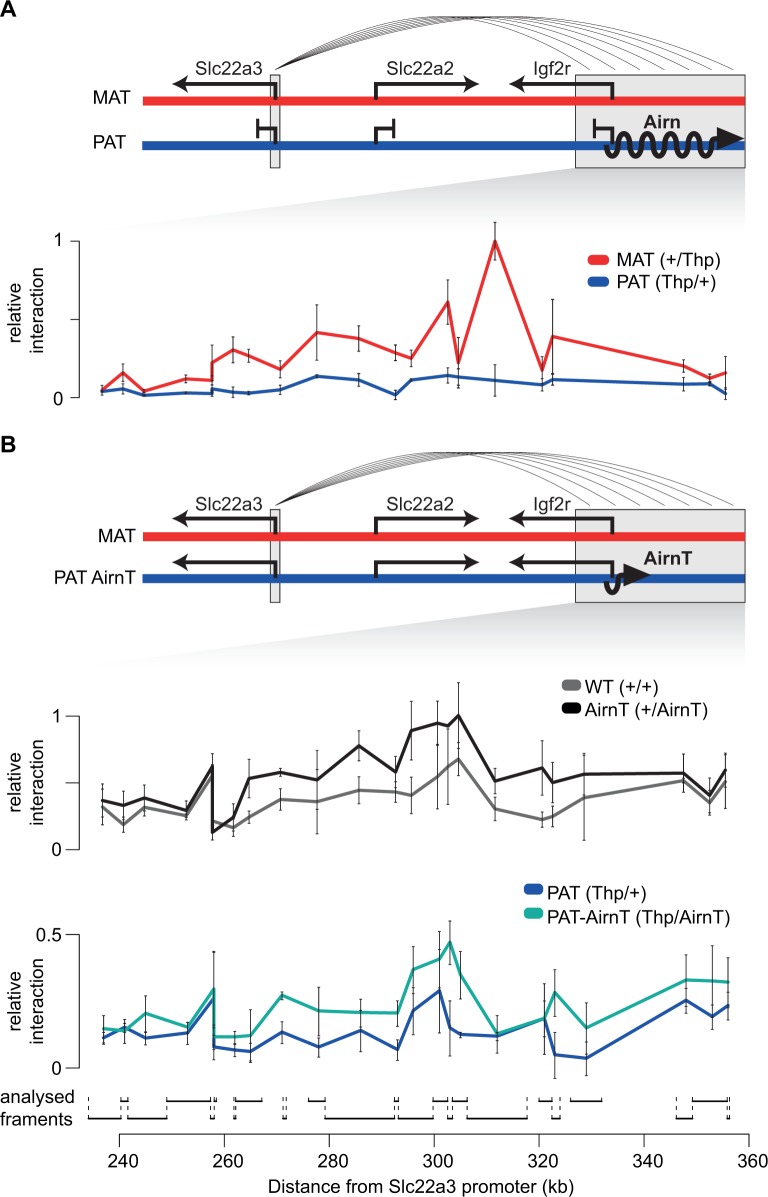
Fig 1
Fig 1. Chromosome Conformation Capture (3C) indicates that the Airn gene body may contain multiple enhancers for Slc22a3.
(A) Chromosome interactions between the Slc22a3 promoter and the Airn gene body are enriched on the maternal allele. Top: In the Igf2r imprinted cluster in visceral yolk sac (VYS), Slc22a3, Slc22a2 and Igf2r are expressed from the maternal (red) and repressed on the paternal (blue) allele. Long arrows indicate active expression, blocked arrows indicate repression. The Slc22a3 promoter region (3C bait fragment) and Airn gene body (3C prey fragments) are indicated by grey boxes. Multiple lines indicate the interactions assayed by 3C. Bottom: The relative level of 3C interactions identified on the maternal (red, +/Thp) and paternal (blue, Thp/+) alleles. (B) Paternal allele chromosome interactions between the Slc22a3 promoter and the Airn gene body are increased following truncation of Airn. Top: Imprinted silencing in the Igf2r cluster in the VYS is lost following truncation of Airn (AirnT, colors and arrows as in A). Middle: The relative level of 3C interactions identified in the wildtype (black, +/+) and AirnT (grey, +/AirnT) mice (both parental alleles present). Bottom: The relative level of 3C interactions detected on the wildtype (dark blue, Thp/+) and the AirnT (cyan, Thp/AirnT) paternal alleles. 3C interactions were determined using Taqman qPCR, normalized to the mean of 2 interactions in the Igf2 cluster, and then the highest interaction for A and B were set to 1, as detailed in the methods. Positions and size of prey fragments investigated in the 3C assay are indicated at the bottom. Points and error bars are mean and standard deviation of 3 technical replicates.
Fig 2
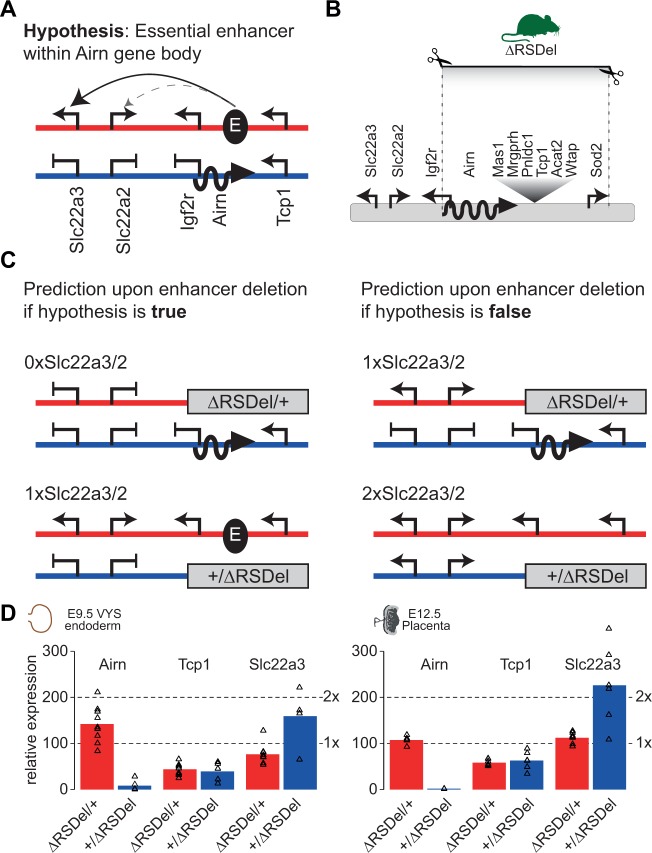
Fig 2. Deletion of the Airn gene indicates that it contains no essential enhancers for Slc22a3.
(A) The enhancer interference hypothesis. The Airn gene body contains an essential enhancer (E) that interacts with the Slc22a3 promoter (solid arrow) and potentially also with the Slc22a2 promoter (dashed arrow) on the maternal allele (red) activating gene expression (arrows). On the paternal allele (blue) Airn (wavy line) prevents this interaction causing silencing (blocked arrows). (B) The RSDel deletion spans 270 kb from the Airn promoter to the third intron of the Sod2 gene, and includes the entire 118 kb Airn gene and 6 addition genes. The deletion was constructed by Cre-mediated trans recombination between loxP sites in the R2Δ Airn promoter deletion and the Sod2Δ alleles as detailed in the text. (C) Predicted expression patterns in the RSDel deletion that includes the entire Airn gene. Left: Prediction if enhancer interference hypothesis is correct: The maternal deletion removes the essential enhancer for Slc22a3 and Slc22a2 preventing their upregulation, and leading to a loss of expression. The paternal deletion removes Airn, but also the essential enhancer, so Slc22a3 and Slc22a2 remain silenced on the paternal allele, leading to normal levels of expression. Right: Prediction if enhancer interference hypothesis is false: The maternal deletion has no effect on expression of Slc22a3 and Slc22a2, leading to normal levels of expression. The paternal deletion removes Airn leading to a loss of imprinted silencing on the paternal allele, and a doubling of Slc22a3 and Slc22a2 expression. (D) The RSDel maternal deletion does not affect Slc22a3 expression, whereas the paternal deletion leads to a doubling of Slc22a3 expression. RT-qPCR expression analysis of the RSDel maternal deletion (red, RSDel/+) and paternal deletion (blue, +/RSDel) in E9.5 VYS endoderm (left) and E12.5 placenta (right). Expression levels are normalized to wildtype for each cross (set to 100). Bars show the mean and triangles indicate all data points (biological replicates). Note that Airn and Tcp1 (non-imprinted gene) are within the deletion while Slc22a3 is outside.
Fig 3
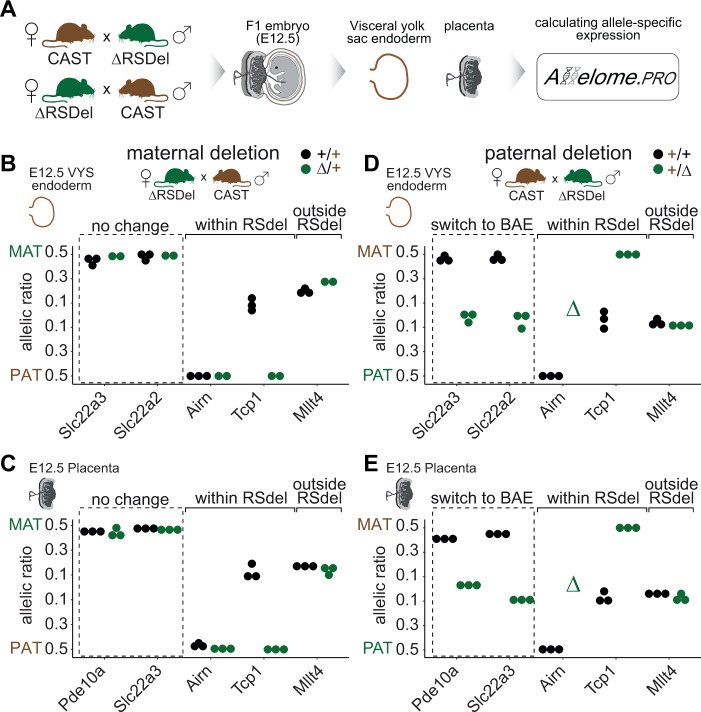
Fig 3. Allele-specific expression analysis shows imprinted expression is unaffected by maternal deletion of the Airn gene, but lost upon paternal deletion.
(A) VYS endoderm and placenta was isolated from E12.5 F1 embryos from RSDel x CAST reciprocal crosses and subject to RNA-seq (3 wildtype and 3 RSDel from each cross and tissue). The data was subject to allelic expression analysis using the Allelome.PRO pipeline [33] as detailed in the methods. (B) The maternal RSDel deletion does not affect imprinted expression of Slc22a3 and Slc22a2 in VYS endoderm. Within the deletion Airn is unaffected as it is exclusively paternally expressed, while the non-imprinted gene Tcp1 becomes paternally expressed, and Mllt4 lying 750kb outside of the deletion is unaffected. (C) The maternal RSDel deletion does not affect imprinted expression of Slc22a3 and Pde10a in placenta. Within the deletion Airn and Tcp1, show paternal expression, while Mllt4 is unaffected. (D) The paternal RSDel deletion leads to loss of Slc22a3 and Slc22a2 imprinted expression in VYS endoderm. Within the deletion Airn expression is lost, as it is shows exclusive paternal expression, while Tcp1 shows maternal expression, and Mllt4 outside the deletion is unaffected. (E) The paternal RSDel deletion leads to loss of Slc22a3 and Pde10a imprinted expression in placenta. Airn expression is lost, Tcp1 becomes maternally expressed, and Mllt4 is unaffected.
Fig 4
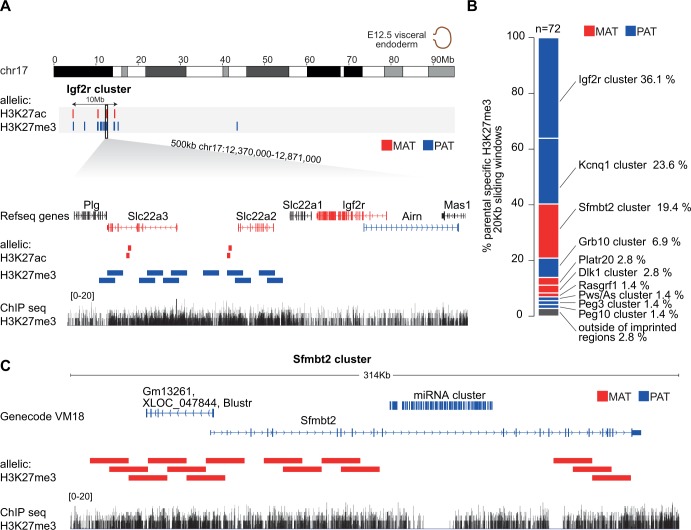
Fig 4. Broad enrichments of H3K27me3 cover the silenced allele of imprinted genes in VYS endoderm.
(A) Maternal enrichment of H3K27ac and paternal enrichment of H3K27me3 is present at sites across the entire 10Mb Igf2r cluster in VYS endoderm, despite imprinted expression being limited to the 450Kb from Slc22a3 to Airn in this tissue. In this region showing imprinted expression, broad enrichment of H3K27me3 covers the silenced paternal alleles of Slc22a3 and Slc22a2, while more focal maternal enrichment of H3K27ac is seen within these genes. (B) Genome-wide 97.2% of H3K27me3 parental allele enriched 20kb windows in VYS endoderm lie within imprinted clusters, with the Igf2r cluster showing the highest number, followed by the Kcnq1 cluster and then the Sfmbt2 cluster. (C) H3K27me3 is enriched over the silenced maternal allele of Sfmbt2 and Blustr in the Sfmbt2 cluster.
Fig 5
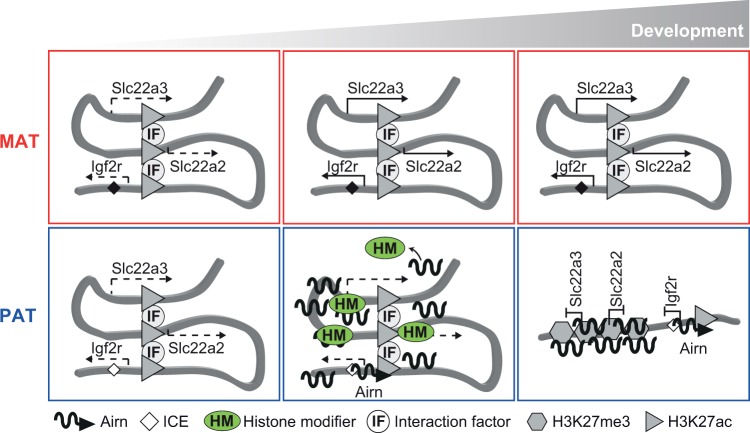
Fig 5. Model: chromosome conformation guides Airn lncRNA to target silencing of distant imprinted genes in extra-embryonic tissues.
Left: In early development where Airn is not expressed, and the genes that it regulates Igf2r, Slc22a2 and Slc22a3 are expressed at low levels from both alleles (dashed arrows). Both parental alleles have a chromosomal conformation that brings the Airn gene body and the promoters of Slc22a2 and Slc22a3 in close proximity. These chromosome interactions may be mediated by interaction factors (IF) at regions of open chromatin marked by H3K27ac histone modification (triangles). The imprint control element (ICE) or Airn promoter is methylated on the maternal allele (filled diamond) and unmethylated on the paternal allele (unfilled diamond). Middle: As development progresses, methylation on the maternal allele prevents expression of Airn, the chromosome conformation is maintained and Igf2r, Slc22a2 and Slc22a3 are upregulated (solid arrows). On the unmethylated paternal allele, Airn (wavy line) starts to be expressed and recruits repressive histone modifiers (HM) and targets them to the promoters of Slc22a2 and Slc22a3, preventing these genes from being upregulated. Airn prevents Igf2r from being upregulated by transcriptional interference with its promoter [7]. Right: Later in development, on the maternal allele the chromosome conformation is maintained and Igf2r, Slc22a2 and Slc22a3 are expressed. On the paternal allele, the loss of H3K27ac and the establishment of a compact repressive chromatin domain including H3K27me3, maintains silencing of Slc22a2 and Slc22a3, and leads to the loss of chromosome interactions.

References

    1. Uszczynska-Ratajczak B, Lagarde J, Frankish A, Guigo R, Johnson R (2018) Towards a complete map of the human long non-coding RNA transcriptome. Nat Rev Genet 19: 535–548. 10.1038/s41576-018-0017-y - DOI - PMC - PubMed
    1. Marchese FP, Raimondi I, Huarte M (2017) The multidimensional mechanisms of long noncoding RNA function. Genome Biol 18: 206 10.1186/s13059-017-1348-2 - DOI - PMC - PubMed
    1. Balas MM, Johnson AM (2018) Exploring the mechanisms behind long noncoding RNAs and cancer. Noncoding RNA Res 3: 108–117. 10.1016/j.ncrna.2018.03.001 - DOI - PMC - PubMed
    1. Delas MJ, Hannon GJ (2017) lncRNAs in development and disease: from functions to mechanisms. Open Biol 7. - PMC - PubMed
    1. Sleutels F, Zwart R, Barlow DP (2002) The non-coding Air RNA is required for silencing autosomal imprinted genes. Nature 415: 810–813. 10.1038/415810a - DOI - PubMed

Publication types