


Alcohol demand moderates brief motivational intervention outcomes in underage young adult drinkers
- PMID: 31330464
- PMCID: PMC6708778
- DOI: 10.1016/j.addbeh.2019.106044
Alcohol demand moderates brief motivational intervention outcomes in underage young adult drinkers
Abstract
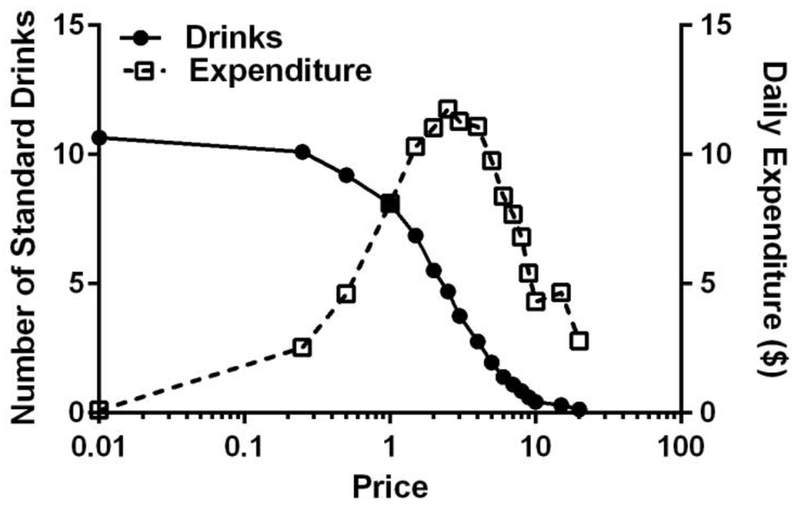
Introduction: The Alcohol Purchase Task (APT), a behavioral economic measure of alcohol's reinforcing value (demand), has been used to predict the effects of Brief Motivational Intervention (BMI) on alcohol use outcomes. However, it is not known whether BMI may be more or less efficacious, relative to control, among those with different levels of alcohol demand prior to treatment.
Methods: Non college-attending young adults (N = 150) reporting past-month heavy drinking were randomized to a single in-person session of BMI or a relaxation training control (REL). The BMI included delivery of personalized feedback and focused on developing discrepancy between the young adults' goals and their current pattern of alcohol use. At baseline, participants completed assessments of alcohol use and the APT. Drinking levels were re-assessed at 6 weeks and 3 months post-intervention. Demand indices derived from the APT were examined as moderators of treatment effects on follow-up drinking after covarying for baseline alcohol use.
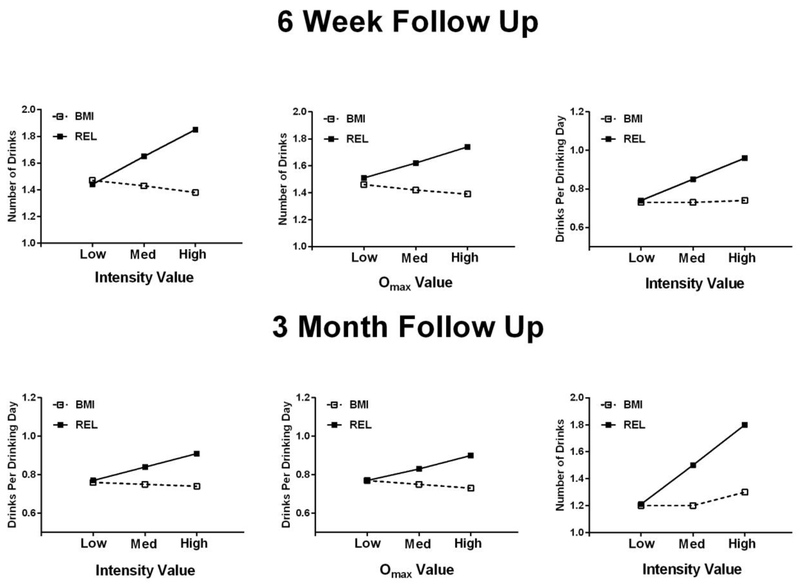
Results: Two of four APT demand indices - intensity and Omax - moderated treatment outcomes. Relative to REL, BMI led to greater reductions in total number of drinks consumed and drinks per drinking day among participants with higher baseline alcohol demand. This association was not observed among participants with lower levels of alcohol demand.
Conclusions: These results demonstrate that BMI may be particularly beneficial for those with a high reinforcing value of alcohol. The mechanism for this effect is unclear, and determining the process by which BMI confers increased benefit for these individuals is a fruitful area for future work.
Keywords: Alcohol; Behavioral economics; Treatment; Young adults.
Copyright © 2019 Elsevier Ltd. All rights reserved.
Conflict of interest statement
DECLARATION OF INTERESTS
The authors have no financial conflicts of interest to disclose.
Conflict of Interest
The authors have not conflicts of interest to report.
Figures
References
-
- Johnston LD, O ’malley PM, Miech RA, Bachman JG, Schulenberg JE. Key Findings on Adolescent Drug Use. http://www.monitoringthefuture.org//pubs/monographs/mtf-overview2016.pdf. Accessed February 24, 2017.
-
- Hingson R, Zha W, Smyth D. Magnitude and Trends in Heavy Episodic Drinking, Alcohol-Impaired Driving, and Alcohol-Related Mortality and Overdose Hospitalizations Among Emerging Adults of College Ages 18-24 in the United States, 1998-2014. J Stud Alcohol Drugs. 2017;78(4):540–548. http://www.ncbi.nlm.nih.gov/pubmed/28728636. Accessed January 30, 2019. - PMC - PubMed
-
- White HR, Labouvie EW, Papadaratsakis V. Changes in Substance use during the Transition to Adulthood: A Comparison of College Students and Their Noncollege Age Peers. J Drug Issues. 2005;35(2):281–306. doi: 10.1177/002204260503500204. - DOI
-
- Barnett NP, Monti PM, Spirito A, et al. Alcohol use and related harm among older adolescents treated in an emergency department: the importance of alcohol status and college status. J Stud Alcohol. 2003;64(3):342–349. http://www.ncbi.nlm.nih.gov/pubmed/12817822. Accessed March 26, 2018. - PubMed
-
- Quinn PD, Fromme K. Alcohol use and related problems among college students and their noncollege peers: the competing roles of personality and peer influence. J Stud Alcohol Drugs. 2011;72(4):622–632. http://www.ncbi.nlm.nih.gov/pubmed/21683044. Accessed March 26, 2018. - PMC - PubMed
Publication types
MeSH terms
Grants and funding
LinkOut - more resources
Full Text Sources
Miscellaneous
