Review
. 2019 Jul 20;11(7):1017.
doi: 10.3390/cancers11071017.

The Molecular Hallmarks of the Serrated Pathway in Colorectal Cancer

Affiliations
Review

The Molecular Hallmarks of the Serrated Pathway in Colorectal Cancer

Fatima Domenica Elisa De Palma et al. Cancers (Basel). .

Abstract

Colorectal cancer (CRC) is a leading cause of cancer death worldwide. It includes different subtypes that differ in their clinical and prognostic features. In the past decade, in addition to the conventional adenoma-carcinoma model, an alternative multistep mechanism of carcinogenesis, namely the "serrated pathway", has been described. Approximately, 15 to 30% of all CRCs arise from neoplastic serrated polyps, a heterogeneous group of lesions that are histologically classified into three morphologic categories: hyperplastic polyps, sessile serrated adenomas/polyps, and the traditional serrated adenomas/polyps. Serrated polyps are characterized by genetic (BRAF or KRAS mutations) and epigenetic (CpG island methylator phenotype (CIMP)) alterations that cooperate to initiate and drive malignant transformation from normal colon mucosa to polyps, and then to CRC. The high heterogeneity of the serrated lesions renders their diagnostic and pathological interpretation difficult. Hence, novel genetic and epigenetic biomarkers are required for better classification and management of CRCs. To date, several molecular alterations have been associated with the serrated polyp-CRC sequence. In addition, the gut microbiota is emerging as a contributor to/modulator of the serrated pathway. This review summarizes the state of the art of the genetic, epigenetic and microbiota signatures associated with serrated CRCs, together with their clinical implications.

Keywords: CIMP; CIN; DNA methylation; MSI; colorectal cancer; gut microbiota; serrated adenocarcinoma; serrated lesions; serrated pathway; serrated polyp.


Conflict of interest statement

The authors declare no conflict of interest.

Figures
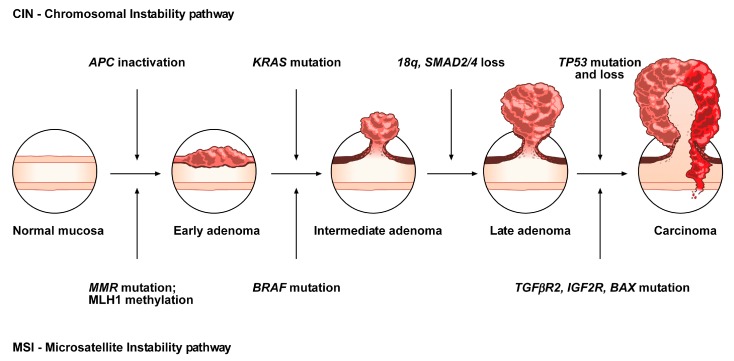
Figure 1
Figure 1
Conventional adenoma-to-carcinoma sequence. The chromosomal instability (CIN) pathway begins with bi-allelic mutations in the tumor suppressor gene APC within the normal colonic mucosa. The latter progressively differentiate into adenocarcinoma upon acquisition of additional mutations in the genes KRAS, SMAD4, and TP53, with consequent dysregulation of the Wnt/β-catenin, MAPK, PI3K and TGF-β signaling pathways. Alternatively, the MSI pathway involves an initial alteration of the Wnt signaling that leads to the formation of an early adenoma. Then, BRAF mutation followed by alterations of the genes TGFBR2, IGF2R, and BAX, participate in the progression toward the intermediate and late stages of carcinogenesis.
Figure 2
Figure 2
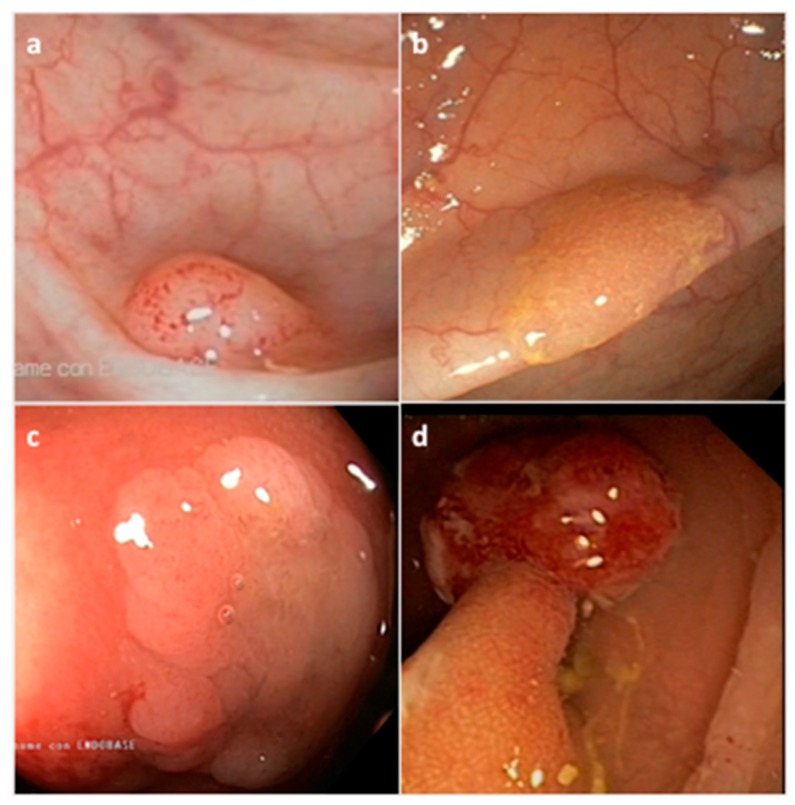
Representative endoscopic appearance of serrated lesions of the colorectum. (a) Hyperplastic polyp; (b) Sessile serrated adenoma/polyp; (c) Sessile serrated adenoma/polyp with dysplasia; (d) Traditional serrated adenoma. (Courtesy of Prof. Dr. Giovanni D. De Palma, University of Naples Federico II, Naples, Italy).
Figure 3
Figure 3
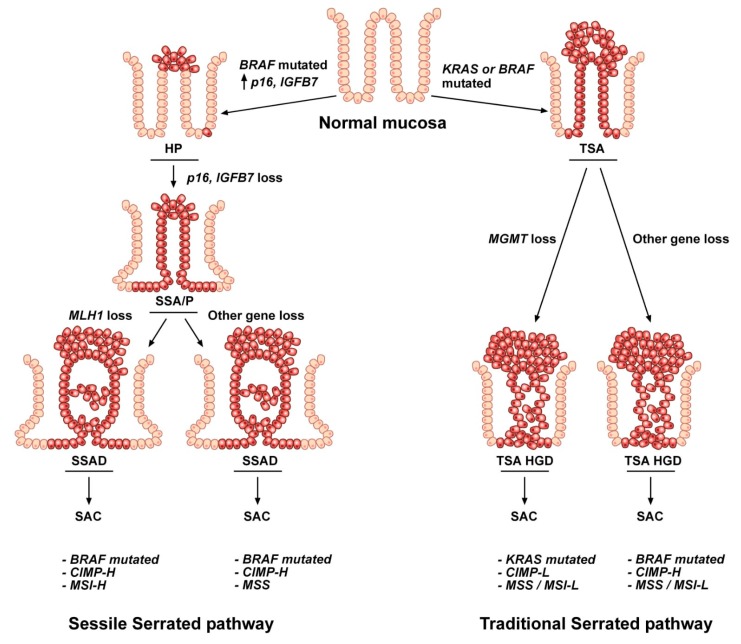
Representation of the two serrated pathways. The sequence leading to serrated Colorectal cancer (CRC) can occur in two different molecular pathways, the sessile and the traditional serrated routes. The tumorigenic process involves progressive accumulation of specific genetic and epigenetic hits affecting normal colon epithelial cells. In the sessile serrated pathway, the transformation of the normal mucosa begins with BRAF mutations, followed by p16 and IGFBP7 promoter hypermethylation and the consequent progression toward serrated adenocarcinoma, mainly through MLH1 epigenetic alterations. In contrast, the traditional serrated pathway involves KRAS or BRAF mutations in normal colon cells which, together with MGMT or other gene methylation alterations, malignantly evolve toward traditional serrated adenoma (TSA) high-grade dysplasia and serrated adenocarcinoma (SAC).

References

    1. Kuipers E.J., Grady W.M., Lieberman D., Seufferlein T., Sung J.J., Boelens P.G., van de Velde C.J.H., Watanabe T. Colorectal cancer. Nat. Rev. Dis. Primer. 2015;1:15065. doi: 10.1038/nrdp.2015.65. - DOI - PMC - PubMed
    1. Nguyen H.T., Nguyen H.T., Duong H.-Q., Duong H.-Q. The molecular characteristics of colorectal cancer: Implications for diagnosis and therapy (Review) Oncol. Lett. 2018;16:9–18. doi: 10.3892/ol.2018.8679. - DOI - PMC - PubMed
    1. Bogaert J., Prenen H. Molecular genetics of colorectal cancer. Ann. Gastroenterol. 2014;27:9–14. - PMC - PubMed
    1. Wong K., Xie G. Updates on the Molecular Genetics of Colorectal Cancer. Colorectal Cancer Open Access. 2017;3 doi: 10.21767/2471-9943.100032. - DOI
    1. Kuipers E.J., Rösch T., Bretthauer M. Colorectal cancer screening--optimizing current strategies and new directions. Nat. Rev. Clin. Oncol. 2013;10:130–142. doi: 10.1038/nrclinonc.2013.12. - DOI - PubMed